
Penny Dreadfuls, 1849 · page 19 of 394
The Mysteries of the Court of London — page 19: what you’re looking at
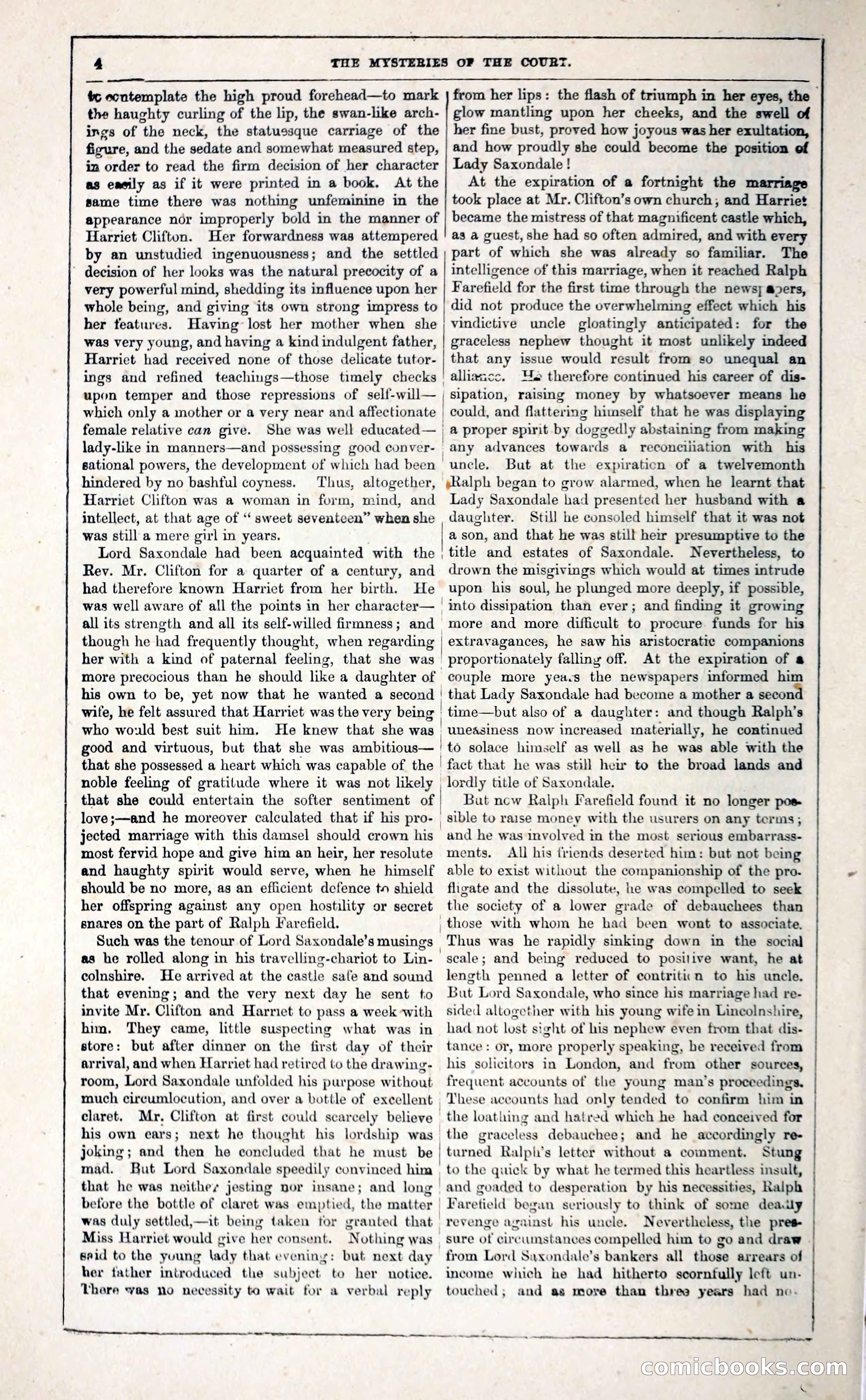
A restored page from Penny Dreadfuls, 1849. Page through the whole issue in the reader above.
📄 Transcribed text from this page (OCR, searchable)
Machine-transcribed from the original scan — historical spelling and the odd misread are preserved.
4 THE MYSTERIES OF THE COURT. = ——— ee tc ecntemplate the high proud forehead—to mark the haughty curling of the lip, the swan-like arch- ings of the neck, the statussque carriage of the firure, and the sedate and somewhat measured step, in order to read the firm decision of her character as easily as if it were printed in a book, At the same time there was nothing unfeminine in the appearance ndr improperly bold in the manner of Harriet Clifton. Her forwardness was attempered by an unstudied ingenuousness; and the settled ~ decision of her looks was the natural precocity of a very powerful mind, shedding its influence upon her whole being, and giving its own strong impress to her features. Having lost her mother when she was very young, and having a kind indulgent father, Harriet had received none of those delicate tutor- ings and refined teachings—those timely checks | upon temper and those repressions of self-will— which only a mother or a very near and affectionate | female relative can give. She was well educated — | lady-like in manners—and possessing good conver- sational powers, the development of which had been hindered by no bashful coyness. Thus, altogether, Harriet Clifton was a woman in form, mind, and intellect, at that age of “‘ sweet seventeen” when she was still a mere girl in years. Lord Saxondale had been acquainted with the | Rev. Mr. Clifton for a quarter of a century, and had therefore known Harriet from her birth. He was well aware of all the points in her character— from her lips: the flash of triumph in her eyes, the glow mantling upon her cheeks, and the swell of her fine bust, proved how joyous was her exultation, and how proudly she could become the position of Lady Saxondale! At the expiration of a fortnight the marriage took place at Mr. Clifton’s own church, and Harriet became the mistress of that magnificent castle which, as a guest, she had so often admired, and with every part of which she was already so familiar. The intelligence of this marriage, when it reached Ralph Farefield for the first time through the news] @pers, did not produce the overwhelming effect which his vindictive uncle gloatingly anticipated: for the graceless nephew thought it most unlikely indeed that any issue would result from so unequal an alliaacc. Ue therefore continued his career of dis- sipation, raising money by whatsoever means he could, and flattering himself that he was displaying @ proper spirit by doggedly abstaining from making any advances towards a reconciiiation with his uncle. But at the expiration of a twelyemonth »Ralph began to grow alarmed, when he learnt that Lady Saxondale had presented her husband with a daughter. Still he consoled himself that it was not ason, and that he was still he presumptive to the title and estates of Saxondale. Nevertheless, to drown the misgivings which would at times intrude upon his soul, he plunged more deeply, if possible, into dissipation than ever; and finding it growing all its strength and all its self-willed firmness; and more and more difficult to procure funds for his though he had frequently thought, when regarding | extravagances, he saw his aristocratic companions her with a kind of paternal feeling, that she was proportionately falling off. At the expiration of a more precocious than he should like a daughter of couple more yeacs the newspapers informed him his own to be, yet now that he wanted a second | that Lady Saxondale had become a mother a secon wife, he felt assured that Harriet was the very being | time—but also of a daughter: and though Ralph’s who would best suit him. He knew that she was uneasiness now increased materially, he continued good and virtuous, but that she was ambitious— | to solace himself as well as he was able with the that she possessed a heart which was capable of the | fact that he was still heir to the broad lands and noble feeling of gratitude where it was not likely that she could entertain the softer sentiment of love ;—and he moreover calculated that if his pro- jected marriage with this damsel should crown his most fervid hope and give him an heir, her resolute and haughty spirit would serve, when he himself should be no more, as an eflicient defence to shield her offspring against any open hostility or secret snares on the part of Ralph Farefield. Such was the tenour of Lord Saxondale’s musings as he rolled along in his travelling-chariot to Lin- colnshire. He arrived at the castle safe and sound that evening; and the very next day he sent to invite Mr. Clifton and Harriet to pass a week with him. They came, little suspecting what was in store: but after dinner on the first day of their arrival, and when Harriet had retired to the drawing- room, Lord Saxondale unfolded his purpose without much circumlocution, and over a bottle of execllent claret. Mr, Clifton at first could scarcely believe his own ears; next he thought his lordship was joking; and then he eoncluded that he must be | mad. But Lord Saxondale speedily convinced him that he was neithes jesting nor insane; and long before the bottle of claret was emptied, the matter was duly settled,—it being taken tor granted that Miss Harriet would give her consent. Nothing was said to the young lady that evening: but next day her tather introduced the subject to her notice. There vas no necessity to wait for a verbal reply lordly title of Saxondale. But new Ralph Farefield found it no longer poe sible to raise money with the usurers on any terms; and he was involved in the most serious embarrass- ments. All his friends deserted him: but not being able to exist without the companionship of the pro. flizate and the dissolute, he was compelled to seek the society of a lower grade of debauchees than _those with whom he had been wont to associate. Thus was he rapidly sinking down in the social scale; and being reduced to positive want, he at length penned a letter of econtritin to his uncle, But Lord Saxondale, who since his marriage had re- sided altogether with his young wife in Lincolnshire, hact not lost sight of his nephew even from that dis- tance : Or, more properly speaking, be received from his solicitors in London, and from other sources, frequent accounts of the young man’s proceedings. These accounts had only tended to confirm him in the loathing and hatred which he had conceived for the graceless debauchee; and he accordingly re- turned Ralpl’s letter without a comment. Stung to the quick by what he termed this heartless insult, and goaded to desperation by his necessities, Ralph Faretield began seriously to think of some deadly revenge against his uncle. Nevertheless, the pres- sure of circumstances compelled him to go and draw from Lord Saxondale’s bankers all those arrears of income which he had hitherto scornfully left un- touched; and as more than three years had no. ee A A ._———.. — (COMMUC 0)(0)(0) -_ nS <S (E(@)