
Penny Dreadfuls, 1849 · page 18 of 394
The Mysteries of the Court of London — page 18: what you’re looking at
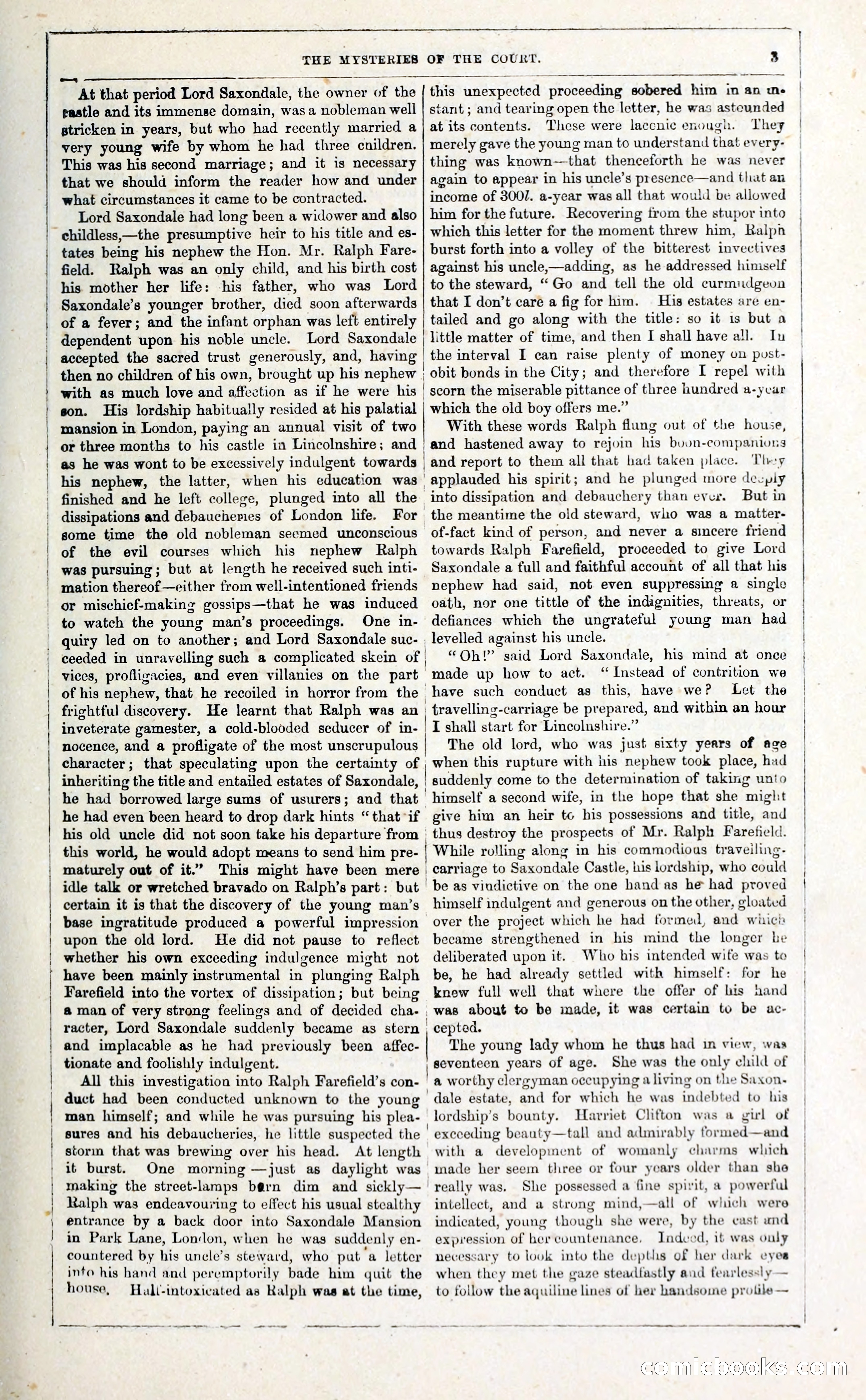
A restored page from Penny Dreadfuls, 1849. Page through the whole issue in the reader above.
📄 Transcribed text from this page (OCR, searchable)
Machine-transcribed from the original scan — historical spelling and the odd misread are preserved.
————_——- -_— THE MYSTERIES At that period Lord Saxondale, the owner of the eastle and its immense domain, was a nobleman well gtricken in years, but who had recently married a very young wife by whom he had three cnildren. This was his second marriage; and it is necessary that we should inform the reader how and under what circumstances it came to be contracted. Lord Saxondale had long been a widower and also “ childless,—the presumptive heir to his title and es- tates being his nephew the Hon. Mr. Ralph Fare- field. Ralph was an only child, and his birth cost his mother her life: his father, who was Lord Saxondale’s younger brother, died soon afterwards of a fever; and the infant orphan was left entirely dependent upon his noble uncle. Lord Saxondale accepted the sacred trust generously, and, having then no children of his own, brought up his nephew with as much love and affection as if he were his gon. His lordship habitually resided at his palatial mansion in London, paying an annual visit of two or three months to his castle in Lincolnshire; and as he was wont to be excessively indulgent towards his nephew, the latter, when his education was finished and he left college, plunged into all the dissipations and debaucheries of London life. For some time the old nobleman seemed unconscious of the evil courses which his nephew Ralph was pursuing; but at length he received such inti- mation thereof—either from well-intentioned friends or mischief-making gossips—that he was induced to watch the young man’s proceedings. One in- quiry led on to another; and Lord Saxondale suc- ceeded in unravelling such a complicated skein of vices, profligacies, and even villanies on the part of his nephew, that he recoiled in horror from the frichtful discovery. He learnt that Ralph was an inveterate gamester, a cold-blooded seducer of in- nocence, and a profligate of the most unscrupulous character; that speculating upon the certainty of inheriting the title and entailed estates of Saxondale, he had borrowed large sums of usurers; and that he had even been heard to drop dark hints “ that “if his old uncle did not soon take his departure from this world, he would adopt means to send him pre- maturely out of it.” This might have been mere idle talk or wretched bravado on Ralph’s part: but certain it is that the discovery of the young man’s base ingratitude produced a powerful impression upon the old lord. He did not pause to reflect whether his own exceeding indulgence micht not have been mainly instrumental in plunging Ralph Farefield into the vortex of dissipation; but being a man of very strong feelings and of decided cha- racter, Lord Saxondale suddenly became as stern and implacable as he had previously been affec- tionate and foolishly indulgent. All this investigation into Ralph Farefield’s con- duct had been conducted unknown to the young man himself; and while he was pursuing his plea- sures and his debaucheries, he little suspected the : storm that was brewing over his head. At length it burst. One morning —just as daylight was making the street-lamps b@rn dim and sickly—_ Ralph was endeavouring to effect his usual stealthy entrance by a back door into Saxondale Mansion in Park Lane, London, when he was suddenly en- countered by his uncle’s steward, who put a letter info his hand and peremptorily bade him quit the house, Hali-intoxicated as Ralph was at the time, —_—--- ge me es a a a a OF THE COURT. 3 this unexpected proceeding sobered him in an m- stant; and tearing open the letter, he was asteunded at its contents. These were laccnic enough. They merely gave the young man to understand that every- thing was known—that thenceforth he was never again to appear in his uncle’s presence—and that an income of 3001. a-year was all that would be allowed him for the future. Recovering from the stupor into which this letter for the moment threw him, Ralpn burst forth into a volley of the bitterest invectives against his uncle,—adding, as he addressed hiniself to the steward, “ Go and tell the old curmiudgeva that I don’t care a fig for him. His estates are en- tailed and go along with the title: so it 1s but a little matter of time, and then I shall have all. In the interval I can raise plenty of money on post- obit bonds in the City; and therefore I repel with scorn the miserable pittance of three hundred a-ycar which the old boy offers me.” With these words Ralph flung out of the house, and hastened away to rejoin his boon-companions and report to them all that had taken place. They ' applauded his spirit; and he plunged more devply into dissipation and debauchery than evex. But in the meantime the old steward, who was a matter- of-fact kind of person, and never a sincere friend towards Ralph Farefield, proceeded to give Lord Saxondale a full and faithful account of all that his nephew had said, not even suppressing a single oath, nor one tittle of the indignities, threats, or defiances which the ungrateful young man had levelled against his uncle. “Oh!” gaid Lord Saxondale, his mind at once made up how to act. “Instead of contrition we have such conduct as this, have we? Let the travelling-carriage be prepared, and within an hour I shall start for Lincolnshire.” The old lord, who was just sixty years of ace when this rupture with iis nephew took place, had | suddenly come to the determination of taking unio himself a second wife, in the hope that she might give him an heir tc his possessions and title, and thus destroy the prospects of Mr. Ralph Farefield. While rolling along in his commodious traveiling- carriage to Saxondale Castle, is lordship, who could be as vindictive on the one hand as he had proved himself indulgent and generous on the other, gloated over the project which he had formed, and wiich became strengthened in his mind the longer be deliberated upon it. Who his intended wite was to be, he had already settled with himself: for he knew full well that where the offer of his hand was about to be made, it was certain to be ac- cepted. The young lady whom he thus had in view, was seventeen years of age. She was the only cluld of a worthy clergyman occupying a living on the Saxon- dale estate, and for which he was indebted to his lordship’s bounty. Harriet Clifton was a girl of excceding beauty—tall and admirably tormed—and with a development of womanly charms which made her seem three or four years older than she really was. She possessed a fine spirit, a powerful intellect, and a strong mind,—all of wluich were indicated, young though she were, by the cast und expression of her countenance, Indcved, it was ouly necessary to look into the depths of her dark eyes when they met the gaze steadfastly and fearlessly — to follow the aguiline lines of her handsome prolle — (EO)