
Penny Dreadfuls, 1849 · page 218 of 394
The Mysteries of the Court of London — page 218: what you’re looking at
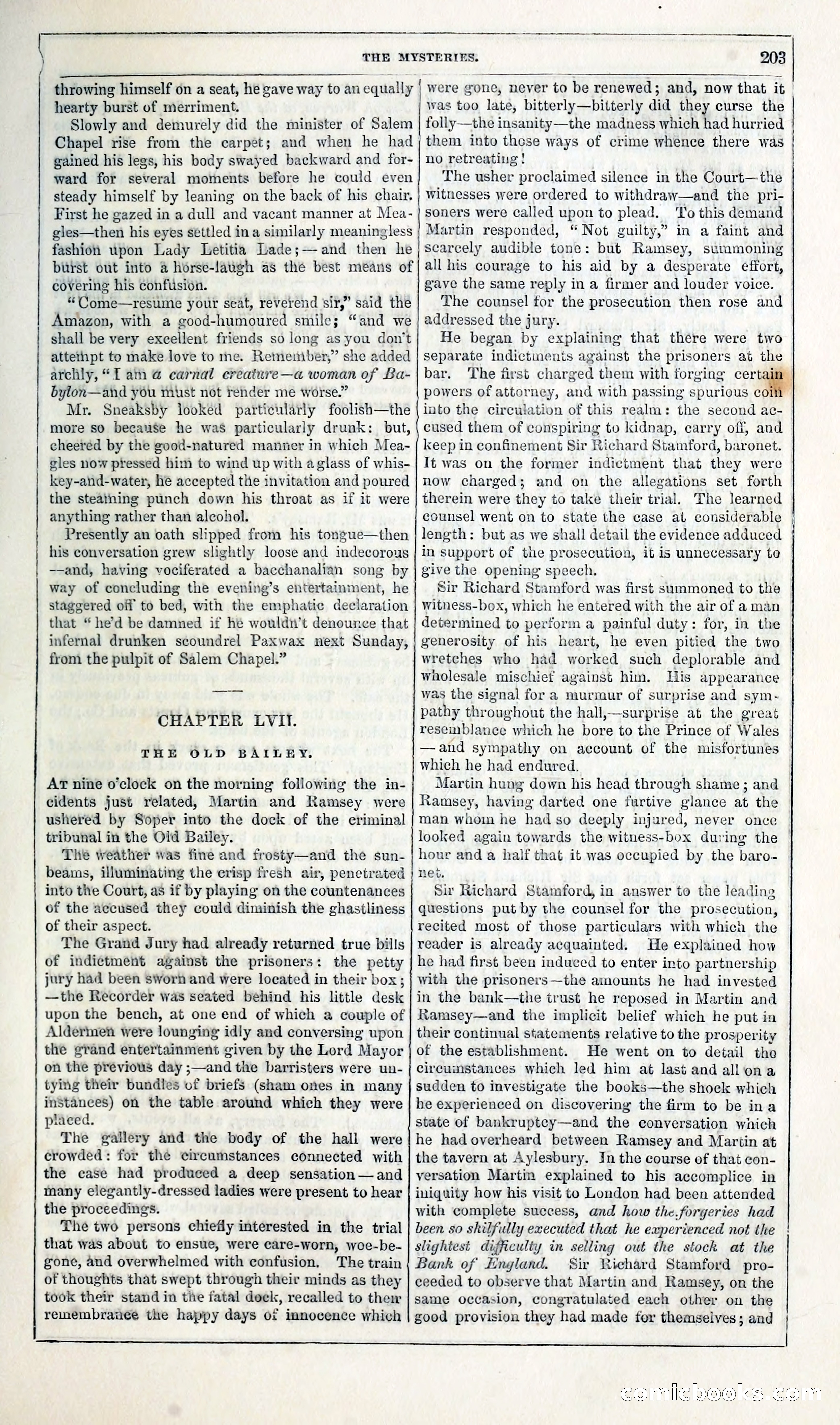
A restored page from Penny Dreadfuls, 1849. Page through the whole issue in the reader above.
📄 Transcribed text from this page (OCR, searchable)
Machine-transcribed from the original scan — historical spelling and the odd misread are preserved.
\ THE MYSTERIES. — throwing himself on a seat, he gave way to an equally hearty burst of merriment. Slowly and demurely did the minister of Salem Chapel rise from the carpet; and when he had gained his legs, his body swayed backward and for- ward for several moments before he could even steady himself by leaning on the back of his chair. First he gazed in a dull and vacant manner at Mea- gles—then his eyes settled ina similarly meaningless fashion upon Lady Letitia Lade;—and then he burst out into & horse-laugh as the best means of covering his confusion. “ Come—resume your seat, reverend sir,” said the Amazon, with a good-humoured smile; “and we shall be very excellent friends so long as you don't attethpt to make love to me. Remennber,”’ she added archly, “fam @ carnal creature—a woman of Ba- bylon—and you mist not render me worse.” Mr. Sneaksby looked particularly foolish—the more so because he was particularly drunk: but, cheeréd by the good-natured manner in which Mea- gles now pressed him to wind up with a glass of whis- key-and-water, he accepted the invitation and poured the steatning punch down his throat as if it were anything rather than alcohol. Presently an oath slipped from his tongue—then his conversation grew slightly loose and indecorous —and, having vociferated a bacchanalian song by way of concluding the evening’s entertainment, he staggered off to bed, with the emphatic declaration that “ he’d be damned if he wouldn’t denounce that infernal drunken scoundrel Paxwax next Sunday, from the pulpit of Salem Chapel.” CHAPTER LVII. THE OLD BAILEY. At nine o’clock on the morning following the in- cidents just related, Martin and Ramsey were ushered by Soper into the dock of the eriminal tribunal in the Old Bailey. The weather was fine and frosty—and the sun- beams, illuminating the erisp fresh air, penetrated into the Court, as if by playing on the countenances of the aecused they could diminish the ghastliness of their aspect. The Grand Jury had already returned true bills of indictment against the prisoners: the petty jury had been sworn and were located in their box; —the Recorder was seated behind his little desk upon the bench, at one end of which a couple of Aldermen were lounging idly and conversing upon the grand entertainment given by the Lord Mayor on the previous day ;—and the barristers were un- tying their bundles of briefs (sham ones in many instances) on the table around which they were placed. The gallery and the body of the hall were crowded: for the circumstances connected with the case had produced a deep sensation —and many elegantly-dressed ladies were present to hear the proceedings. The two persons chiefly interested in the trial that was about to ensue, were care-worn, woe-be- gone, and overwhelmed with confusion, The train of thoughts that swept through their minds as they took their stand in the fatal deck, recalled to thew remembranee the happy days of innocence which 203 were gone, never to be renewed; and, now that it | was too late, bitterly—bitterly did they curse the folly—the insanity—the madness which had hurried them into these ways of crime whence there was no retreating ! The usher proclaimed silence in the Court—the witnesses were ordered to withdraw—and the pri- soners were called upon to plead. To this demand Martin responded, “Not guilty,” in a faint and scarcely audible tone: but Ramsey, summoning all his courage to his aid by a desperate effort, gave the same reply in a firmer and louder voice. The counsel for the prosecution then rose and addressed the jury. He began by explaining that there were two separate indictments against the prisoners at the bar. The first charged them with forging certain powers of attorney, and with passing spurious co into the circulation of this realm: the second ac- cused them of conspiring to kidnap, carry off, and keep in confinement Sir Richard Stamford, baronet. It was on the former indictment that they were now charged; and on the allegations set forth therein were they to take their trial. The learned counsel went on to state the case at considerable length: but as we shall detail the evidence adduced in support of the prosecution, it is unnecessary to give the opening speech. Sir Richard Stamford was first summoned to the witness-box, which he entered with the air of aman — determined to perform a painful duty: for, in the generosity of his heart, he even pitied the two | wretches who had worked such deplorable and wholesale mischief against him. His appearance was the signal for a murmur of surprise and sym- pathy throughout the hall,—surprise at the great resemblance which he bore to the Prince of Wales | —and sympathy on account of the misfortunes which he had endured. | | Martin hung down his head through shame; and | Ramsey, having darted one furtive glance at the man whom he had so deeply injured, never once looked again towards the witness-box during the | hour and a half that it was occupied by the baro- het. Sir Richard Stamford, in answer to the leading questions put by the counsel for the prosecution, recited most of those particulars with which the reader is already acquainted. He explained how he had first been induced to enter into partnership with the prisoners—the amounts he had invested in the bank—the trust he reposed in Martin and Ramsey—and the implicit belief which he put in their continual statements relative to the prosperity of the establishment. He went on to detail the circumstances which led him at last and allona sudden to investigate the books—the shoek which he experienced on discovering the firm to be ina state of bankruptey—and the conversation which he had overheard between Ramsey and Martin at the tavern at Aylesbury. In the course of that con- versation Martm explained to his accomplice in iniquity how his visit to London had been attended with complete success, and how the.forgeries had been so shilfully executed that he experienced not the slightest difficulty in selling out the stock at the Bank of England. Siv Richard Stamford pro- ceeded to observe that Martin and Ramsey, on the same occasion, congratulated each other on the good provision they had made for themselves ; and ae eee ee COmicoooks.€®