
Penny Dreadfuls, 1900 · page 385 of 398
Moths by Ouida — page 385: what you’re looking at
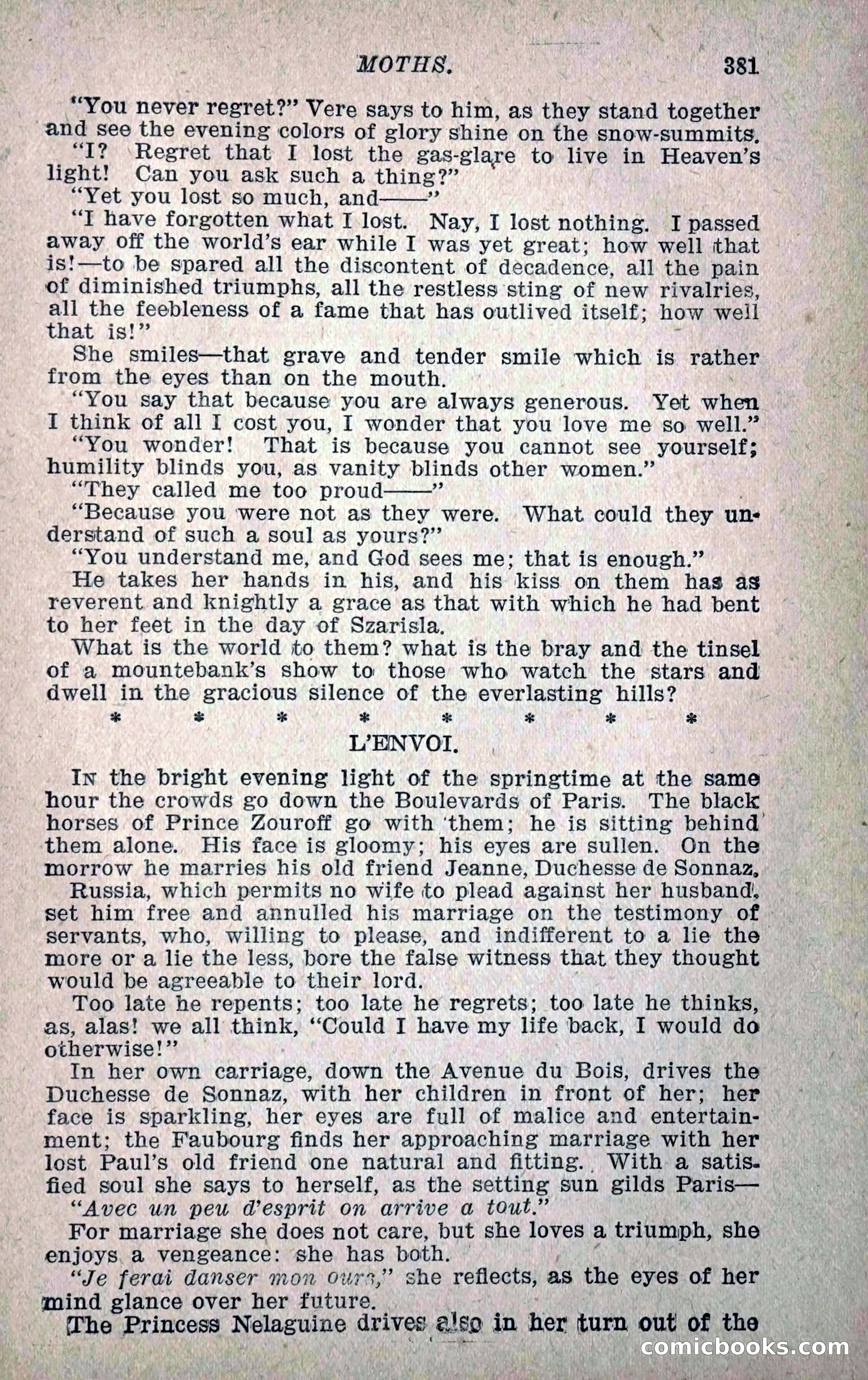
A restored page from Penny Dreadfuls, 1900. Page through the whole issue in the reader above.
📄 Transcribed text from this page (OCR, searchable)
Machine-transcribed from the original scan — historical spelling and the odd misread are preserved.
MOTHER: oO gga | “You never regret?” Vere says to hin: as they stand together and see the evening colors of glory shine on the snow- summits, “I? ‘Regret that I lost the gas- -glare to live in Heaven's light! Can you ask such a thing?” “Yet you lost so much, and op “T have forgotten what I lost. Nay, I lost nothing. I passed away off the world’s ear while I was yet great; how well that is!—to be spared all the discontent of decadence, all the pain of diminished triumphs, all the restless sting of new rivalries, all the feebleness of a fame that has outlived itself; how well that is!” She smiles—that grave and tender smile which is rather from the eyes than on the mouth. “You say that because you are always generous. Yet when © I think of all I cost you, I wonder that you love me so well.” “You wonder! That is because you cannot see yourself; humility blinds you, as vanity blinds other women.’ “They called me too proud . “Because you were not as they were. What could they uns derstand of such a soul as yours?” “You understand me, and God sees me; that is enough.” He takes her hands in his, and his kiss on them has as reverent and knightly a grace as that with which he had bent to her feet in the day of Szarisla. What is the world to them? what is the bray and the tinsel of a mountebank’s show to those who watch the stars and dwell in the gracious silence of the everlasting hills? + ss * *# % * eS 8 L’ENVOT, In the bright evening light of the springtime at the same hour the crowds go down the Boulevards of Paris. The black horses of Prince Zouroff go with ‘them; he is sitting behind’ them alone. His face is gloomy; his eyes are sullen. On the morrow he marries his old friend Jeanne, Duchesse de Sonnaz, Russia, which permits no wife to plead against her husband, set him free and annulled his marriage on the testimony of . servants, who, willing to please, and indifferent to a lie the more ora lie the less, bore the false witness that they thought would be agreeable to their lord. Too late he repents; too late he regrets; too late he thinks, as, alas! we all think, “Could I have my life back, I would do \ otherwise! In her own carriage, down the Avenue du Bois, drives the Duchesse de Sonnaz, with her children in front of her; her face is sparkling, her eyes are full of malice and entertain- ment; the Faubourg finds her approaching marriage with her lost Paul’s old friend one natural and fitting. With a satis. fied soul she says to herself, as the setting sun gilds Paris— “Avec un peu Wesprit on arrive a tout.” For marriage she does not care, but she loves a, triumph, she enjoys. a vengeance: she has both. | “Je ferai danser mon ours,” she reflects, as the eyes of her mind glance over her future. co ERO core N eae drives also in her turn out of the | Sh eo mn ck KOS) VURE ARR | Fy 4