
Penny Dreadfuls, 1900 · page 214 of 398
Moths by Ouida — page 214: what you’re looking at
A restored page from Penny Dreadfuls, 1900. Page through the whole issue in the reader above.
📄 Transcribed text from this page (OCR, searchable)
Machine-transcribed from the original scan — historical spelling and the odd misread are preserved.
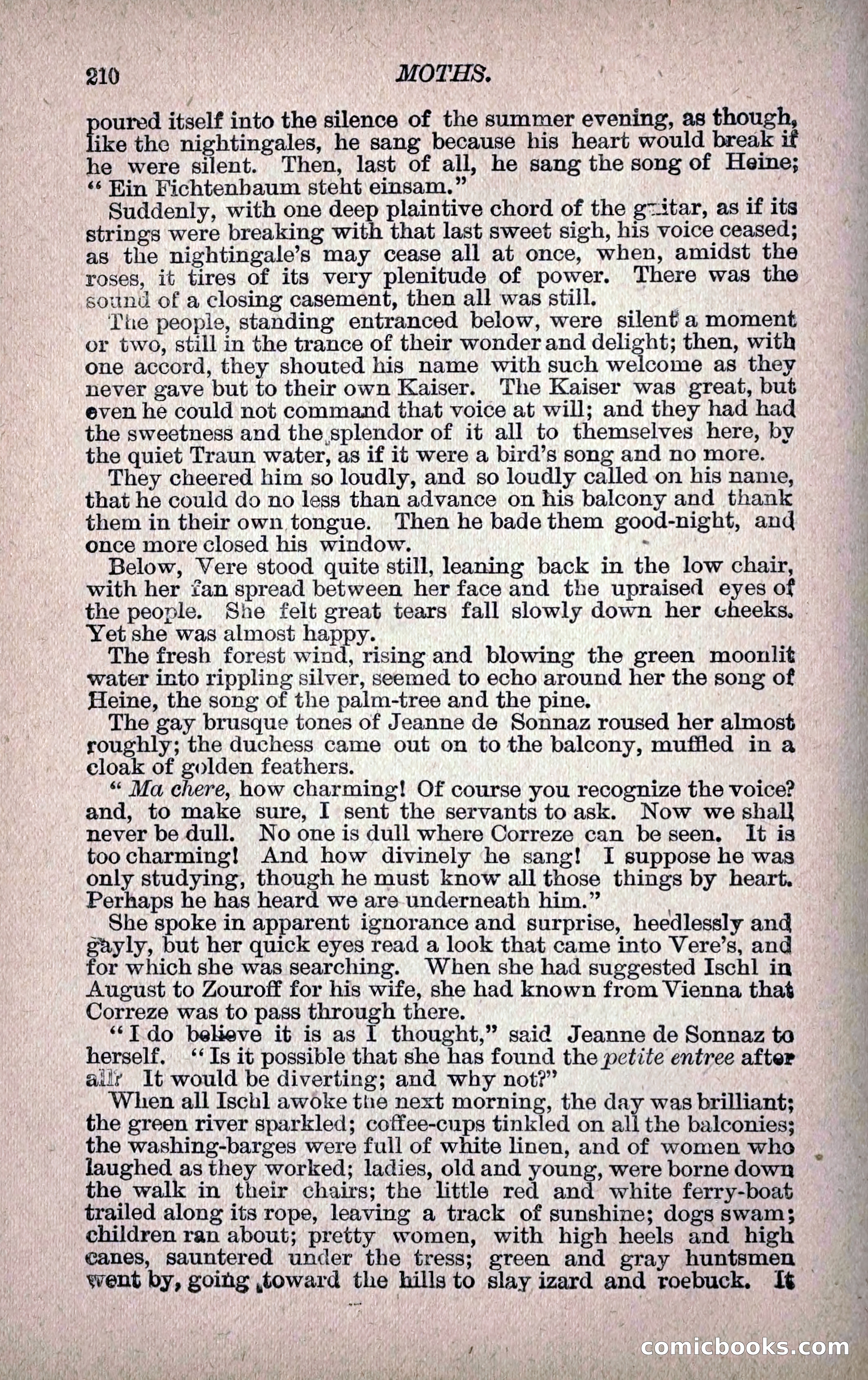
810 MOTHS. Wi oured itsalt into the silence of the summer evening, as though, ike the nightingales, he sang because his heart would break if » he were silent. Then, last of all, he sang the song of Heine; ‘¢ Hin Fichtenbaum steht einsam.” Suddenly, with one deep plaintive chord of the guitar, as if its strings were breaking with that last sweet sigh, his voice ceased; as the nightingale’s may cease all at once, when, amidst the roses, it tires of its very plenitude of power. There was the sound of a closing casement, then all was still. The people, standing entranced below, were silent a moment or two, still in the trance of their wonder and delight; then, with one accord, they shouted his name with such welcome as they never gave but to their own Kaiser. The Kaiser was great, but even he could not command that voice at will; and they had had the sweetness and the splendor of it all to themselves here, by the quiet Traun water, as if it were a bird’s song and no more. They cheered him so loudly, and so loudly called on his namie, that he could do no less than advance on his balcony and thank them in their own tongue. Then he bade them good-night, and once more closed his window. . Below, Vere stood quite still, leaning back in the low chair, with her fan spread between her face and the upraised eyes of the people. She felt great tears fall slowly down her cheeks, - Yet she was almost happy. The fresh forest wind, rising and blowing the green moonlit water into rippling silver, seemed to echo around her the song of Heine, the song of the palm-tree and the pine, The gay brusque tones of Jeanne de Sonnaz roused her almost roughly; the duchess came out on to the balcony, muffled in a cloak of golden feathers. “ Ma chere, how charming! Of course you recognize the voice? and, to make sure, I sent the servants toask. Now we shall never be dull. Noone is dull where Correze can be seen. It is too charming! And how divinely he sang! I suppose he was only studying, though he must know all those things by heart. Perhaps he has heard we are underneath him.” } She spoke in apparent ignorance and surprise, heedlessly and gayly, but her quick eyes read a look that came into Vere’s, and for which she was searching. When she had suggested Ischl in August to Zouroff for his wife, she had known from Vienna that Correze was to pass through there. ““T do bekeve it is as | thought,” said Jeanne de Sonnaz ta herself. ‘‘Is it possible that she has found the petite entree after ailr It would be diverting; and why not?” When all Ischl awoke the next morning, the day was brilliant; the green river sparkled; coffee-cups tinkled on ali the balconies; the washing-barges were full of white linen, and of women who laughed as they worked; ladies, old and young, were borne down the walk in their chairs; the little red and white ferry-boat trailed along its rope, leaving a track of sunshine; dogs swam; children ran about; pretty women, with high heels and high canes, sauntered under the tress; green and gray huntsmen went by, going toward the hills to slay izard and roebuck. It ) aay + He PEM NON Sel ‘com cbooks ; : i eT Vis WL : + ‘ . | 4 gv met, | \ , 3 : - Ay Tf - Aft i its Ae (E(@ :> ht eS Bre) py