
Penny Dreadfuls, 1900 · page 213 of 398
Moths by Ouida — page 213: what you’re looking at
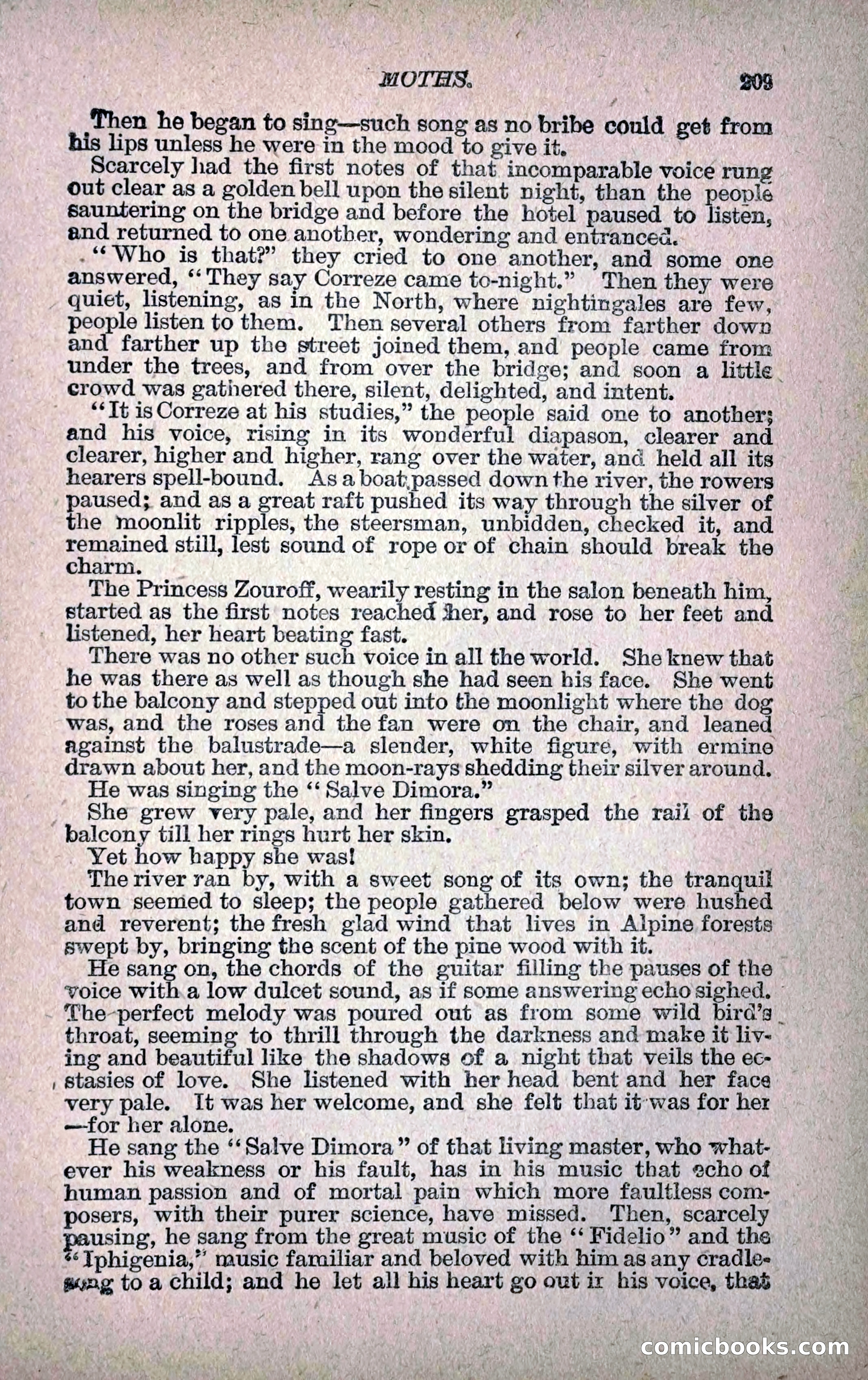
A restored page from Penny Dreadfuls, 1900. Page through the whole issue in the reader above.
📄 Transcribed text from this page (OCR, searchable)
Machine-transcribed from the original scan — historical spelling and the odd misread are preserved.
os MOTHS, moat 805. Then he began to sing—such song as no bribe could get from lips unless he were in the mood to give it, Scarcely had the first notes of that incomparable voice rung out clear as a golden bell upon the silent night, than the people sauntering on the bridge and before the hotel paused to listen, and returned to one another, wondering and entranced. .‘* Who is that?” they cried to one another, and some one answered, ‘‘ They say Correze came to-night.” Then they were - quiet, listening, as in the North, where nightingales are few, ee listen to them. Then several others from farther down and farther up the street joined them, and people came from under the trees, and from over the bridge; and soon a little crowd was gathered there, silent, delighted, and intent. “Tt is Correze at his studies,” the people said one to another; and his voice, rising in its wonderful diapason, clearer and clearer, higher and higher, rang over the water, and held all its hearers spell-bound. Asaboat,passed down the river, the rowers paused; and as a great raft pushed its way through the silver of the moonlit ripples, the steersman, unbidden, checked it, and aed still, lest sound of rope or of chain should break the charm. The Princess Zouroff, wearily resting in the salon beneath him, started as the first notes reached ther, and rose to her feet and listened, her heart beating fast. There was no other such voice in all the world. She knew that he was there as well as though she had seen his face. She went to the balcony and stepped out into the moonlight where the dog was, and the roses and the fan were on the chair, and leaned against the balustrade—a slender, white figure, with ermine drawn about her, and the moon-rays shedding their silver around. He was singing the ‘‘ Salve Dimora.” She grew very pale, and her fingers grasped the raii of the balcony till her rings hurt her skin. _ Yet how happy she was! The river ran by, with a sweet song of its own; the tranquil town seemed to sleep; the people gathered below were hushed and reverent; the fresh glad wind that lives in Alpine forests swept by, bringing the scent of the pine wood with it. | He sang on, the chords of the guitar filling the pauses of the — voice with.a low dulcet sound, as if some answering echo sighed. ~ The-perfect melody was poured out as from some wild bird’a throat, seeming to thrill through the darkness and make it liv- ing and beautiful like the shadows of a night that veils the ec- stasies of love. She listened with her head bent and her face very pale. It was her welcome, and she felt that it-was for her — —for her alone. a He sang the ‘Salve Dimora” of that living master, who what- ever his weakness or his fault, has in his music that echo of human passion and of mortal pain which more faultless com- posers, with their purer science, have missed. Then, scarcely pausing, he sang from the great music of the ‘‘ Fidelio” and the ‘‘Tphigenia,”’ music familiar and beloved with him as any cradle- | gone to a Child; and he let all his heart go out iz his voice, that _ ee : a : a'tm, < 7 4 ¥ : of a : - .., * ’ fi ; wy? ‘s ‘ i