
Penny Dreadfuls, 1900 · page 109 of 398
Moths by Ouida — page 109: what you’re looking at
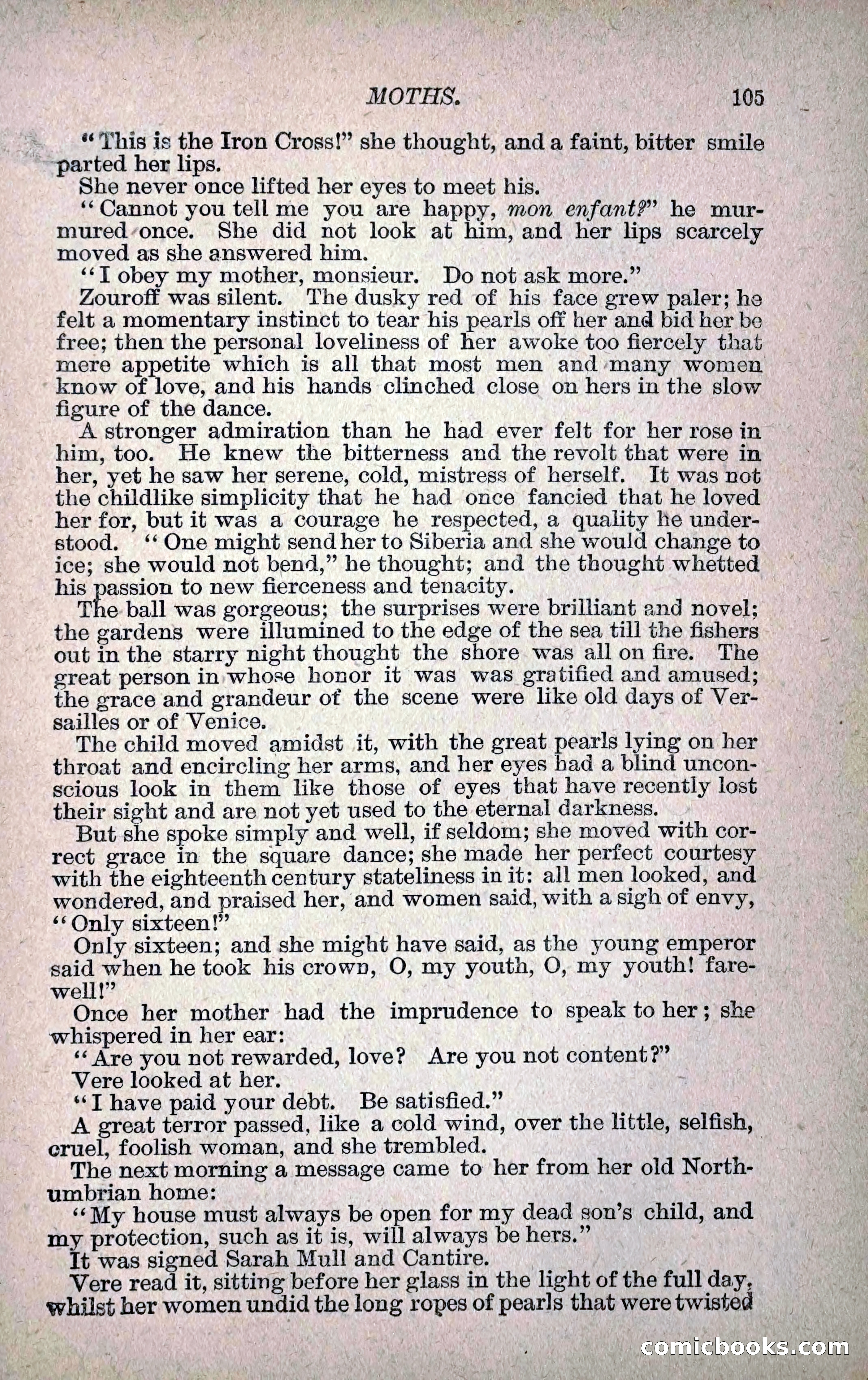
A restored page from Penny Dreadfuls, 1900. Page through the whole issue in the reader above.
📄 Transcribed text from this page (OCR, searchable)
Machine-transcribed from the original scan — historical spelling and the odd misread are preserved.
MOTHS. 105 “This is the Iron Cross!” she thought, and a faint, bitter smile parted her lips. She never once lifted her eyes to meet his. ‘*Cannot you tell me you are happy, mon enfant?” he mur- mured-once. She did not look at him, and her lips scarcely moved as she answered him. ‘‘T obey my mother, monsieur. Do not ask more.” Zouroff was silent. The dusky red of his face grew paler; he felt a momentary instinct to tear his pearls off her and bid her be free; then the personal loveliness of her awoke too fiercely that mere appetite which is all that most men and many women know of love, and his hands clinched close on hers in the slow figure of the dance. A stronger admiration than he had ever felt for her rose in him, too. He knew the bitterness and the revolt that were in her, yet he saw her serene, cold, mistress of herself. It was not the childlike simplicity that he had once fancied that he loved her for, but it was a courage he respected, a quality he under- stood. ‘‘ One might send hex to Siberia and she would change to ice; she would not bend,” he thought; and the thought whetted his passion to new fierceness and tenacity. The ball was gorgeous; the surprises were brilliant and novel; the gardens were illumined to the edge of the sea till the fishers out in the starry night thought the shore was all on fire. The great person in,whose honor it was was gratified and amused; the grace and grandeur of the scene were like old days of Ver- sailles or of Venice. The child moved amidst it, with the great pearls lying on her throat and encircling her arms, and her eyes bad a blind uncon- scious look in them like those of eyes that have recently lost their sight and are not yet used to the eternal darkness. _ But she spoke simply and well, if seldom; she moved with cor- rect grace in the square dance; she made her perfect courtesy with the eighteenth century stateliness in it: all men looked, and wondered, and praised her, and women said, with a sigh of envy, ‘‘Only sixteen!” Only sixteen; and she might have said, as the young emperor said when he took his crown, O, my youth, O, my youth! fare- well!” ; Once her mother had the imprudence to speak to her; she whispered in her ear: ‘«‘ Are you not rewarded, love? Are you not content?” Vere looked at her. : ‘‘T have paid your debt. Be satisfied.” A great terror passed, like a cold wind, over the little, selfish, cruel, foolish woman, and she trembled. | The next morning a message came to her from her old North- umbrian home: ‘‘My house must always be open for my dead son’s child, and my protection, such as it is, will always be hers.” | It was signed Sarah Mull and Cantire. ney Vere read it, sitting before her glass in the light of the full day, whilst her women undid the long ropes of pearls that were twisted co aA (Cc 900 cS (E(0)