
Penny Dreadfuls, 1900 · page 108 of 398
Moths by Ouida — page 108: what you’re looking at
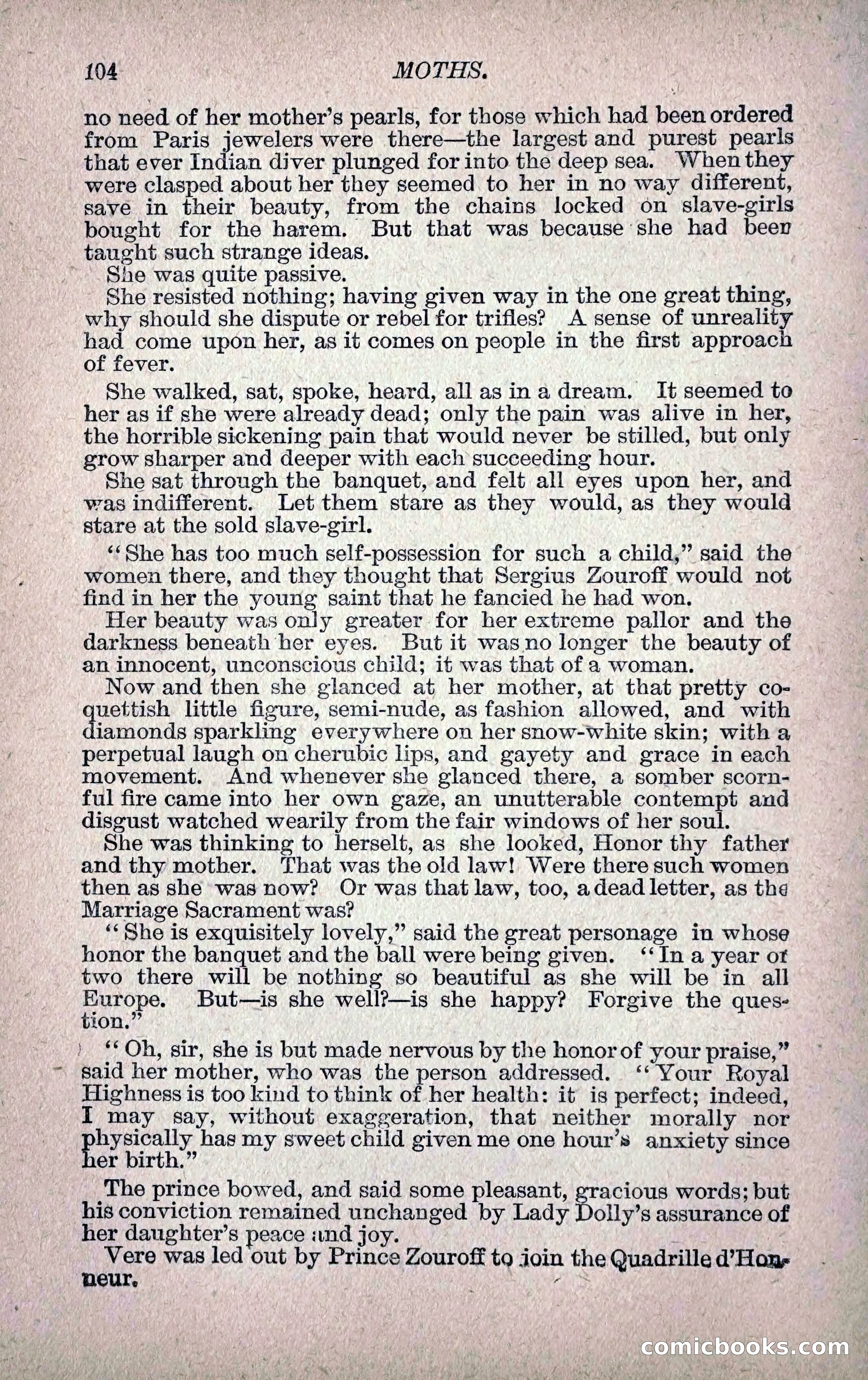
A restored page from Penny Dreadfuls, 1900. Page through the whole issue in the reader above.
📄 Transcribed text from this page (OCR, searchable)
Machine-transcribed from the original scan — historical spelling and the odd misread are preserved.
104 MOTHS. no need of her mother’s pearls, for those which had been ordered from Paris jewelers were there—the largest and purest pearls that ever Indian diver plunged for into the deep sea. When they were clasped about her they seemed to her in no way different, save in their beauty, from the chains locked on slave-girls bought for the harem. But that was because she had beer taught such strange ideas. She was quite passive. She resisted nothing; having given way in the one great thing, why should she dispute or rebel for trifles? A sense of unreality had come upon her, as it comes on people in the first approach of fever. She walked, sat, spoke, heard, allasina dream, It seemed to her as if she were already dead; only the pain was alive in her, the horrible sickening pain that would never be stilled, but only grow sharper and deeper with each succeeding hour. She sat through the banquet, and felt all eyes upon her, and was indifferent. Let them stare as they would, as they would stare at the sold slave-girl. ‘‘She has too much self-possession for such a child,” said the women there, and they thought that Sergius Zouroff would not find in her the young saint that he fancied he had won, Her beauty was only greater for her extreme pallor and the darkness beneath her eyes. But it wasno longer the beauty of an innocent, unconscious child; it was that of a woman. Now and then she glanced at her mother, at that pretty co- Soma little figure, semi-nude, as fashion allowed, and with iamonds sparkling everywhere on her snow-white skin; with a _ perpetual laugh on cherubic lips, and gayety and grace in each movement. And whenever she glanced there, a somber scorn- ful fire came into her own gaze, an unutterable contempt and disgust watched wearily from the fair windows of her soul. She was thinking to herselt, as she looked, Honor thy father and thy mother. That was the old law! Were there such women then as she was now? Or was that law, too, adead letter, as the Marriage Sacrament was? ‘‘She is exquisitely lovely,” said the great personage in whose honor the banquet and the ball were being given. ‘‘In a year of two there will be nothing so beautiful as she will be in all “alae aie But—is she well?—is she happy? Forgive the ques- ion.” ) **Qh, sir, she is but made nervous by the honor of your praise,” said her mother, who was the person addressed. ‘‘ Your Royal Highness is too kind to think of her health: it is perfect; indeed, I may say, without exaggeration, that neither morally nor | sind has my sweet child given me one hour’s anxiety since er birth.’ The prince bowed, and said some pleasant, gracious words; but his conviction remained unchanged by Lady Dolly’s assurance of her daughter’s peace ind joy. if Vere was led out by Prince Zouroff tq join the Quadrille d’Hon- peur, cl ae | (eX) al (@ ,00 ESS ” 4 i “ ; F é ‘ % - . + A 7 7 - nN : ? ef na * ioe | f NM eu . 7 . ~» ibub af, : » sa * st 7 ' ” } . - (e(e)