
Penny Dreadfuls, 1854 · page 299 of 399
Joseph Wilmot, or, The Memoirs of a Man-Servant — page 299: what you’re looking at
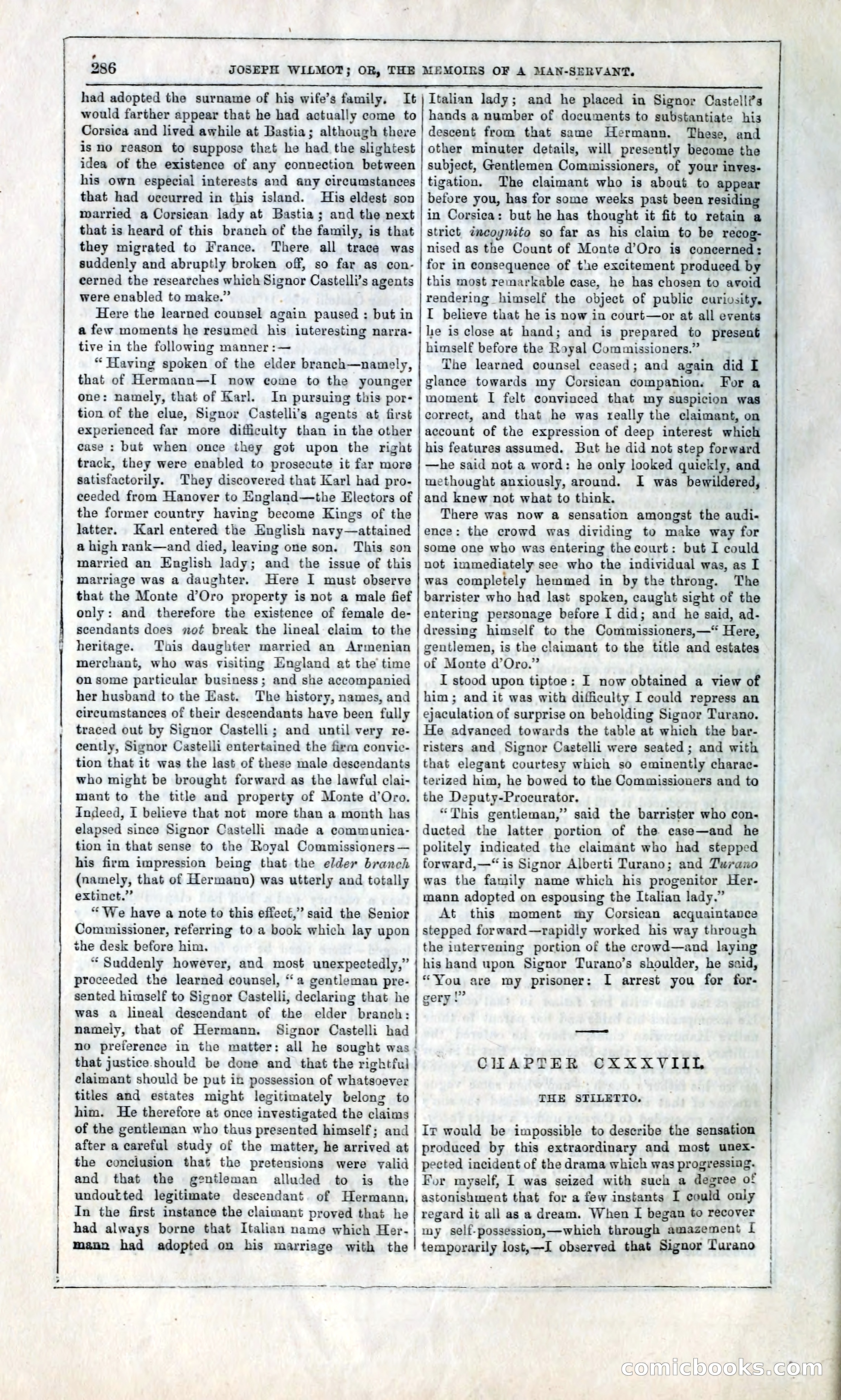
A restored page from Penny Dreadfuls, 1854. Page through the whole issue in the reader above.
📄 Transcribed text from this page (OCR, searchable)
Machine-transcribed from the original scan — historical spelling and the odd misread are preserved.
‘ 286 JOSEPH WILMOT; OR, THE MEMOIRS OF A MAN-SERVANT. had adopted the surname of his wife’s family, It would farther appear that he had actually come to Corsica and lived awhile at Bastia; although there is no reason to suppose that he had the slightest idea of the existence of any connection between his own especial interests and any circumstances that had occurred in this island. His eldest son married a Corsican lady at Bastia; and the next that is heard of this branch of the family, is that they migrated to France. There all trace was suddenly and abruptly broken off, so far as con- cerned the researches which Signor Castelli’s agents were enabled to make.” : Here the learned counsel again paused : but in a few moments he resumed his iuteresting narra- tive in the following manner :— “ Having spoken of the elder branch—namely, that of Hermann—I now come to the younger one: namely, that of Karl. In pursuing this por- tion of the elue, Signor Castelli’s agents at first experienced far more difficulty than in the other case : but when once they got upon the right track, they were enabled to prosecute it far more satisfactorily. They discovered that Karl had pro- ceeded from Hanover to England—the Electors of the former country having become Kings of the latter. Karl entered the Huglish navy—attained a high rank—and died, leaving one son. This son married an English lady; and the issue of this marriage was a daughter. Here I must observe that the Monte d’Oro property is not a male fief only: and therefore the existence of female de- scendants does not break the lineal claim to the heritage. This daughter married an Armenian merchant, who was visiting England at the time on some particular business; and she accompanied her husband to the East. The history, names, and circumstances of their descendants have been fully traced out by Signor Castelli; and until very re- cently, Signor Castelli entertained the firm convic- tion that it was the last of these male descendants who might be brought forward as the lawful clai- mant to the title and property of Monte d’Oro. Indeed, I believe that not more than a month has elapsed since Signor Castelli made a communica- tion in that sense to the Royal Commissioners — his firm impression being that the elder branch (namely, that of Hermann) was utterly and totally extinct.” “We have a note to this effect,” said the Senior Commissioner, referring to a book which lay upon the desk before him. “ Suddenly however, and most unexpectedly,” proceeded the learned counsel, “a gentleman pre- sented himself to Signor Castelli, declaring that he was a lineal descendant of the elder branch: namely, that of Hermann. Signor Castelli had no preference in the matter: all he sought was | that justice. should be dome and that the rightful claimant should be put it possession of whatsoever titles and estates might legitimately belong to him. He therefore at once investigated the claims of the gentleman who thus presented himself; and after a careful study of the matter, he arrived at the conclusion thaté the pretensions were valid and that the gentleman alluded to is the undoutted legitimate descendant. of Hermann, In the first instance the claimant proved that he Italian lady; and he placed in Signor Castellis hands a number of documents to substantiate his descent from that same Hermann. These, and other minuter details, will presently become the subject, Gentlemen Commissioners, of your inyes- tigation. The claimant who is about to appear before you, has for some weeks past been residing in Corsica: but he has thought it fit to retain a strict tncoynito so far as his claim to be recog- nised as the Count of Monte d’Oro is concerned: for in consequence of the excitement produced by this most remarkable case, he has chosen to avoid rendering himself the object of public curiosity. I believe that he is now in court—or at all events le is close at hand; and is prepared to present himself before the Royal Commissioners.” The learned counsel ceased; and again did I glance towards my Corsican companion. For a moment I felt convinced that my suspicion was correct, and that he was really the claimant, on account of the expression of deep interest which his features assumed. But he did not step forward —he said not a word: he only looked quickly, and methought anxiously, around. I was bewildered, and knew not what to think. | There was now a sensation amongst the audi- ence: the crowd was dividing to make way for some one who was entering the court: but I could not immediately see who the individual was, as I © was completely hemmed in by the throng. The barrister who had last spoken, caught sight of the entering personage before I did; and he said, ad- dressing himself to the Commissioners,—“ Here, gentlemen, is the claimant to the title and estates of Monte d’Oro.” I stood upon tiptoe: I now obtained a view of him; and it was with difficulty I could repress an ejaculation of surprise on beholding Signor Turano. He advanced towards the table at which the bar- risters and Signor Castelli were seated; and with that elegant courtesy which so eminently charac- terized him, he bowed to the Commissiouers and to the Deputy-Procurator. “This gentleman,” said the barrister who con- ducted the latter portion of the case—and he politely indicated the claimant who had stepped forward,—“ is Signor Alberti Turano; and Turano was the family name which his progenitor Her- mann adopted on espousing the Italian lady.” At this moment my Corsican acquaintance stepped forward—rapidly worked his way through the intervening portion of the crowd—and laying his hand upon Signor Turano’s shoulder, he said, “You are my prisoner: I arrest you for for- 193 gery u eS CITAPTER CXXXVIIL THE STILETTO. Ir would be impossible to describe the sensation produced by this extraordinary and most unex- pected incident of the drama which was progressing. For myself, I was seized with such a degree of astonishment that for a few instants I could only regard it all as a dream. When I began to recover had always borne that Italian name which Her-| my self-possession,—which through amazement f mann had adopted on his marriage with the! temporarily lost,—I observed that Signor Turano ee €ElO@QO) eee ee + ee. +s ee ee: ce.