
Penny Dreadfuls, 1854 · page 298 of 399
Joseph Wilmot, or, The Memoirs of a Man-Servant — page 298: what you’re looking at
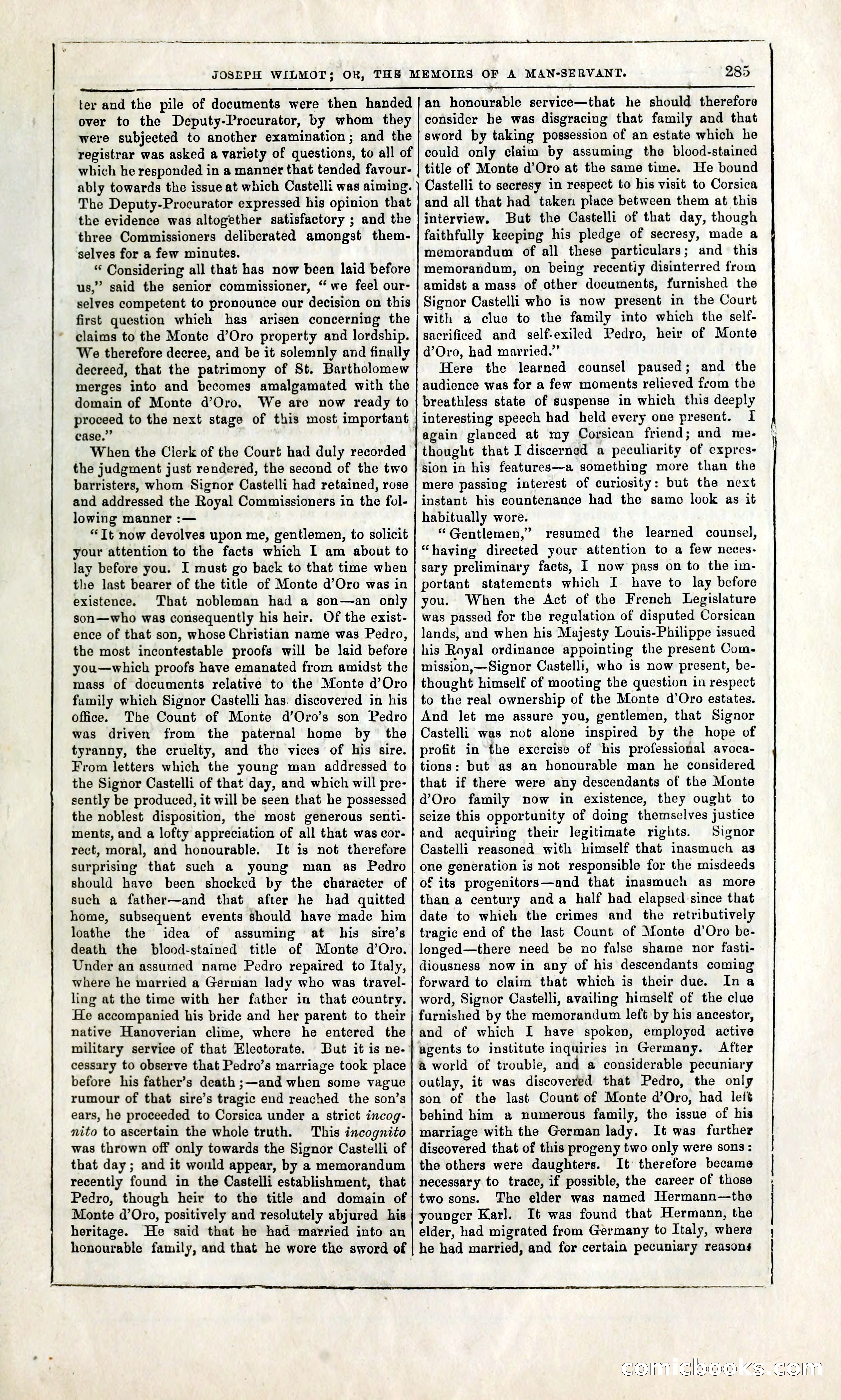
A restored page from Penny Dreadfuls, 1854. Page through the whole issue in the reader above.
📄 Transcribed text from this page (OCR, searchable)
Machine-transcribed from the original scan — historical spelling and the odd misread are preserved.
JOSEPH WILMOT; OR, THE MEMOIRS OF A MAN-SERVANT. ter and the pile of documents were then handed over to the Deputy-Procurator, by whom they were subjected to another examination; and the registrar was asked a variety of questions, to all of which he responded in a manner that tended favour- ably towards the issue at which Castelli was aiming. The Deputy-Procurator expressed his opinion that the evidence was altogether satisfactory ; and the three Commissioners deliberated amongst them- selves for a few minutes. “ Considering all that has now been laid before us,” said the senior commissioner, “ we feel our- selves competent to pronounce our decision on this first question which has arisen concerning the claims to the Monte d’Oro property and lordship. We therefore decree, and be it solemnly and finally decreed, that the patrimony of St. Bartholomew merges into and becomes amalgamated with the domain of Monte d’Oro. We are now ready to proceed to the next stage of this most important. case.” When the Clerk of the Court had duly recorded the judgment just rendered, the second of the two barristers, whom Signor Castelli had retained, rose and addressed the Royal Commissioners in the fol- lowing manner :— “Tt now devolves upon me, gentlemen, to solicit your attention to the facts which I am about to lay before you. I must go back to that time when the last bearer of the title of Monte d’Oro was in existence. That nobleman had a son—an only son—who was consequently his heir. Of the exist- ence of that son, whose Christian name was Pedro, the most incontestable proofs will be laid before you—which proofs have emanated from amidst the mass of documents relative to the Monte d’Oro family which Signor Castelli has. discovered in his office. The Count of Monte d’Oro’s son Pedro was driven from the paternal home by the tyranny, the cruelty, and the vices of his sire. From letters which the young man addressed to the Signor Castelli of that day, and which will pre- sently be produced, it will be seen that he possessed the noblest disposition, the most generous senti- ments, and a lofty appreciation of all that was cor- rect, moral, and honourable. It is not therefore surprising that such a young man as Pedro | should have been shocked by the character of such a father—and that after he had quitted home, subsequent events should have made him loathe the idea of assuming at his sire’s death the blood-stained title of Monte d’Oro. Under an assumed name Pedro repaired to Italy, where he married a German lady who was travel- ling at the time with her father in that country. He accompanied his bride and her parent to their native Hanoverian clime, where he entered the military service of that Electorate. cessary to observe that Pedro’s marriage took place before his father’s death ;—and when some vague rumour of that sire’s tragic end reached the son’s ears, he proceeded to Corsica under a strict incog- nito to ascertain the whole truth. This incognito was thrown off only towards the Signor Castelli of that day; and it would appear, by a memorandum recently found in the Castelli establishment, that Pedro, though heir to the title and domain of Monte d’Oro, positively and resolutely abjured his heritage. He said that he had married into an honourable family, and that he wore the sword of But it is ne-’ 285 an honourable service—that he should therefore consider he was disgracing that family and that sword by taking possession of an estate which he could only claim by assuming the blood-stained title of Monte d’Oro at the same time. He bound Castelli to secresy in respect to his visit to Corsica and all that had taken place between them at this interview. But the Castelli of that day, though faithfully keeping his pledge of secresy, made a memorandum of all these particulars; and this memorandum, on being recentiy disinterred from amidst a mass of other documents, furnished the Signor Castelli who is now present in the Court with a clue to the family into which the self- sacrificed and self-exiled Pedro, heir of Monte d’Oro, had married.” Here the learned counsel paused; and the audience was for a few moments relieved from the breathless state of suspense in which this deeply interesting speech had held every one present. I again glanced at my Corsican friend; and me- thought that I discerned a peculiarity of expres- sion in his features—a something more than the mere passing interest of curiosity: but the next instant his countenance had the same look as it habitually wore. . “ Gentlemen,’ resumed the learned counsel, “having directed your attention to a few neces- sary preliminary facts, I now pass on to the 1m- portant statements which I have to lay before you. When the Act of the French Legislature was passed for the regulation of disputed Corsican lands, and when his Majesty Louis-Philippe issued his Royal ordinance appointing the present Com- mission,—Signor Castelli, who is now present, be- thought himself of mooting the question in respect to the real ownership of the Monte d’Oro estates. And let me assure you, gentlemen, that Signor Castelli was not alone inspired by the hope of profit in the exercise of his professional avoca- tions: but as an honourable man he considered that if there were any descendants of the Monte d@’Oro family now in existence, they ought to seize this opportunity of doing themselves justice and acquiring their legitimate rights. Signor Castelli reasoned with himself that inasmuch as one generation is not responsible for the misdeeds of its progenitors—and that inasmuch as more than a century anda half had elapsed since that date to which the crimes and the retributively tragic end of the last Count of Monte d’Oro be- longed—there need be no false shame nor fasti- diousness now in any of his descendants coming forward to claim that which is their due. Ina word, Signor Castelli, availing himself of the clue furnished by the memorandum left by his ancestor, and of which I have spoken, employed active agents to institute inquiries in Germany. After a world of trouble, and a considerable pecuniary outlay, it was discovered that Pedro, the only son of the last Count of Monte d’Oro, had left behind him a numerous family, the issue of his marriage with the German lady. It was further discovered that of this progeny two only were sons: the others were daughters. It therefore became necessary to trace, if possible, the career of those two sons. The elder was named Hermann—the younger Karl. It was found that Hermann, the elder, had migrated from Germany to Italy, whera he had married, and for certain pecuniary reasong ee ee Doo S co