
Penny Dreadfuls, 1854 · page 293 of 399
Joseph Wilmot, or, The Memoirs of a Man-Servant — page 293: what you’re looking at
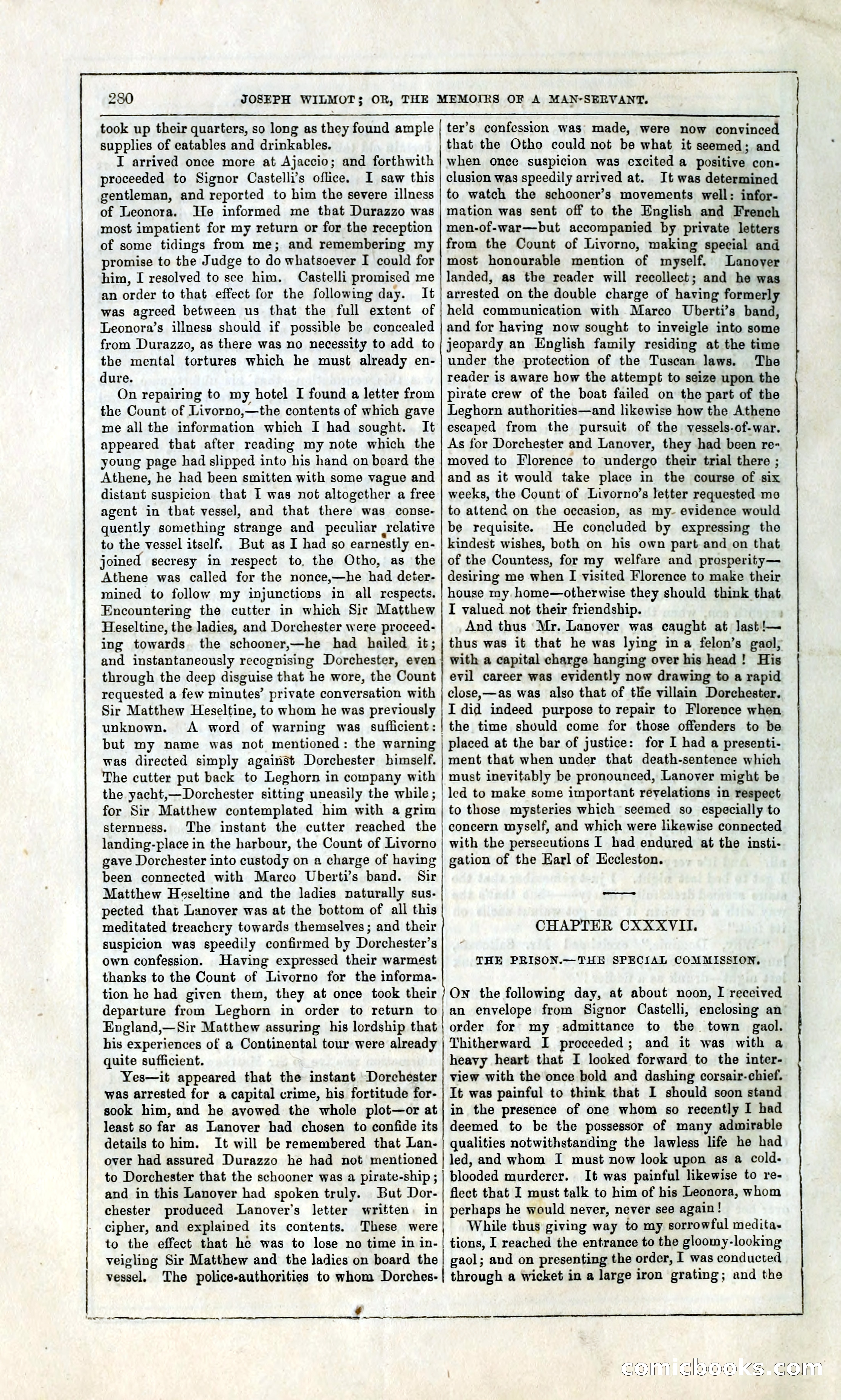
A restored page from Penny Dreadfuls, 1854. Page through the whole issue in the reader above.
📄 Transcribed text from this page (OCR, searchable)
Machine-transcribed from the original scan — historical spelling and the odd misread are preserved.
280 took up their quarters, so long as they found ample supplies of eatables and drinkables. I arrived once more at Ajaccio; and forthwith proceeded to Signor Castelli’s office. I saw this gentleman, and reported to him the severe illness of Leonora. He informed me that Durazzo was most impatient for my return or for the reception of some tidings from me; and remembering my promise to the Judge to do whatsoever I could for him, I resolved to see him. Castelli promised me an order to that effect for the following day. It was agreed between us that the full extent of Leonora’s illness should if possible be concealed from Durazzo, as there was no necessity to add to the mental tortures which he must already en- dure. On repairing to my hotel I found a letter from the Count of Livorno,—the contents of which gave me all the information which I had sought. It appeared that after reading my note which the young page had slipped into his hand on board the Athene, he had been smitten with some vague and distant suspicion that I was not altogether a free agent in that vessel, and that there was conse- quently something strange and peculiar relative to the vessel itself. But as I had so earnestly en- joined secresy in respect to. the Otho, as the Athene was called for the nonce,—he had deter- mined to follow my injunctions in all respects. Encountering the cutter in which Sir Matthew Heseltine, the ladies, and Dorchester were proceed: ing towards the schooner,—he had hailed it; and instantaneously recognising Dorchester, even through the deep disguise that he wore, the Count requested a few minutes’ private conversation with Sir Matthew Heseltine, to whom he was previously unknown. <A word of warning was suflicient: but my name was not mentioned: the warning was directed simply against Dorchester himself. The cutter put back to Leghorn in company with the yacht,—Dorchester sitting uneasily the while; for Sir Maithew contemplated him with a grim sternness. The instant the cutter reached the landing-place in the harbour, the Count of Livorno gave Dorchester into custody on a charge of having been connected with Marco Uberti’s band. Sir Matthew Heseltine and the ladies naturally sus- pected that Lanover was at the bottom of all this meditated treachery towards themselves; and their suspicion was speedily confirmed by Dorchester’s own confession. Having expressed their warmest thanks to the Count of Livorno for the informa- tion he had given them, they at once took their departure from Leghorn in order to return to Evgland,—Sir Matthew assuring his lordship that his experiences of a Continental tour were already quite sufficient. Yes—it appeared that the instant Dorchester was arrested for a capital crime, his fortitude for- sook him, and he ayowed the whole plot—or at least so far as Lanover had chosen to confide its details to him. It will be remembered that Lan- over had assured Durazzo he had not mentioned to Dorchester that the schooner was a pirate-ship ; and in this Lanoyer had spoken truly. But Dor- chester produced Lanover’s letter written in cipher, and explained its contents. These were to the effect that he was to lose no time in in- veigling Sir Matthew and the ladies on board the vessel, 4 oe a Cs eel JOSEPH WILMOT; OR, THE MEMOIRS OF A MAN-SERVANT. ter’s confession was’ made, were now convinced that the Otho could not be what it seemed; and when once suspicion was excited a positive con- clusion was speedily arrived at. It was determined to watch the schooner’s movements well: infor- mation was sent off to the English and French men-of-war—but accompanied by private letters from the Count of Livorno, making special and most honourable mention of myself. Lanover landed, as the reader will recollect; and he was arrested on the double charge of having formerly held communication with Marco Uberti’s band, and for having now sought to inveigle into some jeopardy an English family residing at the time under the protection of the Tuscan laws. The reader is aware how the attempt to seize upon the pirate crew of the boat failed on the part of the Leghorn authorities—and likewise how the Athene escaped from the pursuit of the vessels-of-war. As for Dorchester and Lanover, they had been re- moved to Florence to undergo their trial there ; and as it would take place in the course of six weeks, the Count of Livorno’s letter requested mo to attenc on the occasion, as my- evidence would be requisite. He concluded by expressing the kindest wishes, both on his own part and on that of the Countess, for my welfare and prosperity— desiring me when I visited Florence to make their house my home—otherwise they should think that I valued not their friendship. And thus Mr. Lanover was caught at last !— thus was it that he was lying ina felon’s gaol, with a capital charge hanging over his head! His evil career was evidently now drawing to a rapid close,—as was also that of the villain Dorchester. I did indeed purpose to repair to Florence when the time should come for those offenders to be placed at the bar of justice: for I had a presenti- ment that when under that death-sentence which must inevitably be pronounced, Lanover might be led to make some important revelations in respect to those mysteries which seemed so especially to concern myself, and which were likewise connected with the persecutions I had endured at the insti- gation of the Earl of Kccleston. iematie ememieee oo CHAPTER CXXXVII. THE PRISON.—THE SPECIAL COMMISSION. On the following day, at about noon, I received an envelope from Signor Castelli, enclosing an order for my admittance to the town gaol. Thitherward I proceeded; and it was with a heavy heart that I looked forward to the inter- view with the once bold and dashing corsair-chief. It was painful to think that I should soon stand in the presence of one whom so recently I had deemed to be the possessor of many admirable qualities notwithstanding the lawless life he had led, and whom I must now look upon as a cold- blooded murderer. It was painful likewise to re- flect that I must talk to him of his Leonora, whom perhaps he would never, never see again! While thus giving way to my sorrowful medita- tions, I reached the entrance to the gloomy-looking gaol; and on presenting the order, I was conducted The police-authorities to whom Dorches-| through a wicket in a large iron grating; and the ElOOO SS Eom