
Penny Dreadfuls, 1854 · page 292 of 399
Joseph Wilmot, or, The Memoirs of a Man-Servant — page 292: what you’re looking at
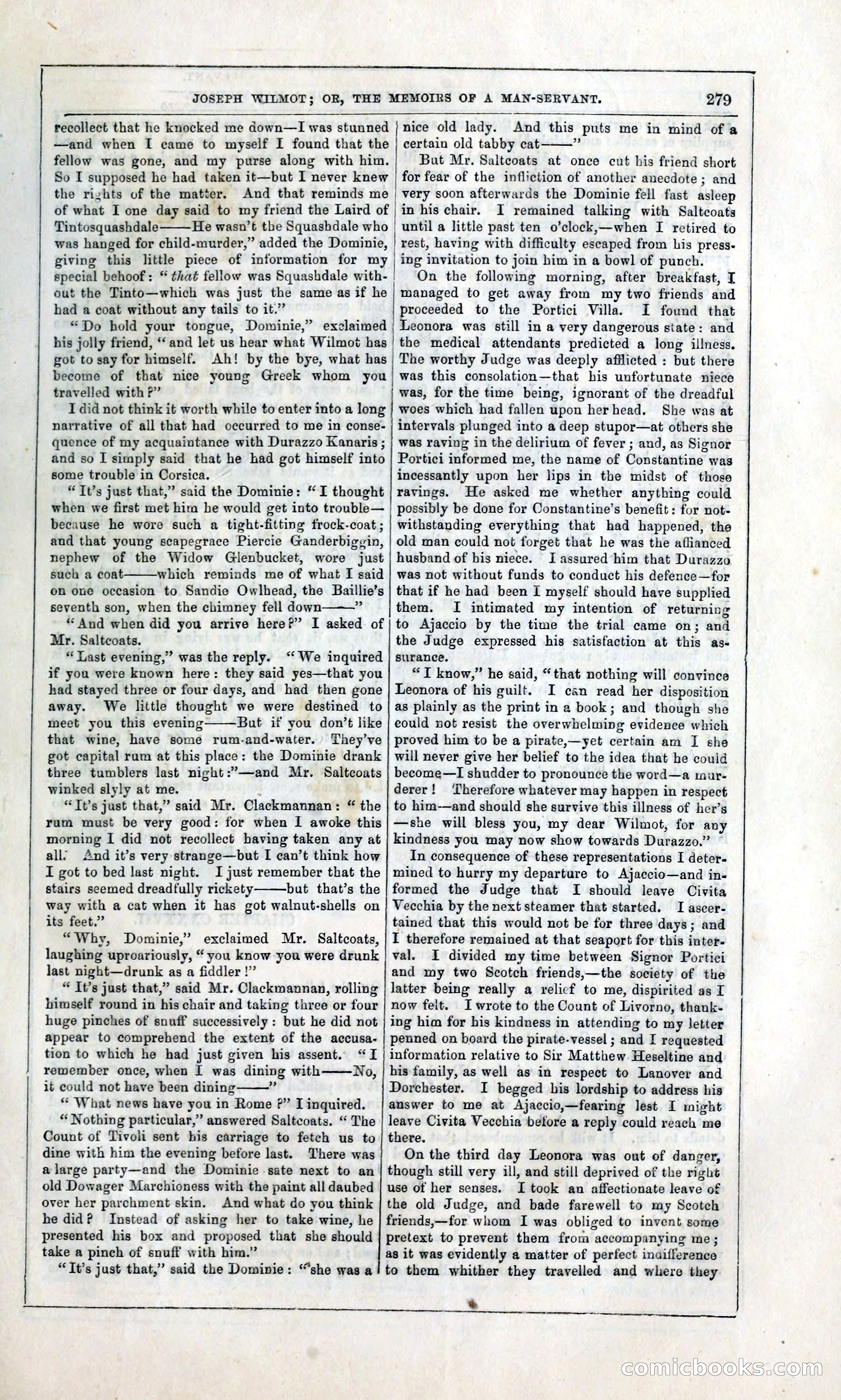
A restored page from Penny Dreadfuls, 1854. Page through the whole issue in the reader above.
📄 Transcribed text from this page (OCR, searchable)
Machine-transcribed from the original scan — historical spelling and the odd misread are preserved.
eee JOSEPH WILMOT; OR, THE MEMOIRS OF A MAN-SERVANT. 279 recollect that he knocked me down—I was stunned } nice old lady. And this puts me in mind of a —and when I came to myself I found that the | certain old tabby cat fellow was gone, and my purse along with him. 3) But Mr. Saltcoats at once cut his friend short So I supposed he had taken it—but I never knew | for fear of the infliction of another anecdote; and the rights of the matter. And that reminds me of what I one day said to my friend the Laird of Tintosquashdale: He wasn’t the Squashdale who was hanged for child-murder,” added the Dominie, giving this little piece of information for my special behoof: “ that fellow was Squashdale with- out the Tinto—which was just the same as if he had a coat without any tails to it.” “Do hold your tongue, Dominie,” exclaimed his jolly friend, “‘ and let us hear what Wilmot has got to say for himself. Ah! by the bye, what has become of that nice young Greek whom you travelled with P” I did not think it worth while to enter into a long narrative of all that had occurred to me in conse- quence of my acquaintance with Durazzo Kanaris ; and so I simply said that he had got himself into some trouble in Corsica. “Tt’s just that,” said the Dominie: “I thought when we first met him he would get into trouble— because he wore such a tight-fitting frock-coat; and that young scapegrace Piercie Ganderbigyin, nephew of the Widow Glenbucket, wore just such a coat which reminds me of what I said on one occasion to Sandie Owlhead, the Baillie’s seventh son, when the chimney fell down 2 “And when did you arrive here?” I asked of Mr. Saltcoats. * Last evening,” was the reply. ‘ We inquired if you were known here: they said yes—that you had stayed three or four days, and had then gone away. We little thought we were destined to meet you this evening But if you don’t like that wine, have some rum-and-water. They’ve got capital rum at this place: the Dominie drank three tumblers last night:’—and Mr. Saltcoats winked slyly at me. **Tt’s just that,” said Mr. Clackmannan: “ the rum must be very good: for when I awoke this morning I did not recollect having taken any at all; And it’s very strange—but I can’t think how I got to bed last night. I just remember that the stairs seemed dreadfully rickety but that’s the way with a cat when it has got walnut-shells on its feet,” “Why, Dominie,”’ exclaimed Mr. Saltcoats, laughing uproariously, “ you know you were drunk last night—drunk as a fiddler !” “ It’s just that,” said Mr. Clackmannan, rolling himself round in his chair and taking three or four huge pinches of snuff successively : but he did not appear to comprehend the extent of the accusa- tion to which he had just given his assent. “I remember once, when I was dining with——No, it could not have been dining ? * What news have you in Rome ?” L inquired. ** Nothing particular,” answered Saltcoats. “ The Count of Tivoli sent his carriage to fetch us to dine with him the evening before last. There was a large party—and the Dominie sate next to an old Dowager Marchioness with the paint all daubed over her parchment skin. And what do you think he did? Instead of asking her to take wine, he presented his box and proposed that she should take a pinch of snuff with him.” “Tt’s just that,” said the Dominie: “she was a very soon afterwards the Dominie fell fast asleep in his chair. I remained talking with Saltcoats until a little past ten o’clock,—when I retired to rest, having with difficulty escaped from his press- ing invitation to join him in a bowl of punch. On the following morning, after breakfast, T managed to get away from my two friends and proceeded to the Portici Villa. I found that Leonora was still in a very dangerous state: and the medical attendants predicted a long illness. The worthy Judge was deeply afflicted : but there was this consolation—that his unfortunate niece was, for the time being, ignorant of the dreadful woes which had fallen upon herhead. She was at intervals plunged into a deep stupor—at others she was raving in the delirium of fever ; and, as Signor Portici informed me, the name of Constantine was incessantly upon her lips in the midst of those ravings. He asked me whether anything could possibly be done for Constantine’s benefit: for not- withstanding everything that had happened, the old man could not forget that he was the aflianced husband of his niece. I assured him that Durazzo was not without funds to conduct his defence—for that if he had been I myself should have supplied them. J intimated my intention of returning to Ajaccio by the time the trial came on; and the Judge expressed his satisfaction at this as- surance. “T know,” he said, “that nothing will convince Leonora of his guilt. I can read her disposition as plainly as the print in a book; and though she eould not resist the overwhelming evidence which proved him to be a pirate,—yet certain am I she will never give her belief to the idea that he could become—I shudder to pronounce the word—a mur- derer! ‘Therefore whatever may happen in respect to him-—and should she survive this illness of her’s —she will bless you, my dear Wilmot, for any kindness you may now show towards Durazzo.” ~ In consequence of these representations I deter- mined to hurry my departure to Ajaccio—and in- formed the Judge that I should leave Civita Vecchia by the next steamer that started. I ascer- tained that this would not be for three days; and I therefore remained at that seaport for this inter. val. I divided my time between Signor Portici and my two Scotch friends,—the society of the latter being really a relicf to me, dispirited as I now feit. I wrote to the Count of Livorno, thank- ing him for his kindness in attending to my letter penned on board the pirate-vessel ; and I requested information relative to Sir Matthew Heseltine and his family, as well as in respect to Lanover and Dorchester. I begged his lordship to address his answer to me at Ajaccio,—fearing lest I might leave Civita Vecchia betore a reply could reach me there. On the third day Leonora was out of danger, though still very ill, and still deprived of the right use of her senses. I took an affectionate leave of the old Judge, and bade farewell to my Scotch friends,—for whom I was obliged to invent some pretext to prevent them from accompanying me; as it was evidently a matter of perfect inaifference to them whither they travelled and where they * Giook (EO)