
Penny Dreadfuls, 1854 · page 250 of 399
Joseph Wilmot, or, The Memoirs of a Man-Servant — page 250: what you’re looking at
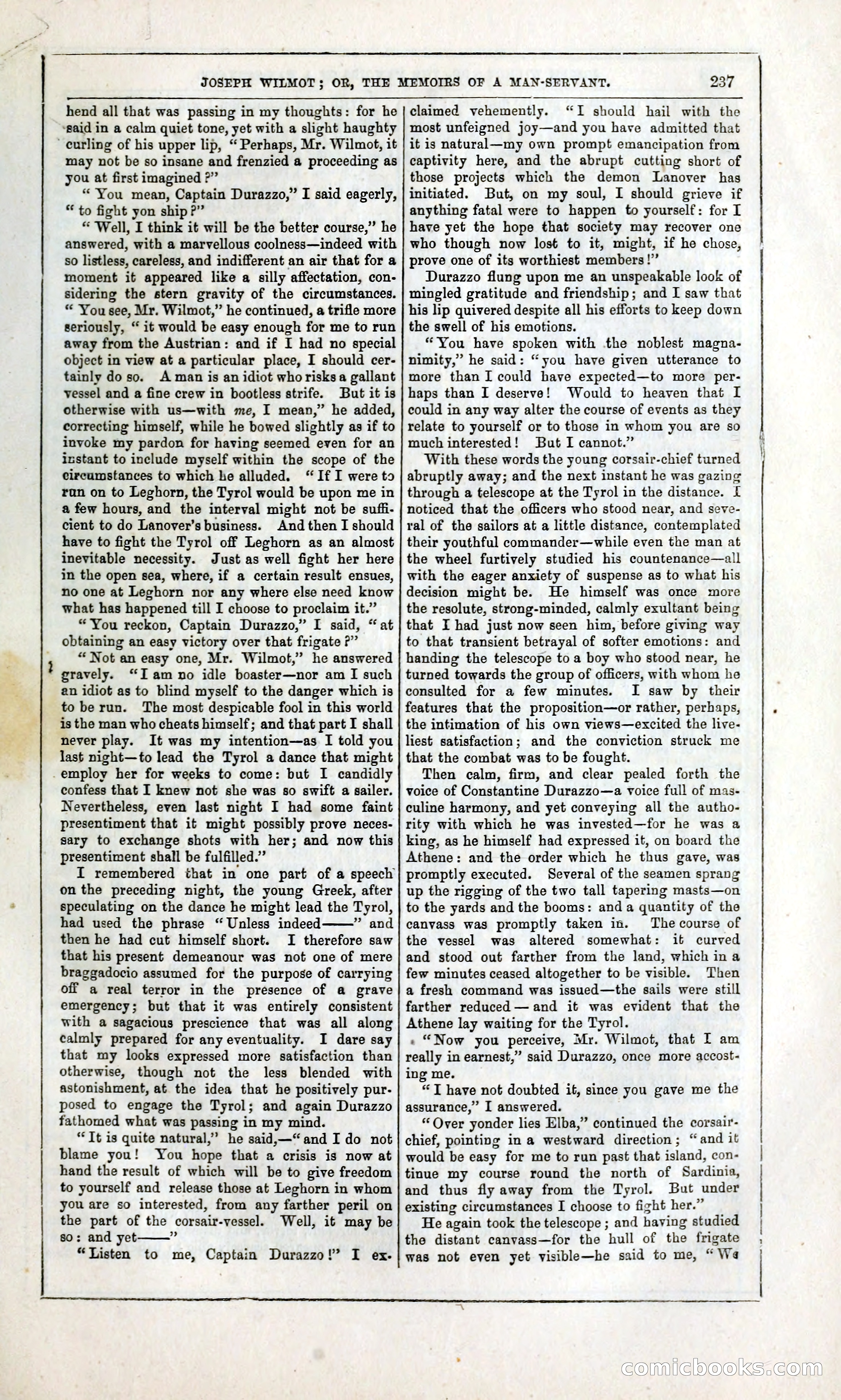
A restored page from Penny Dreadfuls, 1854. Page through the whole issue in the reader above.
📄 Transcribed text from this page (OCR, searchable)
Machine-transcribed from the original scan — historical spelling and the odd misread are preserved.
~ JOSEPH WILMOT; OR, THE MEMOIRS OF A MAN-SERVANT. hend all that was passing in my thoughts: for he ‘said in a calm quiet tone, yet with a slight haughty curling of his upper lip, “ Perhaps, Mr. Wilmot, it may not be so insane and frenzied a proceeding as you at first imagined ?” “ You mean, Captain Durazzo,” I said eagerly, * to fight yon ship?” * Well, I think it will be the better course,” he answered, with a marvellous coolness—indeed with so listless, careless, and indifferent an air that for a moment it appeared like a silly affectation, con- sidering the stern gravity of the circumstances. * You see, Mr. Wilmot,” he continued, a trifle more seriously, “ it would be easy enough for me to run away from the Austrian: and if I had no special object in view at a particular place, I should cer- tainly do so. Aman is an idiot who risks a gallant vessel and a fine crew in bootless strife. But it is otherwise with us—with me, I mean,” he added, correcting himself, while he bowed slightly as if to invoke my pardon for having seemed even for an instant to include myself within the scope of the circumstances to which he alluded. “If I were to ran on to Leghorn, the Tyrol would be upon me in a few hours, and the interval might not be suffi- cient to do Lanover’s business. And then I should have to fight the Tyrol off Leghorn as an almost inevitable necessity. Just as well fight her here in the open sea, where, if a certain result ensues, no one at Leghorn nor any where else need know what has happened till I choose to proclaim it.” “You reckon, Captain Durazzo,” I said, “at obtaining an easy victory over that frigate ?” “ Not an easy one, Mr. Wilmot,” he answered gravely. “Iam no idle boaster—nor am I such an idiot as to blind myself to the danger which is to be run. The most despicable fool in this world is the man who cheats himself; and that part I shall never play. It was my intention—as I told you last night—to lead the Tyrol a dance that might _employ her for weeks to come: but I candidly confess that I knew not she was so swift a sailer. Nevertheless, even last night I had some faint presentiment that it might possibly prove neces- sary to exchange shots with her; and now this presentiment shall be fulfilled.” I remembered that in one part of a speech on the preceding night, the young Greek, after speculating on the dance he might lead the Tyrol, had used the phrase “Unless indeed ” and then he had cut himself short. I therefore saw that his present demeanour was not one of mere braggadocio assumed for the purpose of carrying off a real terror in the presence of a grave emergency; but that it was entirely consistent with a sagacious prescience that was all along calmly prepared for any eventuality. I dare say that my looks expressed more satisfaction than otherwise, though not the less blended with astonishment, at the idea that he positively pur- posed to engage the Tyrol; and again Durazzo fathomed what was passing in my mind. It is quite natural,” he said,—“and I do not blame you! You hope that a crisis is now at hand the result of which will be to give freedom to yourself and release those at Leghorn in whom you are so interested, from any farther peril on the part of the corsair-vesse]l. Well, if may be so: and yet ra “Tisten to me, Captain Durazzo!’ I ex. 237 claimed vehemently. “I should hail with the most unfeigned joy—and you have admitted that it is natural—my own prompt emancipation from captivity here, and the abrupt cutting short of those projects which the demon Lanover has initiated. But, on my soul, I should grieve if anything fatal were to happen to yourself: for I have yet the hope that society may recover one who though now lost to it, might, if he chose, prove one of its worthiest members!’ Durazzo flung upon me an unspeakable look of mingled gratitude and friendship; and I saw that his lip quivered despite all his efforts to keep down the swell of his emotions. “You have spoken with the noblest magna- nimity,” he said: “you have given utterance to more than I could have expected—to more per- haps than I deserve! Would to heaven that I could in any way alter the course of events as they relate to yourself or to those in whom you are so much interested! But I cannot.” With these words the young corsair-chief turned abruptly away; and the next instant he was gazing through a telescope at the Tyrol in the distance. £ noticed that the officers who stood near, and seve- ral of the sailors at a little distance, contemplated their youthful commander—while even the man at the wheel furtively studied his countenance—all with the eager anxiety of suspense as to what his decision might be. He himself was once more the resolute, strong-minded, calmly exultant being that I had just now seen him, before giving way to that transient betrayal of softer emotions: and handing the telescope to a boy who stood near, he turned towards the group of officers, with whom he consulted for a few minutes. I saw by their features that the proposition—or rather, perhaps, the intimation of his own views—excited the live- liest satisfaction; and the conviction struck me that the combat was to be fought. Then calm, firm, and clear pealed forth the voice of Constantine Durazzo—a voice full of mas- culine harmony, and yet conveying all the autho- rity with which he was invested—for he was a king, as he himself had expressed it, on board the Athene: and the order which he thus gave, was promptly executed. Several of the seamen sprang up the rigging of the two tall tapering masts—on to the yards and the booms: anda quantity of the canvass was promptly taken in. The course of the vessel was altered somewhat: it curved and stood out farther from the land, which in a few minutes ceased altogether to be visible. Then a fresh command was issued—the sails were still farther reduced — and it was evident that the Athene lay waiting for the Tyrol. « “Now you perceive, Mr. Wilmot, that I am really in earnest,” said Durazzo, once more accost- ing me. “T have not doubted if, since you gave me the assurance,” I answered. “Over yonder lies Elba,” continued the corsair- chief, pointing in a westward direction; “and it would be easy for me to run past that island, con- tinue my course round the north of Sardinia, and thus fly away from the Tyrol. But under existing circumstances I choose to fight her.” He again took the telescope ; and having studied the distant canvass—for the hull of the frigate was not even yet visible—he said to me, “Wa ELNOO <5) (CO)