
Penny Dreadfuls, 1854 · page 249 of 399
Joseph Wilmot, or, The Memoirs of a Man-Servant — page 249: what you’re looking at
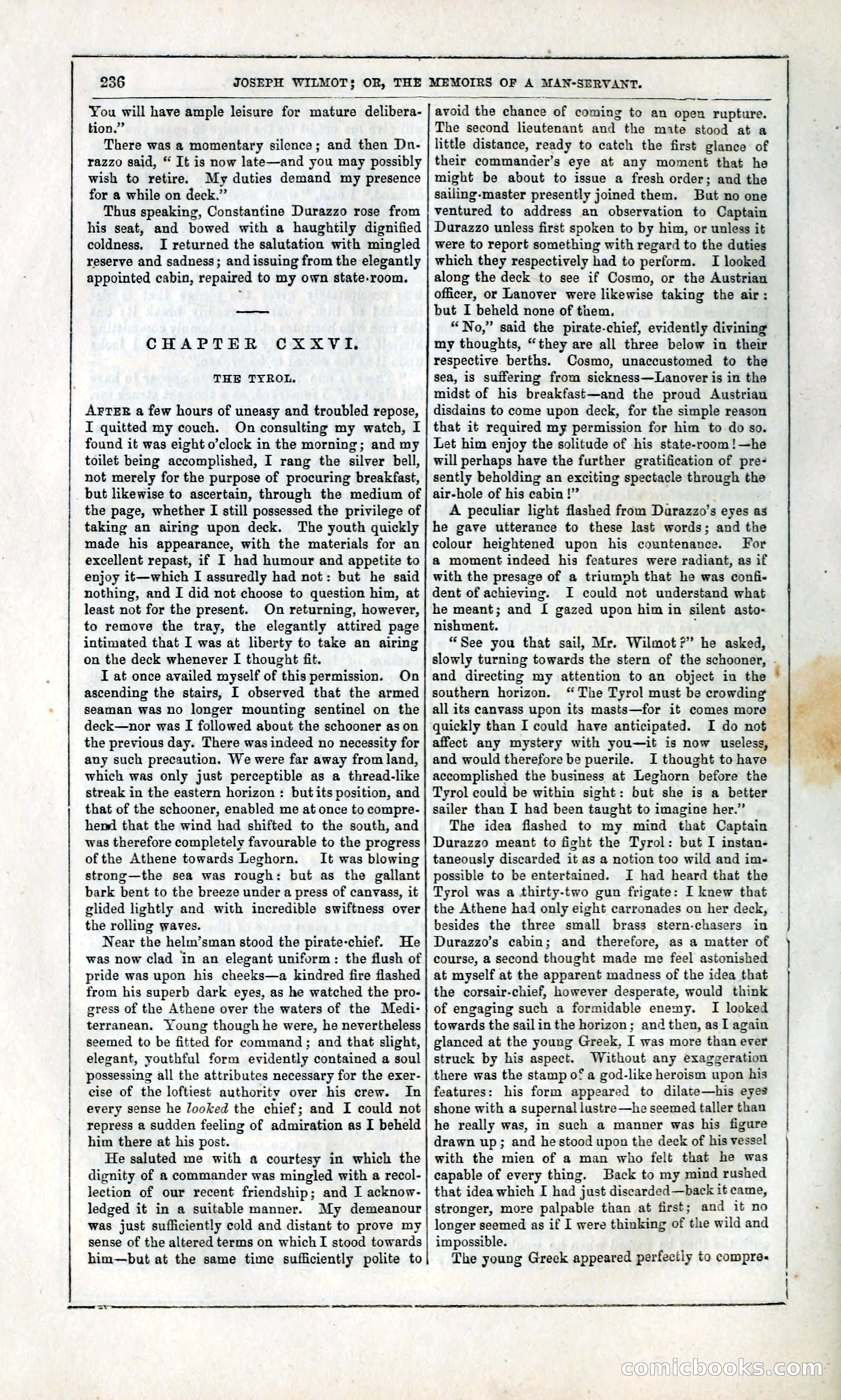
A restored page from Penny Dreadfuls, 1854. Page through the whole issue in the reader above.
📄 Transcribed text from this page (OCR, searchable)
Machine-transcribed from the original scan — historical spelling and the odd misread are preserved.
236 JOSEPH WILMOT;: OR, THE You will have ample leisure for mature delibera- tion.” There was a momentary silence; and then Dn- razzo said, “ It is now late—and you may possibly wish to retire. My duties demand my presence for a while on deck.” Thus speaking, Constantine Durazzo rose from his seat, and bowed with a haughtily dignified coldness. I returned the salutation with mingled reserve and sadness; and issuing from the elegantly appointed cabin, repaired to my own state-room. =a! CHAPTER CXXVI. THE TYROL. AFTER a few hours of uneasy and troubled repose, I quitted my couch. On consulting my watch, I found it was eight o’clock in the morning; and my toilet being accomplished, I rang the silver bell, not merely for the purpose of procuring breakfast, but likewise to ascertain, through the medium of the page, whether I still possessed the privilege of taking an airing upon deck. The youth quickly made his appearance, with the materials for an excellent repast, if I had humour and appetite to enjoy it—which I assuredly had not: but he said nothing, and I did not choose to question him, at least not for the present. On returning, however, to remove the tray, the elegantly attired page intimated that I was at liberty to take an airing on the deck whenever I thought fit. I at once availed myself of this permission. On ascending the stairs, I observed that the armed seaman was no longer mounting sentinel on the deck—nor was I followed about the schooner as on the previous day. There was indeed no necessity for any such precaution. We were far away from land, which was only just perceptible as a thread-like streak in the eastern horizon : butits position, and that of the schooner, enabled me at once to compre- hens that the wind had shifted to the south, and was therefore completely favourable to the progress ofthe Athene towards Leghorn. It was blowing strong—the sea was rough: but as the gallant bark bent to the breeze under a press of canvass, it glided lightly and with incredible swiftness over the rolling waves. Near the helm’sman stood the pirate-chief. He was now clad in an elegant uniform: the flush of pride was upon his cheeks—a kindred fire flashed from his superb dark eyes, as he watched the pro- gress of the Athene over the waters of the Medi- terranean. Young though he were, he nevertheless seemed to be fitted for command; and that slight, elegant, youthful form evidently contained a soul possessing all the attributes necessary for the exer- cise of the loftiest authority over his crew. In every sense he looked the chief; and I could not repress a sudden feeling of admiration as I beheld him there at his post. He saluted me with a courtesy in which the dignity of a commander was mingled with a recol- lection of our recent friendship; and I acknow- ledged it in a suitable manner. My demeanour was just sufficiently cold and distant to prove my sense of the altered terms on which I stood towards him—but at the same time sufficiently polite to MEMOIRS OF A MAN-SERVANT. SO _ — -—— avoid the chance of coming to an open rupture. The second lieutenant and the mate stood at a little distance, ready to catch the first glance of their commander’s eye at any moment that he might be about to issue a fresh order; and the sailing-master presently joined them. But no one ventured to address an observation to Captain Durazzo unless first spoken to by him, or unless it were to report something with regard to the duties which they respectively had to perform. I looked along the deck to see if Cosmo, or the Austrian officer, or Lanover were likewise taking the air: but I beheld none of tiem. “No,” said the pirate-chief, evidently divining my thoughts, “they are all three below in their respective berths. Cosmo, unaccustomed to the sea, is suffering from sickness—Lanover is in the midst of his breakfast—and the proud Austrian disdains to come upon deck, for the simple reason that it required my permission for him to do so. Let him enjoy the solitude of his state-room !—he will perhaps have the further gratification of pre- sently beholding an exciting spectacle through the air-hole of his cabin !” A peculiar light flashed from Durazzo’s eyes as he gave utterance to these last words; and the colour heightened upon his countenance. For & moment indeed his features were radiant, as if with the presage of a triumph that he was confi- dent of achieving. I could not understand what he meant; and I gazed upon him in silent asto- nishment. “See you that sail, Mr. Wilmot?” he asked, slowly turning towards the stern of the schooner, - and directing my attention to an object in the southern horizon. “The Tyrol must be crowding all its canvass upon its masts—for it comes more — quickly than I could have anticipated. I do not affect any mystery with you—it is now useless, and would therefore be puerile. I thought to have accomplished the business at Leghorn before the Tyrol could be within sight: but she is a better sailer than I had been taught to imagine her.” The idea flashed to my mind that Captain Durazzo meant to fight the Tyrol: but I instan- taneously discarded it as a notion too wild and im- possible to be entertained. I had heard that the Tyrol was a thirty-two gun frigate: I knew that the Athene had only eight carronades on her deck, besides the three small brass stern-chasers in Durazzo’s cabin; and therefore, as a matter of course, a second thought made me feel astonished at myself at the apparent madness of the idea that the corsair-chief, however desperate, would think of engaging such a formidable enemy. I looked towards the sail in the horizon; and then, as I again glanced at the young Greek, [ was more than ever struck by his aspect. Without any exaggeration there was the stamp o£ a god-like heroism upon his features: his form appeared to dilate—his eyes shone with a supernal lustre—he seemed taller than he really was, in such a manner was his figure drawn up; and hestood upon the deck of his vessel with the mien of a man who felt that he was capable of every thing. Back to my mind rushed that idea which I had just discarded—back it came, stronger, more palpable than at first; and it no longer seemed as if I were thinking of the wild and impossible. The young Greek appeared perfectly to compre DOOKS G . : , (0)