
Penny Dreadfuls, 1854 · page 232 of 399
Joseph Wilmot, or, The Memoirs of a Man-Servant — page 232: what you’re looking at
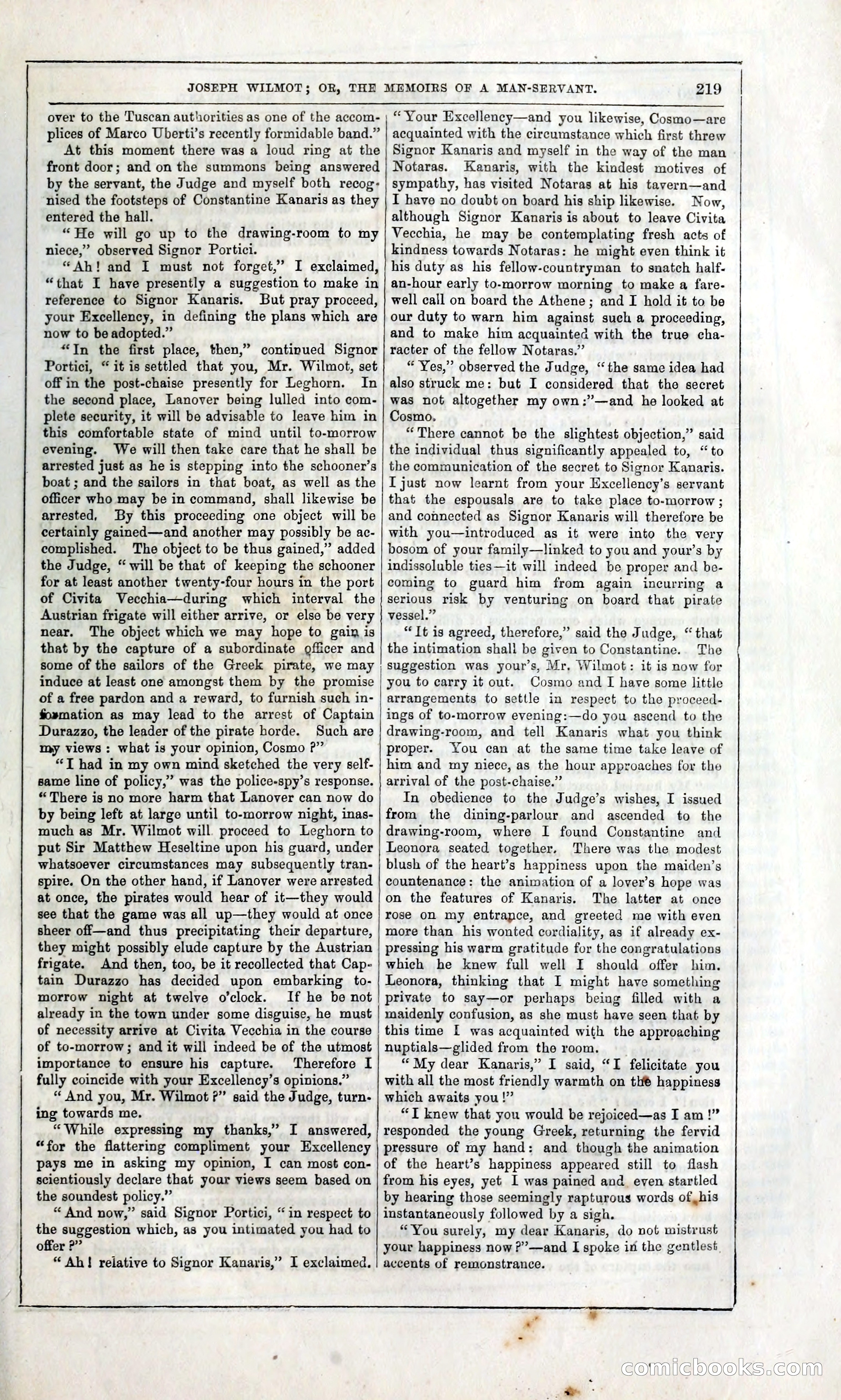
A restored page from Penny Dreadfuls, 1854. Page through the whole issue in the reader above.
📄 Transcribed text from this page (OCR, searchable)
Machine-transcribed from the original scan — historical spelling and the odd misread are preserved.
JOSEPH WILMOT; OR, THE MEMOIRS OF A MAN-SERVANT. 219 a over to the Tuscan authorities as one of the accom- | “ Your Excellency—and you likewise, Cosmo—are plices of Marco Uberti’s recently formidable band.” At this moment there was a loud ring at the front door; and on the summons being answered by the servant, the Judge and myself both recog: nised the footsteps of Constantine Kanaris as they entered the hall. “He will go up to the drawing-room to my niece,” observed Signor Portici. “Ah! and I must not forget,’ I exclaimed, “that I have presently a suggestion to make in reference to Signor Kanaris. But pray proceed, your Excellency, in defining the plans which are now to be adopted.” “Tn the first place, then,” continued Signor Portici, “ it is settled that you, Mr. Wilmot, set off in the post-chaise presently for Leghorn. In the second place, Lanover being lulled into com- plete security, it will be advisable to leave him in this comfortable state of mind until to-morrow evening. We will then take care that he shall be arrested just as he is stepping into the schooner’s boat ; and the sailors in that boat, as well as the officer who may be in command, shall likewise be arrested, By this proceeding one object will be certainly gained—and another may possibly be ac- complished. The object to be thus gained,” added the Judge, “will be that of keeping the schooner for at least another twenty-four hours in the port of Civita Vecchia—during which interval the Austrian frigate will either arrive, or else be very near. The object which we may hope to gain is that by the capture of a subordinate officer and some of the sailors of the Greek pirate, we may induce at least one amongst them by the promise of a free pardon and a reward, to furnish such in- foymation as may lead to the arrest of Captain Durazzo, the leader of the pirate horde. Such are my views : what is your opinion, Cosmo P” “T had in my own mind sketched the very self- same line of policy,” was the police-spy’s response. “There is no more harm that Lanover can now do by being left at large until to-morrow night, inas- much as Mr. Wilmot will proceed to Leghorn to put Sir Matthew Heseltine upon his guard, under whatsoever circumstances may subsequently tran- spire. On the other hand, if Lanover were arrested at once, the pirates would hear of it—they would see that the game was all up—they would at once sheer off—and thus precipitating their departure, they might possibly elude capture by the Austrian frigate. And then, too, be it recollected that Cap- tain Durazzo has decided upon embarking to- morrow night at twelve o’clock. If he be not already in the town under some disguise, he must of necessity arrive at Civita Vecchia in the course of to-morrow; and it will indeed be of the utmost importance to ensure his capture. Therefore I fully coincide with your Excellency’s opinions,” “ And you, Mr. Wilmot ?” said the Judge, turn- ing towards me, “While expressing my thanks,’ I answered, “for the flattering compliment your Excellency pays me in asking my opinion, I can most con- scientiously declare that your views seem based on the soundest policy.” : “ And now,” said Signor Portici, “in respect to the suggestion which, as you intimated you had to offer ?” “Ah! relative to Signor Kanaris,” I exclaimed. Se acquainted with the circumstance which first threw Signor Kanaris and myself in the way of the man Notaras. Kanaris, with the kindest motives of sympathy, has visited Notaras at his tayern—and I have no doubt on board his ship likewise. Now, although Signor Kanaris is about to leave Civita Vecchia, he may be contemplating fresh acts of kindness towards Notaras: he might even think it his duty as his fellow-countryman to snatch half- an-hour early to-morrow morning to make a fare- well call on board the Athene; and I hold it to be our duty to warn him against such a proceeding, and to make him acquainted with the true cha- racter of the fellow Notaras.”’ “ Yes,” observed the Judge, “the same idea had also struck me: but I considered that the secret was not altogether my own:”’—and he looked at Cosmo, “There cannot be the slightest objection,” said the individual thus significantly appealed to, “to the communication of the secret to Signor Kanaris. [just now learnt from your Excellency’s servant that the espousals are to take place to-morrow ; and connected as Signor Kanaris will therefore be with you—introduced as it were into the very bosom of your family—linked to you and your’s by indissoluble ties—it will indeed be proper and be- coming to guard him from again incurring a serious risk by venturing on board that pirate vessel.” “Tt is agreed, therefore,” said the Judge, “that the intimation shall be given to Constantine. The suggestion was your’s, Mr, Wilmot: it is now for you to carry it out. Cosmo and I have some little arrangements to settle in respect to the proceed- ings of to-morrow evening:—do you ascend to the drawing-room, and tell Kanaris what you think proper. You can at the same time take leave of him and my niece, as the hour approaches for the arrival of the post-chaise.” In obedience to the Judge’s wishes, I issued from the dining-parlour and ascended to the drawing-room, where I found Constantine and Leonora seated together. There was the modest blush of the heart’s happiness upon the maiden’s countenance: the animation of a lover’s hope was on the features of Kanaris. The latter at once rose on my entrance, and greeted me with even more than his wonted cordiality, as if already ex- pressing his warm gratitude for the congratulations which he knew full well I should offer him. Leonora, thinking that I might have something private to say—or perhaps being filled with a maidenly confusion, as she must have seen that by this time I was acquainted with the approaching nuptials—glided from the room. “My dear Kanaris,” I said, “I felicitate you with all the most friendly warmth on th happiness which awaits you!” “T knew that you would be rejoiced—as I am !” responded the young Greek, returning the fervid pressure of my hand: and though the animation of the heart’s happiness appeared still to flash from his eyes, yet I was pained and even startled by hearing those seemingly rapturous words of,his instantaneously followed by a sigh. “You surely, my dear Kanaris, do not mistrust your happiness now ?’—and I spoke in the gentlest, accents of remonstrance. Com ElO@QO €5) co