
Penny Dreadfuls, 1854 · page 231 of 399
Joseph Wilmot, or, The Memoirs of a Man-Servant — page 231: what you’re looking at
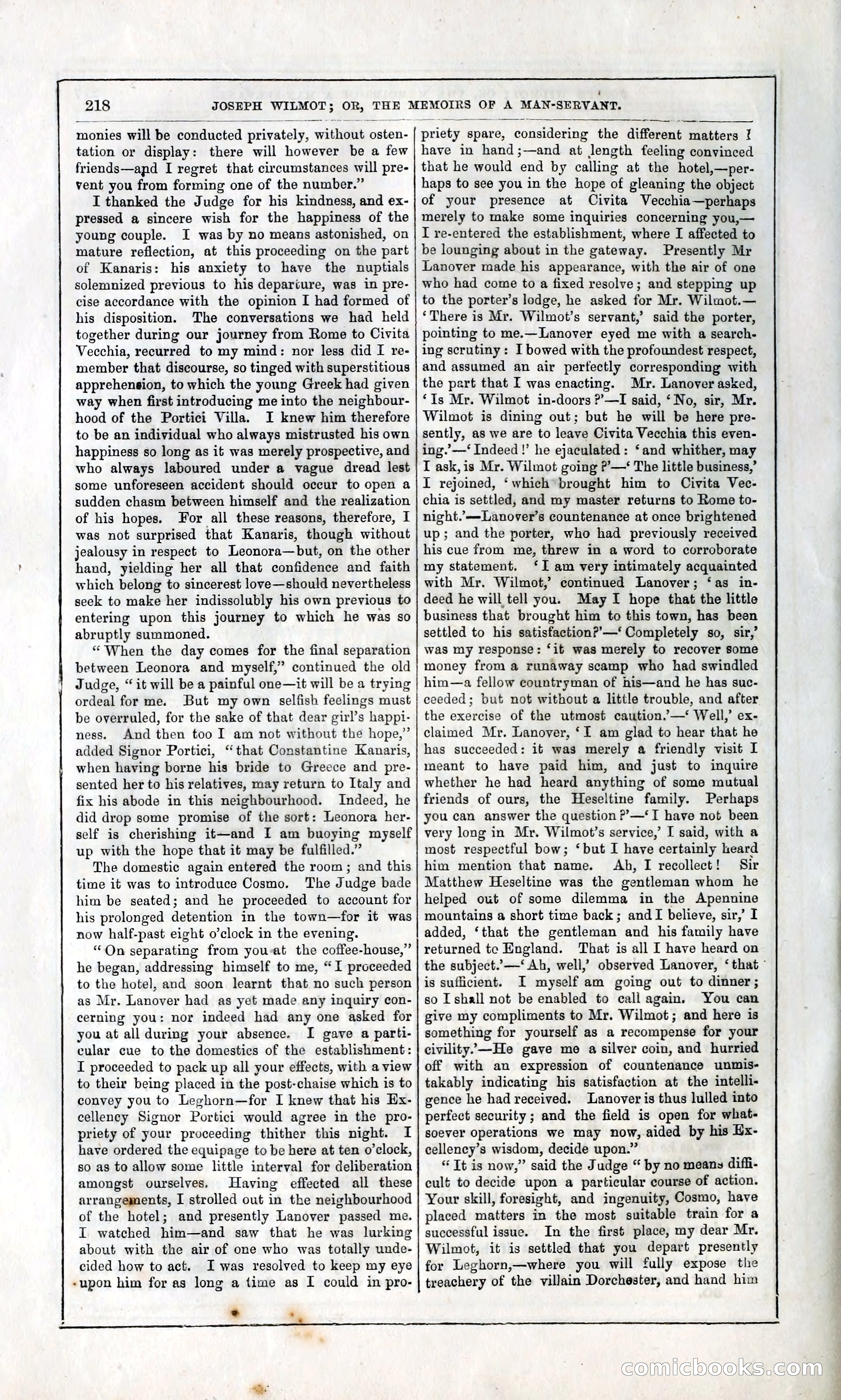
A restored page from Penny Dreadfuls, 1854. Page through the whole issue in the reader above.
📄 Transcribed text from this page (OCR, searchable)
Machine-transcribed from the original scan — historical spelling and the odd misread are preserved.
218 monies will be conducted privately, without osten- tation or display: there will however be a few friends—and I regret that circumstances will pre- vent you from forming one of the number.” I thanked the Judge for his kindness, and ex- pressed a sincere wish for the happiness of the young couple. I was by no means astonished, on mature reflection, at this proceeding on the part of Kanaris: his anxiety to have the nuptials solemnized previous to his departure, was in pre- cise accordance with the opinion I had formed of his disposition. The conversations we had held together during our journey from Rome to Civita Vecchia, recurred to my mind: nor less did I re- member that discourse, so tinged with superstitious apprehension, to which the young Greek had given way when first introducing me into the neighbour- hood of the Portici Villa. I knew him therefore to be an individual who always mistrusted his own happiness so long as it was merely prospective, and who always laboured under a vague dread lest some unforeseen accident should occur to open a sudden chasm between himself and the realization of his hopes. For all these reasons, therefore, I was not surprised that Kanaris, though without jealousy in respect to Leonora—but, on the other hand, yielding her all that confidence and faith which belong to sincerest love—should nevertheless seek to make her indissolubly his own previous to entering upon this journey to which he was so abruptly summoned. “When the day comes for the final separation between Leonora and myself,’ continued the old Judge, “it will be a painful one—it will be a trying ordeal for me. But my own selfish feelings must be overruled, for the sake of that dear girl’s happi- ness. And then tooI am not without the hope,” added Signor Portici, ‘that Constantine Kanaris, when having borne his bride to Greece and pre- sented her to his relatives, may return to Italy and fix his abode in this neighbourhood. Indeed, he did drop some promise of the sort: Leonora her- self is cherishing it—and I am buoying myself up with the hope that it may be fulfilled.” The domestic again entered the room; and this time it was to introduce Cosmo. The Judge bade him be seated; and he proceeded to account for his prolonged detention in the town—for it was now half-past eight o’clock in the evening. “On separating from you-at the coffee-house,” he began, addressing himself to me, “I proceeded to the hotel, and soon learnt that no such person as Mr. Lanover had as yet made any inquiry con- cerning you: nor indeed had any one asked for you at all during your absence. I gave a parti- cular cue to the domestics of the establishment: I proceeded to pack up all your effects, with a view to their being placed in the post-chaise which is to convey you to Leghorn—for I knew that his Ex- eellency Signor Portici would agree in the pro- priety of your proceeding thither this night. I have ordered the equipage to be here at ten o'clock, so as to allow some little interval for deliberation amongst ourselves. Having effected all these arrangements, I strolled out in the neighbourhood of the hotel; and presently Lanover passed me. I watched him—and saw that he was lurking about with the air of one who was totally unde- cided how to act. I was resolved to keep my eye -upon him for as long a time as I could in pro- JOSEPH WILMOT; OR, THE MEMOIRS OF A MAN-SERVANT. ee SS —_—_——- —- priety spare, considering the different matters { have in hand;—and at length feeling convinced that he would end by calling at the hotel,—per- haps to see you in the hope of gleaning the object of your presence at Civita Vecchia—perhaps merely to make some inquiries concerning you,— I re-entered the establishment, where I affected to be lounging about in the gateway. Presently Mr Lanover made his appearance, with the air of one who had come to a fixed resolve; and stepping up to the porter’s lodge, he asked for Mr. Wilmot.— ‘There is Mr. Wilmot’s servant,’ said the porter, pointing to me.—Lanover eyed me with a search- ing scrutiny: I bowed with the profoundest respect, and assumed an air perfectly corresponding with the part that I was enacting. Mr. Lanover asked, ‘Is Mr. Wilmot in-doors ??—I said, ‘No, sir, Mr. Wilmot is dining out; but he will be here pre- sently, as we are to leave Civita Vecchia this even- ing.’—‘ Indeed!’ he ejaculated: ‘and whither, may I ask, is Mr. Wilmot going ?’—*‘ The little business,’ I rejoined, ‘which brought him to Civita Vec- chia is settled, and my master returns to Rome to- night.’—Lanover’s countenance at once brightened up ; and the porter, who had previously received his cue from me, threw in a word to corroborate my statement. ‘I am very intimately acquainted with Mr. Wilmot,’ continued Lanover; ‘as in- deed he will tell you. May I hope that the little business that brought him to this town, has been settled to his satisfaction?’—‘ Completely so, sir,’ was my response: ‘it was merely to recover some money from a runaway scamp who had swindled him—a fellow countryman of his—and he has suc- ceeded; but not without a little trouble, and after the exercise of the utmost caution.’—‘ Well,’ ex- claimed Mr. Lanover, ‘I am glad to hear that he has succeeded: it was merely a friendly visit I meant to have paid him, and just to inquire whether he had heard anything of some mutual friends of ours, the Heseltine family. Perhaps you can answer the question P’—‘T have not been very long in Mr. Wilmot’s service,’ I said, with a most respectful bow; ‘but I have certainly heard him mention that name. Ah, I recollect! Sir Matthew Heseltine was the gentleman whom he helped out of some dilemma in the Apennine mountains a short time back; andI believe, sir,’ I added, ‘that the gentleman and his family have returned te England. That is all I have heard on the subject.’—‘ Ah, well,’ observed Lanover, ‘that is sufficient. I myself am going out to dinner; so I shall not be enabled to call again. You can give my compliments to Mr. Wilmot; and here is something for yourself as a recompense for your civility. —He gave me a silver coin, and hurried off with an expression of countenance unmis- takably indicating his satisfaction at the intelli- gence he had received. ‘Lanover is thus lulled into perfect security ; and the field is open for what- soever operations we may now, aided by his Hx- cellency’s wisdom, decide upon.” “It is now,” said the Judge “ by no means diffi- cult to decide upon a particular course of action. Your skill, foresight, and ingenuity, Cosmo, have placed matters in the most suitable train for a successful issue. In the first place, my dear Mr. Wilmot, it is settled that you depart presently for Leghorn,—where you will fully expose the treachery of the villain Dorchester, and hand him <S Giyoo (CO)