
Penny Dreadfuls, 1854 · page 216 of 399
Joseph Wilmot, or, The Memoirs of a Man-Servant — page 216: what you’re looking at
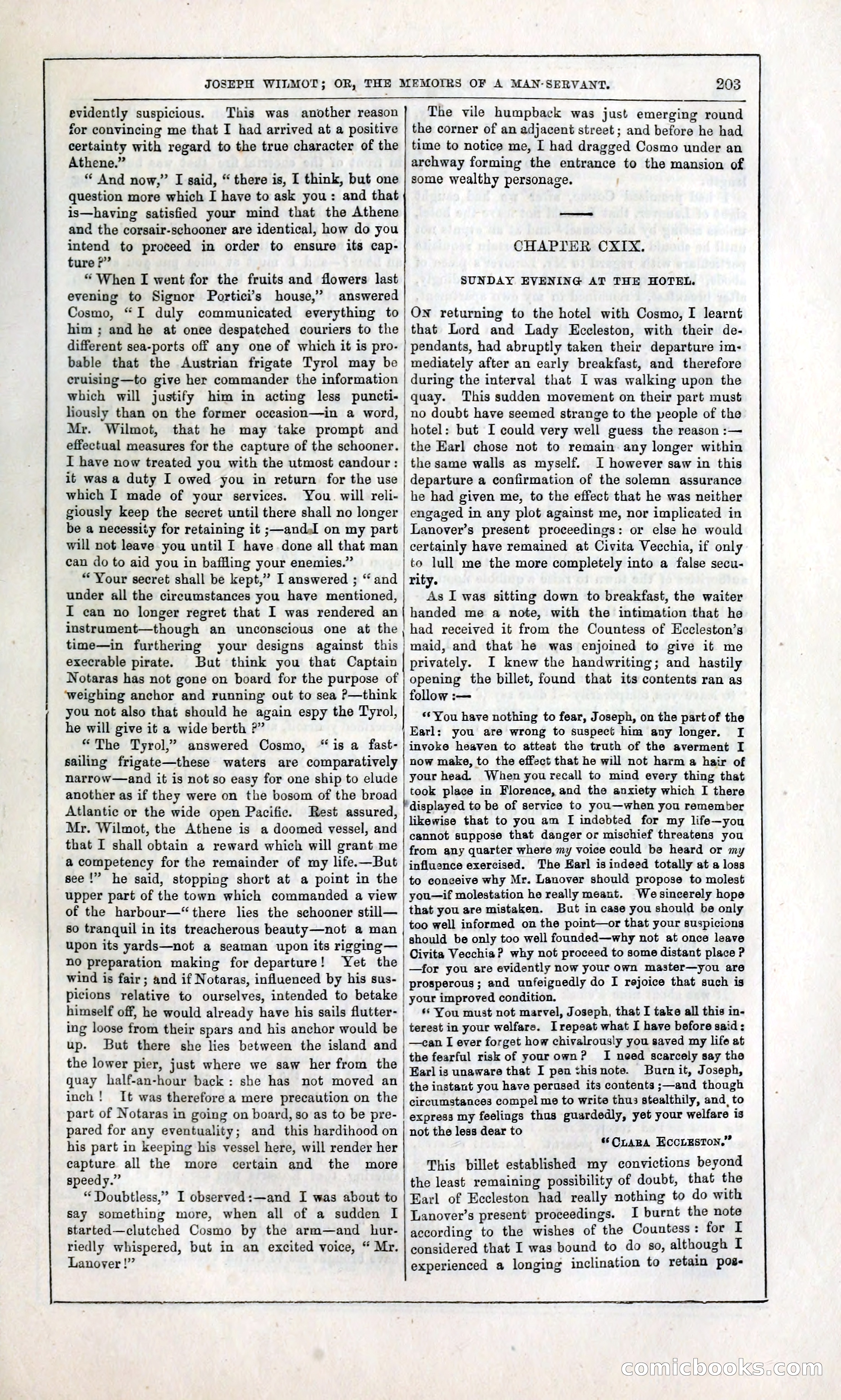
A restored page from Penny Dreadfuls, 1854. Page through the whole issue in the reader above.
📄 Transcribed text from this page (OCR, searchable)
Machine-transcribed from the original scan — historical spelling and the odd misread are preserved.
JOSEPH WILMOT; OR, THE MEMOIRS OF A MAN-SERVANT. 203 evidently suspicious. This was another reason for convincing me that I had arrived at a positive certainty with regard to the true character of the Athene.” “ And now,” I said, “ there is, I think, but one question more which I have to ask you: and that is—having satisfied your mind that the Athene and the corsair-schooner are identical, how do you intend to proceed in order to ensure its cap- ture ?” “ When I went for the fruits and flowers last evening to Signor Portici’s house,” answered Cosmo, “I duly communicated everything to him ; and he at once despatched couriers to the different sea-ports off any one of which it is pro- bable that the Austrian frigate Tyrol may be eruising—to give her commander the information which will justify him in acting less puncti- liously than on the former occasion—in a word, Mr. Wilmot, that he may take prompt and effectual measures for the capture of the schooner. I have now treated you with the utmost candour : it was a duty I owed you in return for the use which I made of your services. You. will reli- giously keep the secret until there shall no longer be a necessity for retaining it ;—andel on my part will not leave you until I have done all that man can do to aid you in baffling your enemies.” “Your secret shall be kept,” I answered ; “ and under all the cireumstances you have mentioned, I can no longer regret that I was rendered an instrument—though an unconscious one at the time—in furthering your designs against this execrable pirate. But think you that Captain Notaras has not gone on board for the purpose of weighing anchor and running out to sea P—think you not also that should he again espy the Tyrol, he will give it a wide berth ?” “The Tyrol,” answered Cosmo, “is a fast- sailing frigate—these waters are comparatively narrow—and it is not so easy for one ship to elude another as if they were on the bosom of the broad Atlantic or the wide open Pacific. Rest assured, Mr. Wilmot, the Athene is a doomed vessel, and that I shall obtain a reward which will grant me a competency for the remainder of my life.—But see !” he said, stopping short at a point in the upper part of the town which commanded a view of the harbour—“ there lies the schooner still— so tranquil in its treacherous beauty—not a man upon its yards—not a seaman upon its rigging— no preparation making for departure! Yet the wind is fair; and if Notaras, influenced by his sus- picions relative to ourselves, intended to betake himself off, he would already have his sails flutter- | ing loose from their spars and his anchor would be | terest in your welfare. Irepeat what I have before said: up. But there she lies between the island and | —can I ever forget how chivalrously you saved my life at the lower pier, just where we saw her from the quay half-an-hour back: she has not moved an inch! It was therefore a mere precaution on the part of Notaras in going on board, so as to be pre- pared for any eventuality; and this hardihood on | not the less dear to his part in keeping his vessel here, will render her capture all the more certain and the more speedy.” | The vile humpback was just emerging round the corner of an adjacent street ; and before he had time to notice me, I had dragged Cosmo under an archway forming the entrance to the mansion of some wealthy personage. CHAPTER CXIX. SUNDAY EVENING AT THE HOTEL. ON returning to the hotel with Cosmo, I learnt that Lord and Lady Eccleston, with their de- pendants, had abruptly taken their departure im: mediately after an early breakfast, and therefore during the interval that I was walking upon the quay. This sudden movement on their part must no doubt have seemed strange to the people of the hotel: but I could very well guess the reason :— the Earl chose not to remain any longer within the same walls as myself. I however saw in this departure a confirmation of the solemn assurance he had given me, to the effect that he was neither engaged in any plot against me, nor implicated in Lanover’s present proceedings: or else he would certainly have remained at Civita Vecchia, if only to lull me the more completely into a false secu- rity. As I was sitting down to breakfast, the waiter handed me a note, with the intimation that he had received it from the Countess of Eccleston’s maid, and that he was enjoined to give it me privately. I knew the handwriting; and hastily opening the billet, found that its contents ran as follow :— **You have nothing to fear, Joseph, on the part of the Earl: you are wrong to suspect him any longer. [I invoke heaven to attest the truth of the averment I now make, to the effect that he will not harm a hair of your head. When yourecall to mind every thing that took place in Florence, and the anxiety which I there displayed to be of service to you—when you remember likewise that to you am [I indebted for my life—you cannot suppose that danger or mischief threatens you from any quarter where my voice could be heard or my influence exercised. The Karl is indeed totally at a loss to conceive why Mr. Lanover should propose to molest you—if molestation he really meant. Wesincerely hope that you are mistaken. But in case you should be only too well informed on the point—or that your suspicions should be only too well founded—why not at once leave Civita Vecchia? why not proceed to some distant place P —for you are evidently now your own master—you are prosperous; and unfeignedly do I rejoice that such is your improved condition. ‘* You must not marvel, Joseph, that I take all this in- the fearful risk of yourown? I need scarcely say the Earl is unaware that I pen thisnote. Burnit, Joseph, the instant you have perused its contents ;—and though circumstances compel me to write thus stealthily, and, to express my feelings thus guardedly, yet your welfare is * OLARA ECCLESTON.” This billet established my convictions beyond the least remaining possibility of doubt, that the “ Doubtless,” I observed:—and I was about to | Harl of Eccleston had really nothing to do with say something more, when all of a sudden I | Lanover’s present proceedings. I burnt the note started—clutched Cosmo by the arm—and hur-| according to the wishes of the Countess: for I riedly whispered, but in an excited voice, “ Mr. | considered that I was bound to do so, although I Lanover !” experienced a longing inclination to retain pos- OOO) (C CS (C@