
Penny Dreadfuls, 1854 · page 215 of 399
Joseph Wilmot, or, The Memoirs of a Man-Servant — page 215: what you’re looking at
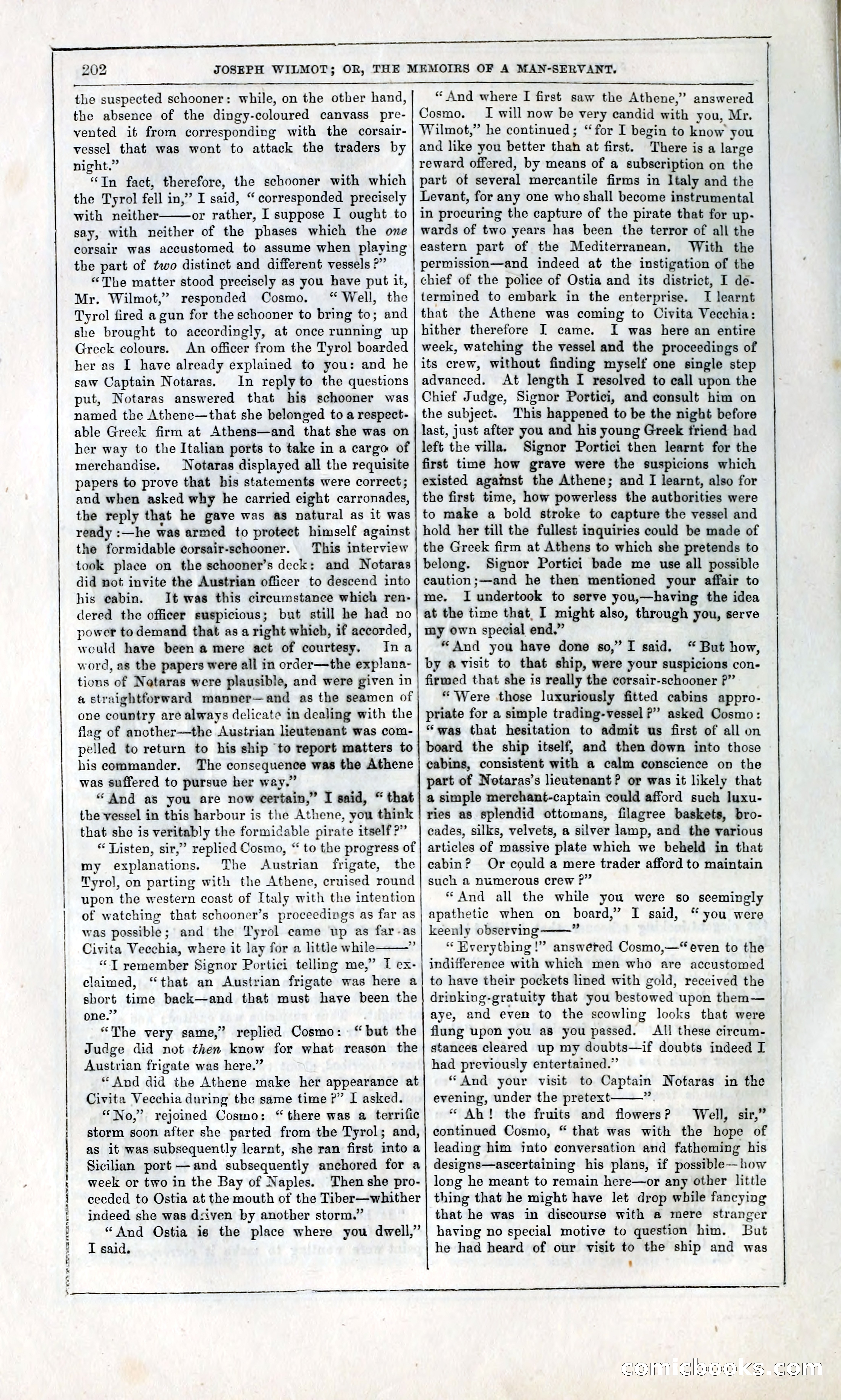
A restored page from Penny Dreadfuls, 1854. Page through the whole issue in the reader above.
📄 Transcribed text from this page (OCR, searchable)
Machine-transcribed from the original scan — historical spelling and the odd misread are preserved.
C8 re a a ee eee ee ee SD | 202 JOSEPH WILMOT; OR, THE MEMOIRS OF A MAN-SERVANT. ————— ee OOO EE LL the suspected schooner: while, on the otber hand, “And where I first saw the Athene,” answered the absence of the dingy-coloured canvass pre-| Cosmo. I will now be very candid with you, Mr. vented it from corresponding with the corsair- | Wilmot,” he continued; “for I begin to know you vessel that was wont to attack the traders by | and like you better thah at first. There is a large night.” reward offered, by means of a subscription on the “In fact, therefore, the schooner with which | part of several mercantile firms in Italy and the the Tyrol fell in,” I said, “ corresponded precisely | Levant, for any one who shall become instrumental with neither or rather, I suppose I ought to | in procuring the capture of the pirate that for up- say, with neither of the phases which the one | wards of two years has been the terror of all the corsair was accustomed to assume when playing | eastern part of the Mediterranean. With the the part of two distinct and different vessels ?”’ permission—and indeed at the instigation of the “The matter stood precisely as you have put it, | chief of the police of Ostia and its district, I de- Mr. Wilmot,” responded Cosmo. ‘“ Well, the | termined to embark in the enterprise. I learnt Tyrol fired a gun for the schooner to bring to; and| that the Athene was coming to Civita Vecchia: she brought to accordingly, at once running up| hither therefore I came. I was here an entire Greek colours. An officer from the Tyrol boarded | week, watching the vessel and the proceedings of her as I have already explained to you: and he|its crew, without finding myself one single step saw Captain Notaras. In reply to the questions | advanced. At length I resolved to call upon the put, Notaras answered that his schooner was | Chief Judge, Signor Portici, and consult him on named the Athene—that she belonged toa respect- | the subject. This happened to be the night before able Greek firm at Athens—and that she was on | last, just after you and his young Greek friend had her way to the Italian ports to take in a cargo of | left the villa. Signor Portici then learnt for the merchandise. Notaras displayed all the requisite | first time how grave were the suspicions which papers to prove that his statements were correct; | existed against the Athene; and I learnt, also for and when asked why he carried eight carronades, | the first time, how powerless the authorities were the reply that he gave was as natural as it was|to make a bold stroke to capture the vessel and ready :—he was armed to protect himself against | hold her till the fullest inquiries could be made of the formidable corsair-schooner. This interview | the Greek firm at Athens to which she pretends to took place on the schooner’s deck: and Notaras| belong. Signor Portici bade me use all possible did not invite the Austrian officer to descend into | caution;—and he then mentioned your affair to his cabin. It was this circumstance which ren-| me. I undertook to serve you,—having the idea dered the officer suspicious; but still he had no| at the time that. I might also, through you, serve powet todemand that as a right which, if accorded, | my own special end,” would have been @ mere act of courtesy. Ina ‘And you have done so,” I said. “ But how, word, as the papers were all in order—the explana- | by a visit to that ship, were your suspicions con- tions of Netaras were plausible, and were given in | firmed that she is really the corsair-schooner P” a straightforward manner—and as the seamen of| “ Were those luxuriously fitted cabins appro- one country are always delicate in dealing with the | priate for a simple trading-vessel ?” asked Cosmo: flag of another—the Austrian lieutenant was com-| “was that hesitation to admit us first of all on pelled to return to his ship ‘to report matters to| board the ship itself, and then down into those his commander. The consequence was the Athene | cabins, consistent with a calm conscience on the was suffered to pursue her way.” part of Notaras’s lieutenant? or was it likely that “And as you are now certain,” I said, “ that| a simple merehant-captain could afford such luxu- the vessel in this harbour is the Athene, you think | ries as splendid ottomans, filagree baskets, bro- that she is veritably the formidable pirate itself?” | cades, silks, velvets, a silver lamp, and the various “Listen, sir,” replied Cosmo, “ to the progress of | articles of massive plate which we beheld in that my explanations. The Austrian frigate, the} cabin? Or could a mere trader afford to maintain Tyrol, on parting with the Athene, cruised round | such a numerous crew P” upon the western coast of Italy with the intention “And all the while you were so seemingly of watching that schooner’s proceedings as far as| apathetic when on board,” I said, “you were was possible; and the Tyrol came up as far-as| keenly observing > Civita Vecchia, where it lay for a little while Y “ Everything!” answered Cosmo,—“ even to the “TI remember Signor Portici telling me,” I ex- indifference with which men who are accustomed claimed, “that an Austrian frigate was here a to have their pockets lined with gold, received the short time back—and that must have been the} drinking-gratuity that you bestowed upon them— one.” aye, and even to the scowling looks that were “The very same.” replied Cosmo: “but the y > p flung upon you as you passed. All these circum- Judge did not then know for what reason the| stances cleared up my doubts—if doubts indeed I Austrian frigate was here.” had previously entertained.” * And did the Athene make her appearance at “And your visit to Captain Notaras in the Civita Vecchia during the same time ?” I asked. evening, under the pretext ¥. “No,” rejoined Cosmo: “there was a terrific] “ Ah! the fruits and flowers? Well, sir,” storm soon after she parted from the Tyrol; and,| continued Cosmo, “ that was with the hope of as it was subsequently learnt, she ran first into a| leading him into conversation and fathoming his Sicilian port —and subsequently anchored for a} designs—ascertaining his plans, if possible—how week or two in the Bay of Naples. Then she pro- long he meant to remain here—or any other little ceeded to Ostia at the mouth of the Tiber—whither | thing that he might have let drop while fancying indeed she was dsiven by another storm.” that he was in discourse with a mere stranger “And Ostia is the place where you dwell,’ | having no special motive to question him. But I said. he had heard of our visit to the ship and was ' 2 Seen ee En COMmmicoaoolks (C@)