
Penny Dreadfuls, 1854 · page 67 of 394
Joseph Wilmot, or, The Memoirs of a Man-Servant — page 67: what you’re looking at
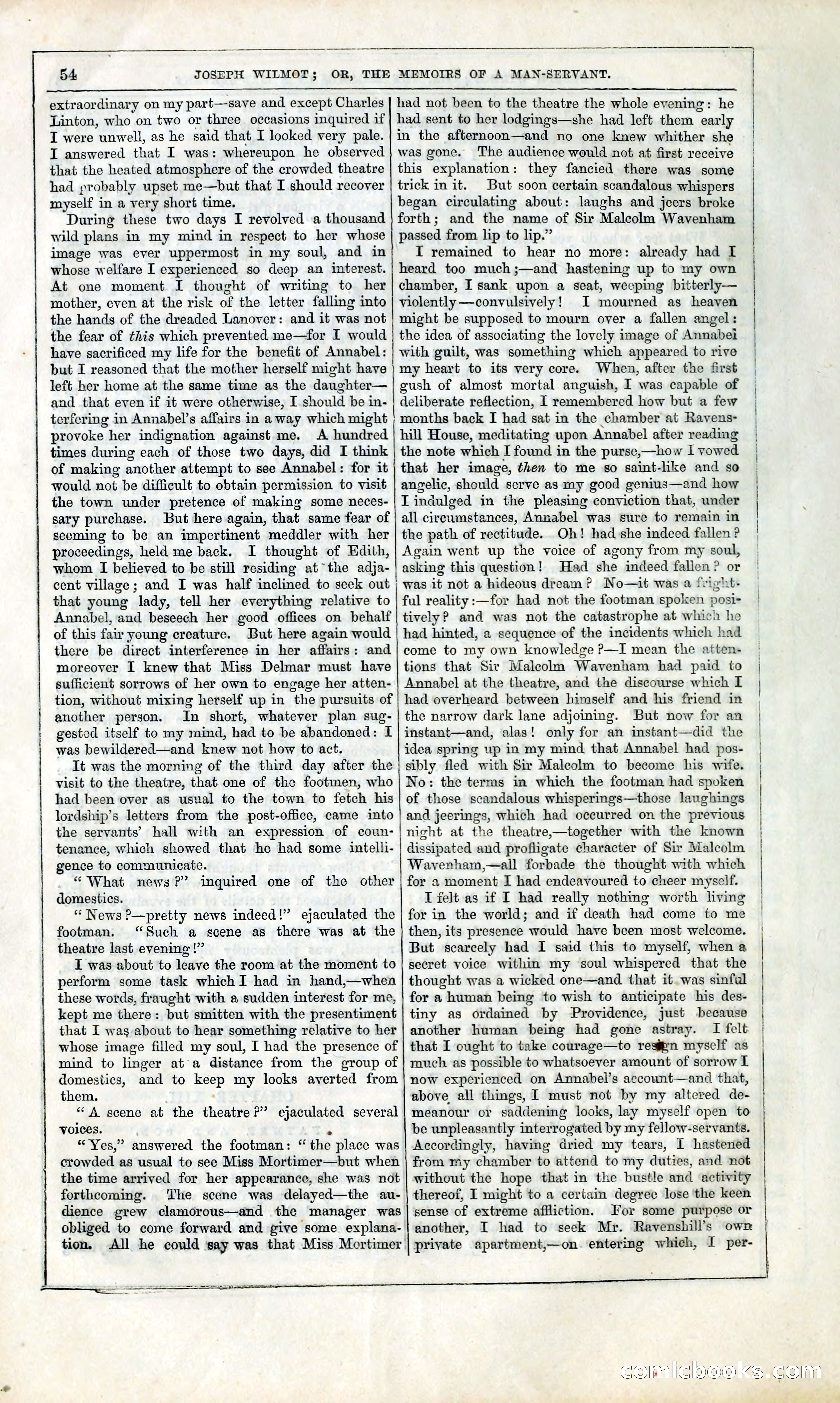
A restored page from Penny Dreadfuls, 1854. Page through the whole issue in the reader above.
📄 Transcribed text from this page (OCR, searchable)
Machine-transcribed from the original scan — historical spelling and the odd misread are preserved.
54: JOSEPH WILMOT; OR, THE MEMOIRS OF A MAN-SERVANT. extraordinary on my part—save and except Charles Linton, who on two or three occasions inquired if I were unwell, as he said that I looked very pale. I answered that I was: whereupon he observed that the heated atmosphere of the crowded theatre had probably upset me—but that I should recover myself in a very short time. During these two days I revolved a thousand wild plans in my mind in respect to her whose image was ever uppermost in my soul, and in whose welfare I experienced so deep an interest. At one moment I thought of writing to her mother, even at the risk of the letter falling into the hands of the dreaded Lanover: and it was not the fear of this which prevented me—for I would have sacrificed my life for the benefit of Annabel: but I reasoned that the mother herself might have left her home at the same time as the daughter— and that even if it were otherwise, I should be in- terfering in Annabel’s affairs in a way which might provoke her indignation against me. A hundred times during each of those two days, did I think of making another attempt to see Annabel: for it would not be difficult to obtain permission to visit the town under pretence of making some neces- sary purchase. But here again, that same fear of seeming to be an impertinent meddler with her proceedings, held me back. I thought of Edith, whom I believed to be still residing atthe adja- cent village; and I was half inclined to seek out that young lady, tell her everything relative to Annabel, and beseech her good offices on behalf of this fair young creature. But here again would there be direct interference in her affairs: and moreover I knew that Miss Delmar must have sufficient sorrows of her own to engage her atten- tion, without mixing herself up in the pursuits of another person. In short, whatever plan sug- gested itself to my mind, had to be abandoned: I was bewildered—and knew not how to act. It was the morning of the third day after the visit to the theatre, that one of the footmen, who had been over as usual to the town to fetch his lordship’s letters from the post-office, came into the servants’ hall with an expression of coun- tenance, which showed that he had some intelli- gence to communicate. “ What news?” inquired one of the other domestics. “ News P—pretty news indeed!” ejaculated the footman. “Such a scene as there was at the theatre last evening !”’ I was about to leave the room at the moment to perform some task which I had in hand,—when these words, fraught with a sudden interest for me, kept me there: but smitten with the presentiment that I was about to hear something relative to her whose image filled my soul, I had the presence of mind to linger at a distance from the group of domestics, and to keep my looks averted from them. : , “A scene at the theatre?’ ejaculated several voices. " “Yes,” answered the footman: “ the place was crowded as usual to see Miss Mortimer—but when the time arrived for her appearance, she was not forthcoming. The scene was delayed—the au- dience grew clamorous—and the manager was obliged to come forward and give some explana- tion. All he could say was that Miss Mortimer had not been to the theatre the whole evening: he had sent to her lodgings—she had left them early in the afternoon—and no one knew whither she was gone. The audience would not at first receive this explanation: they fancied there was some trick in it. But soon certain scandalous whispers began circulating about: laughs and jeers broke forth; and the name of Sir Malcolm Wavenham passed from lip to lip.” I remained to hear no more: already had I heard too much ;—and hastening up to my own chamber, I sank upon a seat, weeping bitterly— violently —convulsively! I mourned as heaven might be supposed to mourn over a fallen angel: the idea of associating the lovely image of Annabel with guilt, was something which appeared to rive my heart to its very core. When, after the first gush of almost mortal anguish, I was capable of deliberate reflection, I remembered how but a few months back I had sat in the chamber at Ravens- hill House, meditating upon Annabel after reading the note which I found in the purse,—how I vowed that her image, then to me so saint-like and so angelic, should serve as my good genius—and how T indulged in the pleasing conviction that, under all circumstances, Annabel was sure to remain in the path of rectitude. Oh! had she indeed fallen ? Again went up the voice of agony from my soul, asking this question! Had she imdeed fallen? or was it not a hideous dream? No—it was a fright- ful reality :—for had not the footman spoken posi- tively? and was not the catastrophe at which he had hinted, a sequence of the incidents which had come to my own knowledge ?—I mean the atten- tions that Sir Maleolm Wavenham had paid to Annabel at the theatre, and the discourse which I had overheard between himself and his friend in the narrow dark lane adjoinmg. But now for an instant—and, alas! only for an imstant—did the idea spring up in my mind that Annabel had pos- sibly fled with Sir Maleolm to become his wife. No: the terms in which the footman had spoken of those scandalous whispermes—those laughings and jeerings, which had occurred on the previous night at the theatre,—together with the known dissipated and profligate character of Sir Malcolm Wavenham,—all forbade the thought with which for 2 moment I had endeavoured to cheer myself. I felt as if I had really nothmg worth lhving for in the world; and if death had come to me then, its presence would have been most welcome. But scarcely had I said this to myself, when a secret voice within my soul whispered that the thought was a wicked one—and that it.was sinful for a human being to wish to anticipate his des- tiny as ordained by Providence, just because another human being had gone astray. I felt that I ought to take courage—to ren myself as much as possible to whatsoever amount of sorrow L now experienced on Annabel’s account—and that, above all things, I must not by my altcred de- meanour or saddening looks, lay myself open to be unpleasantly interrogated by my fellow-servants. Accordingly, having dried my tears, I hastened from my chamber to attend to my duties, and not without the hope that in the bustle and activity thereof, I might to a certain degree lose ‘the keen sense of extreme affliction. For some purpose or enother, I had to seek Mr. Ravenshill’s own private apartment,—on. entering which, I per- = — eee eee ees epee a a i a I eer pea ET TL aA A . a _ OOO) cS (C@) im