
Penny Dreadfuls, 1854 · page 66 of 394
Joseph Wilmot, or, The Memoirs of a Man-Servant — page 66: what you’re looking at
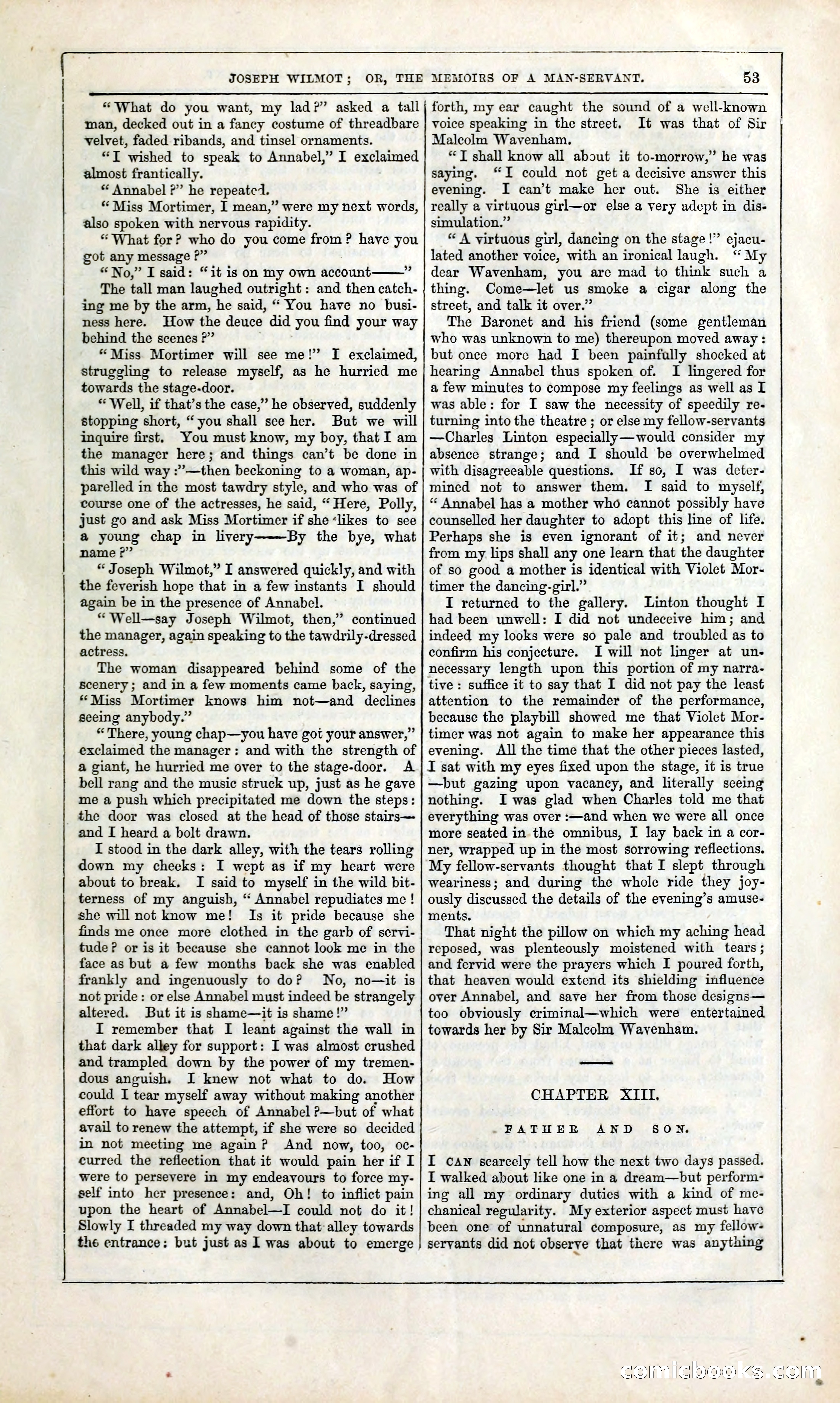
A restored page from Penny Dreadfuls, 1854. Page through the whole issue in the reader above.
📄 Transcribed text from this page (OCR, searchable)
Machine-transcribed from the original scan — historical spelling and the odd misread are preserved.
JOSEPH WILMOT; OR, THE MEMOIRS OF A MAN-SERVANT. 53 * What do you want, my lad?” asked a tall man, decked out in a fancy costume of threadbare velvet, faded ribands, and tinsel ornaments. “JT wished to speak to Annabel,” I exclaimed almost frantically. ** Annabel ?” he repeated. ** Miss Mortimer, I mean,” were my next words, also spoken with nervous rapidity. “ What for? who do you come from? have you got any message ?” “No,” I said: “it is on my own account The tall man laughed outright: and then catch- ing me by the arm, he said, “ You have no busi- ness here. How the deuce did you find your way behind the scenes ?” ** Miss Mortimer will see me!” I exclaimed, struggling to release myself, as he hurried me towards the stage-door. *‘ Well, if that’s the case,” he observed, suddenly stopping short, “you shall see her. But we will inquire first. You must know, my boy, that I am the manager here; and things can’t be done in this wild way :’—then beckoning to a woman, ap- parelled in the most tawdry style, and who was of course one of the actresses, he said, “Here, Polly, just go and ask Miss Mortimer if she ‘likes to see a young chap in livery By the bye, what name ?” “ Joseph Wilmot,” I answered quickly, and with the feverish hope that in a few instants I should again be in the presence of Annabel. “ Well—say Joseph Wilmot, then,” continued the manager, again speaking to the tawdrily-dressed actress. The woman disappeared behind some of the Scenery ; and in a few moments came back, saying, **Miss Mortimer knows him not—and declines seeing anybody.” “There, young chap—you have got your answer,” exclaimed the manager: and with the strength of a giant, he hurried me over to the stage-door. A bell rang and the music struck up, just as he gave me a push which precipitated me down the steps: ad Ps] _ the door was closed at the head of those stairs— and I heard a bolt drawn. I stood in the dark alley, with the tears rolling down my cheeks: I wept as if my heart were about to break. I said to myself in the wild bit- terness of my anguish, “ Annabel repudiates me ! she will not know me! Is it pride because she finds me once more clothed in the garb of servi- tude? or is it because she cannot look me in the face as but a few months back she was enabled frankly and ingenuously to do? No, no—it is not pride : or else Annabel must indeed be strangely altered. But it is shame—it is shame!” I remember that I leant against the wall in that dark alley for support: I was almost crushed and trampled down by the power of my tremen- dous anguish. I knew not what to do. How could I tear myself away without making another effort to have speech of Annabel ?—but of what avail to renew the attempt, if she were so decided in not meeting me againP And now, too, oc- curred the reflection that it would pain her if I were to persevere in my endeavours to force my- self into her presence: and, Oh! to inflict pain upon the heart of Annabel—I could not do it! Slowly I threaded my way down that: alley towards the entrance: but just as 1 was about to emerge forth, my ear caught the sound of a well-known voice speaking in the street. It was that of Sir Malcolm Wavenham. *T shall know all about it to-morrow,” he was saying. “I could not get a decisive answer this evening. I can’t make her out. She is either really a virtuous girl—or else a very adept in dis- simulation.” “ A virtuous girl, dancing on the stage!” ejacu- lated another voice, with an ironical laugh. “My dear Wavenham, you are mad to think such a thing. Come—let us smoke a cigar along the street, and talk it over.” The Baronet and his friend (some gentleman who was unknown to me) thereupon moved away : but once more had I been painfully shocked at hearing Annabel thus spoken of. I lingered for a few minutes to compose my feelings as well as I was able: for I saw the necessity of speedily re- turning into the theatre ; or else my fellow-servants —Charles Linton especially—would consider my absence strange; and I should be overwhelmed with disagreeable questions. If so, I was deter- mined not to answer them. I said to myself, “ Annabel has a mother who cannot possibly have counselled her daughter to adopt this line of life. Perhaps she is even ignorant of it; and never from my lips shall any one learn that the daughter of so good a mother is identical with Violet Mor- timer the dancing-girl.” I returned to the gallery. Linton thought I had been unwell: I did not undeceive him; and indeed my looks were so pale and troubled as to confirm his conjecture. I will not linger at un- necessary length upon this portion of my narra- tive : suffice it to say that I did not pay the least attention to the remainder of the performance, because the playbill showed me that Violet Mor- timer was not again to make her appearance this evening. All the time that the other pieces lasted, I sat with my eyes fixed upon the stage, it is true —but gazing upon vacancy, and literally seeing nothing. Iwas glad when Charles told me that everything was over :—and when we were all once more seated in the omnibus, I lay back in a cor- ner, wrapped up in the most sorrowing reflections. My fellow-servants thought that I slept through weariness; and during the whole ride they joy- ously discussed the details of the evening’s amuse- ments. That night the pillow on which my aching head reposed, was plenteously moistened with tears ; and fervid were the prayers which I poured forth, that heaven would extend its shielding influence over Annabel, and save her from those designs— too obviously criminal—which were entertained towards her by Sir Malcolm Wavenham. TS CHAPTER XIII. -FATHER AND SON, I cAw scarcely tell how the next two days passed. I walked about like one in a dream—but perform- ing all my ordinary duties with a kind of me- chanical regularity. My exterior aspect must have been one of unnatural composure, as my fellow- seryants did not observe that there was anything CoOmmicaooolks co im