
Penny Dreadfuls, 1854 · page 339 of 394
Joseph Wilmot, or, The Memoirs of a Man-Servant — page 339: what you’re looking at
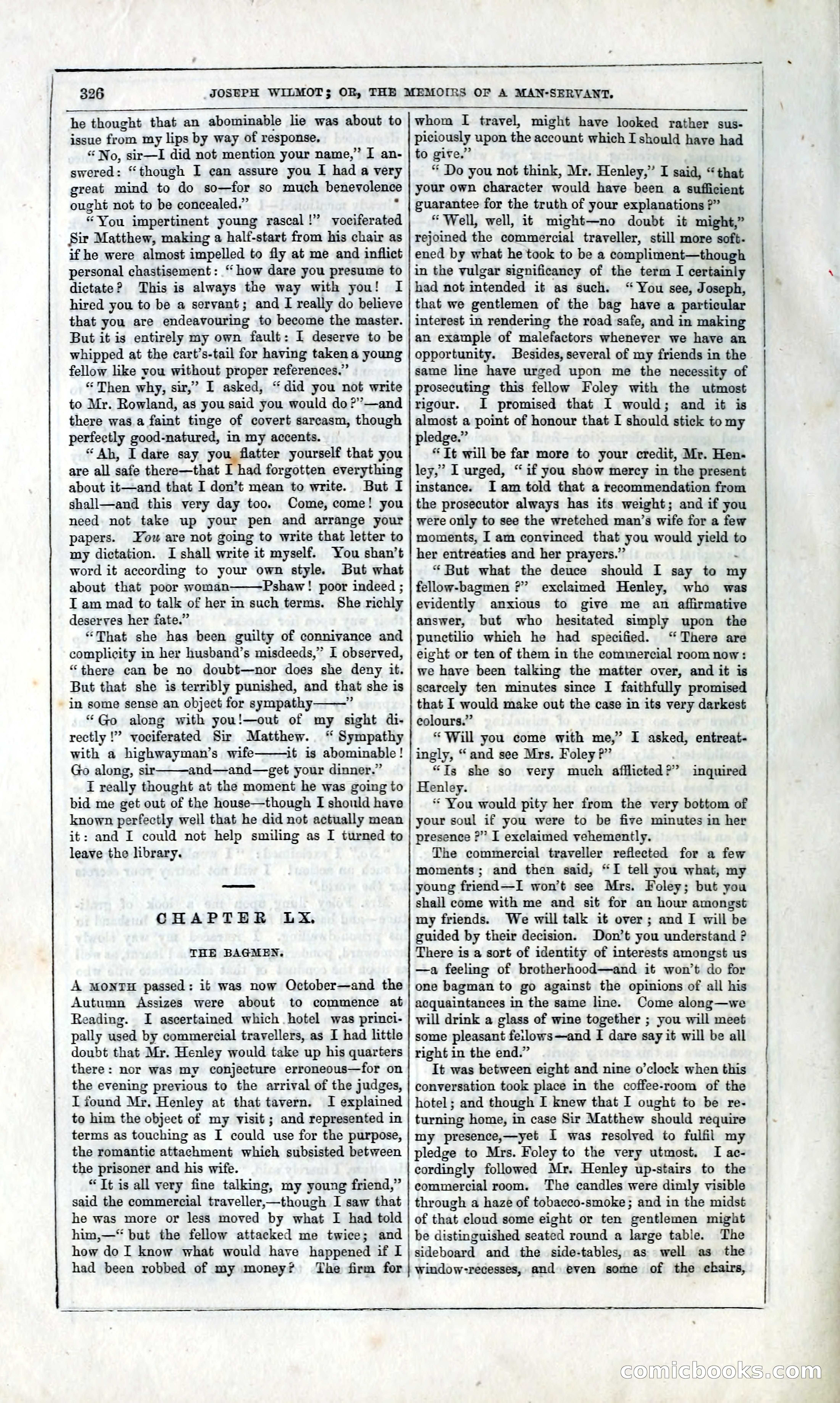
A restored page from Penny Dreadfuls, 1854. Page through the whole issue in the reader above.
📄 Transcribed text from this page (OCR, searchable)
Machine-transcribed from the original scan — historical spelling and the odd misread are preserved.
ne 326 he thought that an abominable lie was about to issue from my lips by way of response, “ No, sir—I did not mention your name,” I an- swered: “though I can assure you I had a very great mind to do so—for so much benevolence ought not to be concealed.” “You impertinent young rascal!” vociferated Sir Matthew, making a half-start from his chair as if he were almost impelled to fly at me and inflict personal chastisement: “ how dare you presume to dictate? This is always the way with you! I hired you to be a servant; and I really do believe that you are endeavouring to become the master. But it is entirely my own fault: I deserve to be whipped at the cart’s-tail for having taken a young fellow like you without proper references,” “Then why, sir,’ I asked, “did you not write to Mr. Rowland, as you said you would do ?”’—and there was.a faint tinge of covert sarcasm, though perfectly good-natured, in my accents. “Ah, I dare say yous flatter yourself that you are all safe there—that I had forgotten everything about it—and that I don’t mean to write. But I shall—and this very day too. Come, come! you need not take up your pen and arrange your papers. You are not going to write that letter to my dictation. I shall write it myself. You shan’t word it according to your own style. But what about that poor woman Pshaw! poor indeed ; IT am mad to talk of her in such terms. She richly deserves her fate.” “That she has been guilty of connivance and complicity in her husband’s misdeeds,” I observed, “there can be no doubt—nor does she deny it. But that she is terribly punished, and that she is in some sense an object for sympathy a “Go along with you!—out of my sight di- rectly !” vociferated Sir Matthew. “ Sympathy with a highwayman’s wife if is abominable! Go along, sir and—and—get your dinner.” I really thought at the moment he was going to bid me get out of the house—though I should have known perfectly well that he did not actually mean it: and I could not help smiling as I turned to leave the hbrary. CHAPTER LX. THE BAGMEN. A MONTH passed: it was now October—and the Autumn Assizes were about to commence at Reading. I ascertained which hotel was princi- pally used by commercial travellers, as I had little doubt that Mr. Henley would take up his quarters there: nor was my conjecture erroneous—for on the evening previous to the arrival of the judges, I iound Mr, Henley at that tavern. I explained to him the object of my visit ; and represented in terms as touching as I could use for the purpose, the romantic attachment which subsisted between the prisoner and his wife. “It is all very fine talking, my young friend,” said the commercial traveller,—though I saw that he was more or less moved by what I had told him,—“ but the fellow attacked me twice; and how do I know what would have happened if L had been robbed of my money? The firm for JOSEPH WILMOT$ OR, THE MEMOIRS OF A MAN-SERVANT, whom I travel, might have looked rather sus- piciously upon the account which I should have had to give.” * Do you not think, Mr. Henley,” I said, “that your own character would have been a sufficient guarantee for the truth of your explanations ?” “Well, well, it might—no doubt it might,” rejoined the commercial traveller, still more soft- ened by what he took to be a compliment—though in the vulgar significancy of the term I certainly had not intended it as such. “ You see, Joseph, that we gentlemen of the bag have a particular interest in rendering the road safe, and in making an example of malefactors whenever we have an opportunity. Besides, several of my friends in the same line have urged upon me the necessity of prosecuting this fellow Foley with the utmost rigour. I promised that I would; and it is almost a point of honour that I should stick tomy pledge.” “Tt will be far more to your credit, Mr. Hen. ley,’ L urged, “if you show mercy in the present instance. Iam told that a recommendation from the prosecutor always has its weight; and if you were only to see the wretched man’s wife for a few moments, I am convinced that you would yield to her entreaties and her prayers.’ “But what the deuce should I say to my fellow-bagmen ?” exclaimed Henley, who was evidently anxious to give me an affirmative answer, but who hesitated simply upon the punctilio which he had specified. “There are eight or ten of them in the commercial room now: we have been talking the matter over, and it is scarcely ten minutes since I faithfully promised that I would make out the case in its very darkest colours.” “Will you come with me,’ ingly, “and see Mrs. Foley?” “Ts she so very much afilicted: 2” inquired Henley. * You would pity her from the very bottom of your soul if you were to be five minutes in her presence ?” I exclaimed vehemently. The commercial traveller reflected for a few moments; and then said, “I tell you what, my young friend—I won’t see Mrs. Foley; but you shall come with me and sit for an hour amongst my friends. We will talk it over; and I will be guided by their decision. Don’t you understand ? There is a sort of identity of interests amongst us —a feeling of brotherhood—and it won’t do for one bagman to go against the opinions of all his acquaintances in the same line. Come along—we will drink a glass of wine together ; you will meet some pleasant feilows—and I dare say it will be all right in the end.” It was between eight and nine o’clock when this conversation took place in the coffee-room of the hotel; and though I knew that I ought to be re- turning home, in case Sir Matthew should require my presence,—yet iL was resolved to fulfil my pledge to Mrs. Foley to the very utmost. I ac- cordingly followed Mr. Henley up-stairs to the commercial room. The candles were dimly visible through a haze of tobacco-smoke ; and in the midst of that cloud some eight or ten gentlemen might be distinguished seated round a large table. The sideboard and the side-tables, as well as the window-recesses, and even some of the chairs, > I asked, entreat- Giaoo cS co im