
Penny Dreadfuls, 1854 · page 338 of 394
Joseph Wilmot, or, The Memoirs of a Man-Servant — page 338: what you’re looking at
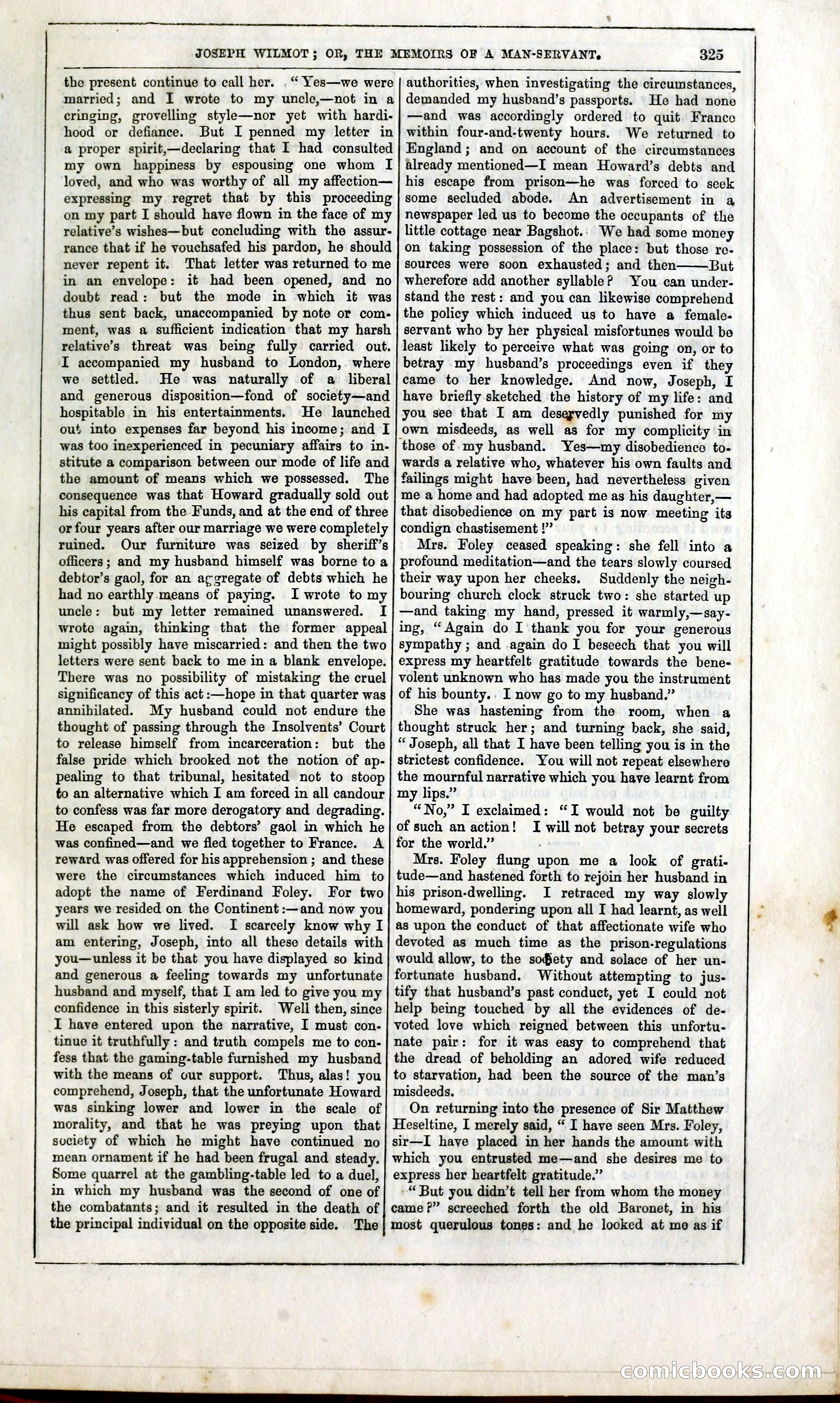
A restored page from Penny Dreadfuls, 1854. Page through the whole issue in the reader above.
📄 Transcribed text from this page (OCR, searchable)
Machine-transcribed from the original scan — historical spelling and the odd misread are preserved.
LL LLL LLL LL A LC A NE JOSEPH WILMOT; OR, THE MEMOIRS OF A MAN-SERVANT, 320 a eS ae ee the present continue to call her. . “ Yes—we were married ; cringing, hood or grovelling style—nor yet with hardi- defiance. But I penned my letter in a proper spirit,—declaring that I had consulted my own happiness by espousing one whom I loved, and who was worthy of all my affection— expressing my regret that by this proceeding on my part I should have flown in the face of my relative’s wishes—but concluding with the assur- rance that if he vouchsafed his pardon, he should never repent it. That letter was returned to me in an envelope: it had been opened, and no doubt read: but the mode in which it was thus sent back, unaccompanied by note or com- ment, was a sufficient indication that my harsh relative’s threat was being fully carried out. I accompanied my husband to London, where we settled. He was naturally of a liberal and generous disposition—fond of society—and hospitable in his entertainments. He launched out into expenses far beyond his income; and I was too inexperienced in pecuniary affairs to in- stitute a comparison between our mode of life and the amount of means which we possessed. The consequence was that Howard gradually sold out his capital from the Funds, and at the end of three or four years after our marriage we were completely ruined. Our furniture was seized by sheriff’s officers; and my husband himself was borne to a debtor’s gaol, for an aggregate of debts which he had no earthly means of paying. I wrote to my uncle: but my letter remained unanswered. I wrote again, thinking that the former appeal might possibly have miscarried: and then the two letters were sent back to me in a blank envelope. There was no possibility of mistaking the cruel significancy of this act:—hope in that quarter was annihilated. My husband could not endure the thought of passing through the Insolvents’ Court to release himself from incarceration: but the false pride which brooked not the notion of ap- pealing to that tribunal, hesitated not to stoop to an alternative which I am forced in all candour to confess was far more derogatory and degrading. He escaped from the debtors’ gaol in which he was confined—and we fled together to France. A reward was offered for his apprehension ; and these were the circumstances which induced him to adopt the name of Ferdinand Foley. For two years we resided on the Continent :—and now you will ask how we lived. I scarcely know why I am entering, Joseph, into all these details with you—unless it be that you have displayed so kind and generous a feeling towards my unfortunate husband and myself, that I am led to give you my confidence in this sisterly spirit. Well then, since I have entered upon the narrative, I must con- tinue it truthfully : and truth compels me to con- fess that the gaming-table furnished my husband with the means of our support. Thus, alas! you comprehend, Joseph, that the unfortunate Howard was sinking lower and lower in the scale of morality, and that he was preying upon that society of which he might have continued no mean ornament if he had been frugal and steady. Some quarrel at the gambling-table led to a duel, in which my husband was the second of one of the combatants; and it resulted in the death of the principal individual on the opposite side. The and I wrote to my uncle,—not in a authorities, when investigating the circumstances, demanded my husband’s passports. He had none —and was accordingly ordered to quit France within four-and-twenty hours. We returned to England; and on account of the circumstances already mentioned—I mean Howard’s debts and his escape from prison—he was forced to seek some secluded abode. An advertisement in a newspaper led us to become the occupants of the little cottage near Bagshot.. We had some money on taking possession of the place: but those re- sources were soon exhausted; and then But wherefore add another syllable? You can under- stand the rest: and you can likewise comprehend the policy which induced us to have a female- servant who by her physical misfortunes would be least likely to perceive what was going on, or to betray my husband’s proceedings even if they came to her knowledge. And now, Joseph, I have briefly sketched the history of my life: and you see that I am deseyvedly punished for my own misdeeds, as well as for my complicity in those of my husband. Yes—my disobedience to- wards a relative who, whatever his own faults and failings might have been, had nevertheless given me a home and had adopted me as his daughter,— that disobedience on my part is now meeting its condign chastisement !” Mrs. Foley ceased speaking: she fell into a profound meditation—and the tears slowly coursed their way upon her cheeks. Suddenly the neigh- bouring church clock struck two: she started up —and taking my hand, pressed it warmly,—say- ing, “Again do I thank you for your generous sympathy ; and again do I beseech that you will express my heartfelt gratitude towards the bene- volent unknown who has made you the instrument of his bounty.. I now go to my husband.” She was hastening from the room, when a thought struck her; and turning back, she said, “ Joseph, all that I have been telling you is in the strictest confidence. You will not repeat elsewhere the mournful narrative which you have learnt from my lips.” “No,” I exclaimed: “I would not be guilty of such an action! TI will not betray your secrets for the world.” Mrs. Foley flung upon me a look of grati- tude—and hastened forth to rejoin her husband in his prison-dwelling. I retraced my way slowly homeward, pondering upon all I had learnt, as well as upon the conduct of that affectionate wife who devoted as much time as the prison-regulations would allow, to the sofjety and solace of her un- fortunate husband. Without attempting to jus- tify that husband’s past conduct, yet I could not help being touched by all the evidences of de- voted love which reigned between this unfortu- nate pair: for it was easy to comprehend that the dread of beholding an adored wife reduced to starvation, had been the source of the man’s misdeeds. On returning into the presence of Sir Matthew Heseltine, I merely said, “ I have seen Mrs. Foley, sir—I have placed in her hands the amount with which you entrusted me—and she desires me to express her heartfelt gratitude.” -“ But you didn’t tell her from whom the money came?” screeched forth the old Baronet, in his most querulous tones: and he locked at me as if Eboo cS (E(@)