
Penny Dreadfuls, 1854 · page 331 of 394
Joseph Wilmot, or, The Memoirs of a Man-Servant — page 331: what you’re looking at
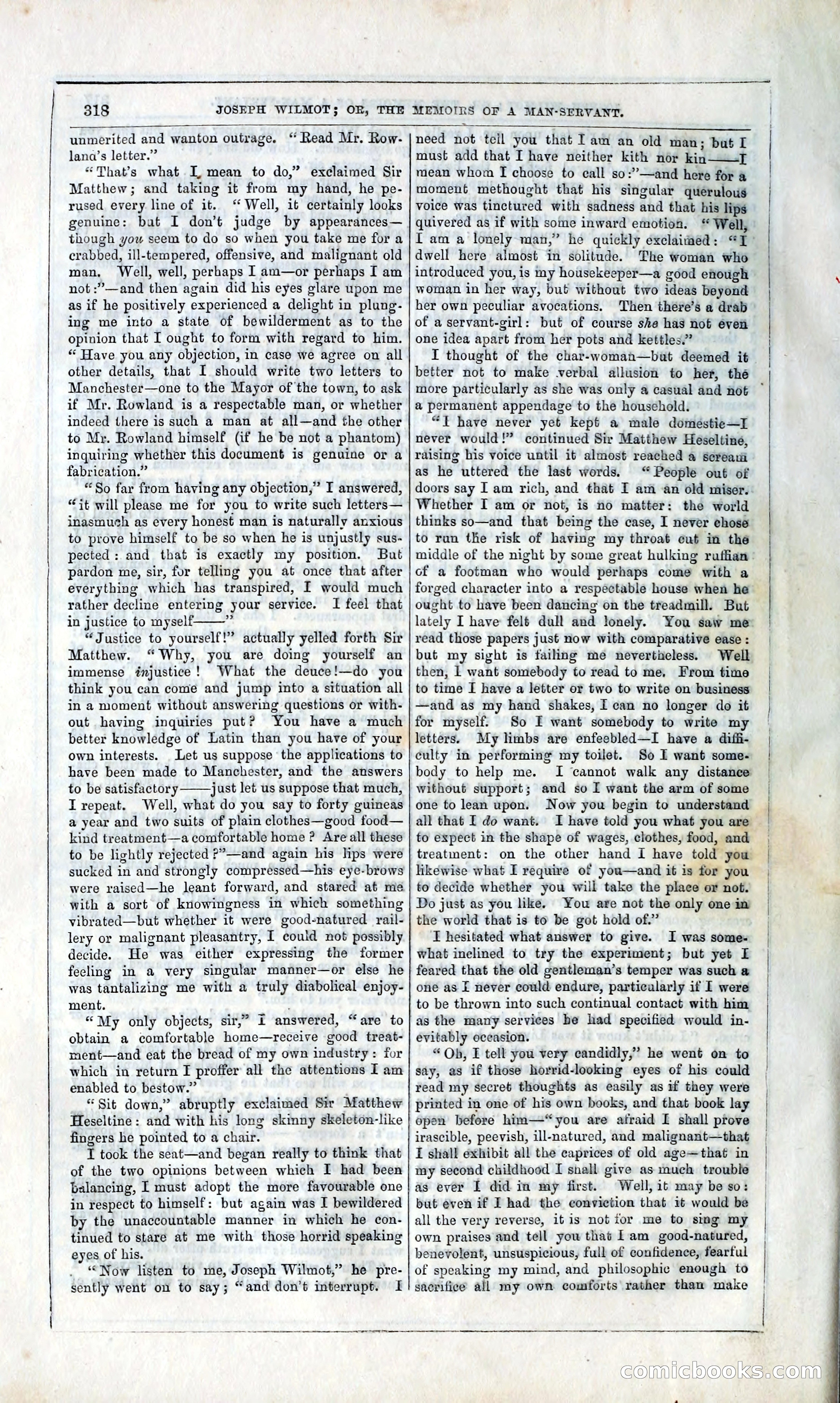
A restored page from Penny Dreadfuls, 1854. Page through the whole issue in the reader above.
📄 Transcribed text from this page (OCR, searchable)
Machine-transcribed from the original scan — historical spelling and the odd misread are preserved.
318 unmerited and wanton outrage. * Read Mr. Row- lana’s letter.” “That's what I, mean to do,” exclaimed Sir Matthew; and taking it from my hand, he pe- rused every line of it. ‘‘ Well, it certainly looks genuine: bat I don’t judge by appearances— though you seem to do so when you take me for a crabbed, ill-tempered, offensive, and malignant old man. Well, well, perhaps 1 am—or perhaps I am not :”—and then again did his eyes glare upon me as if he positively experienced a delight in plung- ing me into a state of bewilderment as to the opinion that I ought to form with regard to him. “ Have you any objection, in case we agree on all other details, that I should write two letters to Manchester—one to the Mayor of the town, to ask if Mr. Rowland is a respectable man, or whether indeed there is such a man at all—and the other to My. Rowland himself (if he be not a phantom) inquiring whether this document is genuine or a fabrication.” “So far from having any objection,” I answered, “it will please me for you to write such letters— inasmuch as every honest man is naturally anxious to prove himself to be so when he is unjustly sus- pected: and that is exactly my position. But pardon me, sir, for telling you at once that after everything which has transpired, I would much rather decline entering your service. I feel that in justice to myself i “Justice to yourself!” actually yelled forth Sir Matthew. “Why, you are doing yourself an immense énjustice! What the deuce!—do you think you can come and jump into a situation all in a Moment without answering questions or with- out having inquiries put? You have a much better knowledge of Latin than you have of your Own interests. Let us suppose the applications to have been made to Manchester, and the answers to be satisfactory just let us suppose that much, IT repeat. Well, what do you say to forty guineas a year and two suits of plain clothes—good food— kind treatment—a comfortable home ? Are all these to be lightly rejected P’—and again his lips were sucked in and strongly compressed—his eye-brows were raised—he leant forward, and stared at me with a sort of knowingness in which something vibrated—but whether it were good-natured rail- lery or malignant pleasantry, I could not possibly decide. He was either expressing the former feeling in a very singular manner—or else he was tantalizing me with a truly diabolical enjoy- ment. ' “My only objects, sir,” 1 answered, “are to obtain a comfortable home—receive good treat- ment—and eat the bread of my own industry: for which in return I proffer all the attentions I am enabled to bestow.” “Sit down,” abruptly exclaimed Sir Matthew Heseltine: and with his long skinny skeleton-like fingers he pointed to a chair. T took the seat—and began really to think that of the two opinions between which I had been balancing, I must adopt the more favourable one in respect to himself: but again was I bewildered by the unaccountable manner in which he con- tinued to stare at me with those horrid speaking eyes of his. ‘“Now listen to me, Joseph Wilmot,” he pre- sently went on to say; “and don’t interrupt. 1 JOSEPH WILMOT; OR, THE 32 er a re — ee MEMOIRS OF A MAN-SERVANT. need not teil you that Tam an old man; but I must add that I have neither kith nor kin ——-T mean whom I choose to call so:”—and here for a moment methought that his singular querulous voice was tinctured with sadness and that his lips quivered as if with some inward emotion. ‘ Well, {am a lonely man,” he quickly exclaimed: “I~ dwell here almost in solitude. The woman who introduced you, is my housekeeper—a good enough woman in her way, but without two ideas beyond her own peculiar avocations. Then there’s a drab of a servant-girl: but of course she has not even one idea apart from her pots and kettles.” I thought of the char-womah—bat deemed it better not to make verbal allusion to her, the more particularly as she was only a casual and not a permanent appendage to the household. “f have never yet kept a male doméstie—I never would!” continued Sir Matthew Heseltine, raising his voice until it almost reached a sereaui as he uttered the last words. “People out of doors say I am rich, and that I am an old miser. Whether I am or not, is no matter: the world thinks so—and that being the case, I never ehose to run the risk of having my throat cut in the middle of the night by some great hulking ruffian of a footman who would perhaps come with a forged character into a respectable house when he ought to have been dancing on the treadmill. But lately I have felé dull and tfonely. read those papers just now with comparative ease : but my sight is failing me nevertiieless. then, L want somebody to read to me, From time to time I have a letter or two to write on business —and as my hand shakes, I can no longer do it for myself. So IE want somebody to write my letters. My limbs are enfeebled—I have a diffi- culty in performing my toilet. So I want some- body to help me. without support; and so I want the arm of some one to lean upon. Now you begin to understand all that I do want. to expect in the shape of wages, clothes, food, and treatment: on the other hand I have told you likewise what I require of you—and it is for you to decide whether you will take the place or not. Do just as you like. You are not the only one im the world that is to be got hold of.” I hesitated what answer to give. I was some- what inelined to try the experiment; but yet I feared that the old gentleman’s temper was such a one as I never could endure, particularly if I were to be thrown into such continual contact with him as the many services be had specified would in- evitably oceasion. “Ob, I tell you very candidly,” he went on to say, as if those horrid-looking eyes of his could read my secret thoughts as easily as nf they were printed in one of his own books, and that book lay epen before him—*“you are afraid L shall prove irascible, peevish, ill-natured, and malignant—that I shall exhibit all the ecaprices of old age+that in my second childhood I snall give as much trouble as ever I did in my first. Well, it may be so: but even if I had the conviction that 1 would be all the very reverse, itis not ior me to simg my own praises and tell you that Lam good-natured, benevolent, unsuspicious, full of confidence, fearful of speaking my mind, and philosophic enough to sacrifice all my own comforts rather than make ood You saw me I cannot walk any distance I have told you what you are and Well CORNICE O@ (c©@)