
Penny Dreadfuls, 1854 · page 330 of 394
Joseph Wilmot, or, The Memoirs of a Man-Servant — page 330: what you’re looking at
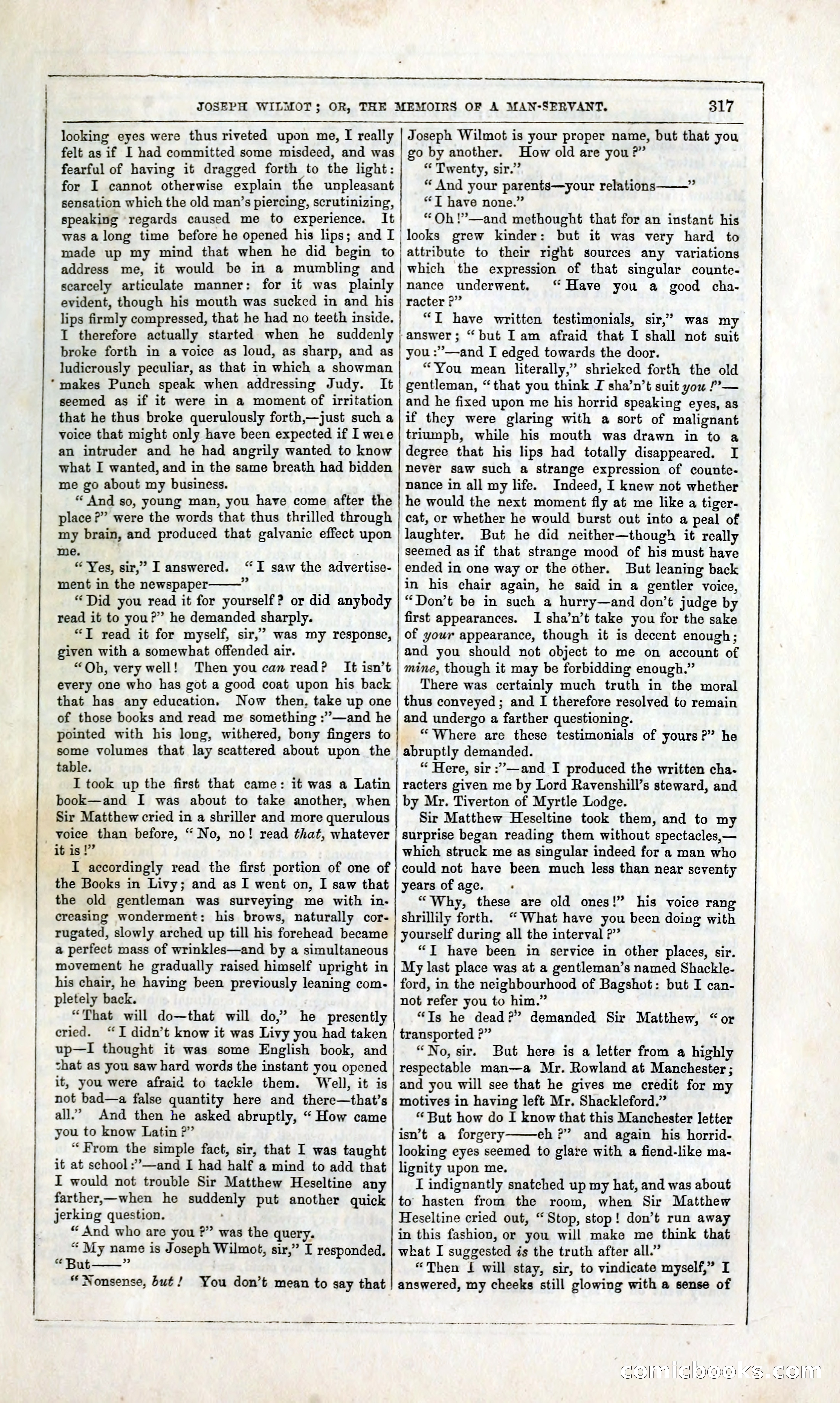
A restored page from Penny Dreadfuls, 1854. Page through the whole issue in the reader above.
📄 Transcribed text from this page (OCR, searchable)
Machine-transcribed from the original scan — historical spelling and the odd misread are preserved.
LS re we JOSEPH WILMOT; OR, THE MEMOIRS OF A MAN-SERVANT. a — —<——s = — 317 looking eyes were thus riveted upon me, I really felt as if I had committed some misdeed, and was fearful of having it dragged forth to the light: for I cannot otherwise explain the unpleasant sensation which the old man’s piercing, scrutinizing, speaking regards caused me to experience. It was along time before he opened his lips; and I made up my mind that when he did begin to address me, it would be in a mumbling and scarcely articulate manner: for if was plainly evident, though his mouth was sucked in and his lips firmly compressed, that he had no teeth inside. I therefore actually started when he suddenly broke forth in a voice as loud, as sharp, and as ludicrously peculiar, as that in which a showman “makes Punch speak when addressing Judy. It seemed as if it were in a moment of irritation that he thus broke querulously forth,—just such a voice that might only have been expected if I weie an intruder and he had angrily wanted to know what I wanted, and in the same breath had bidden me go about my business. “ And so, young man, you have come after the place ?” were the words that thus thrilled through my brain, and produced that galvanic effect upon me. “ Yes, sir,” I answered. “I saw the advertise- ment in the newspaper 4, “Did you read it for yourself? or did anybody read it to you?” he demanded sharply. “I read it for myself, sir,’ was my response, given with a somewhat offended air. “Oh, very well! Then you can read? It isn’t every one who has got a good coat upon his back that has any education. Now then, take up one of those books and read me something :”’—and he pointed with his long, withered, bony fingers to some volumes that lay scattered about upon the table. I took up the first that came: it was a Latin book—and I was about to take another, when Sir Matthew cried in a shriller and more querulous voice than before, “ No, no! read that, whatever it is !” I accordingly read the first portion of one of the Books in Livy; and as I went on, I saw that the old gentleman was surveying me with in- creasing wonderment: his brows, naturally cor- rugated, slowly arched up till his forehead became a perfect mass of wrinkles—and by a simultaneous movement he gradually raised himself upright in his chair, he haying been previously leaning com- pletely back. “That will do—that will do,’ he presently cried. “TI didn’t know it was Livy you had taken up—I thought it was some English book, and shat as you saw hard words the instant you opened it, you were afraid to tackle them. Well, it is not bad—a false quantity here and there—that’s all.” And then he asked abruptly, “ How came you to know Latin ?” “From the simple fact, sir, that I was taught it at school :’—and I had half a mind to add that I would not trouble Sir Matthew Heseltine any farther,—when he suddenly put another quick jerking question. “And who are you ?” was the query. “ My name is Joseph Wilmot, sir,” I responded. ““ But 3? * Nonsense, but! You don’t mean to say that Joseph Wilmot is your proper name, but that you go by another. How old are you ?” “‘ Twenty, sir.” “ And your parents—your relations “I have none.” “Oh !”—and methought that for an instant his looks grew kinder: but it was very hard to attribute to their right sources any variations which the expression of that singular counte- nance underwent. “ Have you a good cha- racter 2” “I have written testimonials, sir,’ was my 33 ‘answer; “but I am afraid that I shall not suit you :’—and I edged towards the door. “You mean literally,” shrieked forth the old gentleman, “that you think I sha’n’t suit you /?— and he fixed upon me his horrid speaking eyes, as if they were glaring with a sort of malignant triumph, while his mouth was drawn in to a degree that his lips had totally disappeared. I never saw such a strange expression of counte- nance in all my life. Indeed, I knew not whether he would the next moment fly at me like a tiger- cat, or whether he would burst out into a peal of laughter. But he did neither—though it really seemed as if that strange mood of his must have ended in one way or the other. But leaning back in his chair again, he said in a gentler voice, “Don’t be in such a hurry—and don’t judge by first appearances. I sha’n’t take you for the sake of your appearance, though it is decent enough; and you should not object to me on account of mine, though it may be forbidding enough.” There was certainly much truth in the moral thus conveyed; and I therefore resolved to remain and undergo a farther questioning. “Where are these testimonials of yours?” he abruptly demanded. “ Here, sir :’—and I produced the written cha- racters given me by Lord Ravenshill’s steward, and by Mr. Tiverton of Myrtle Lodge. Sir Matthew Heseltine took them, and to my surprise began reading them without spectacles,— which struck me as singular indeed for a man who could not have been much less than near seventy years of age. “Why, these are old ones!” his voice rang shrillily forth. ‘“ What have you been doing with yourself during all the interval P” : “I have been in service in other places, sir. My last place was at a gentleman’s named Shackle- ford, in the neighbourhood of Bagshot: but I can- not refer you to him.” “Ts he dead?” demanded Sir Matthew, “or transported ?” “No, sir. But here is a letter from a highly respectable man—a Mr. Rowland at Manchester ; and you will see that he gives me credit for my motives in having left Mr. Shackleford.” “But how do I know that this Manchester letter isn’t a forgery eh ?” and again his horrid- looking eyes seemed to glare with a fiend-like ma- lignity upon me. I indignantly snatched up my hat, and was about to hasten from the room, when Sir Matthew Heseltine cried out, “Stop, stop! don’t run away in this fashion, or you will make me think that wkat I suggested is the truth after all.” “Then I will stay, sir, to vindicate myself,” I answered, my cheeks still glowing with a sense of OOO) S (CO) AA