
Penny Dreadfuls, 1854 · page 309 of 394
Joseph Wilmot, or, The Memoirs of a Man-Servant — page 309: what you’re looking at
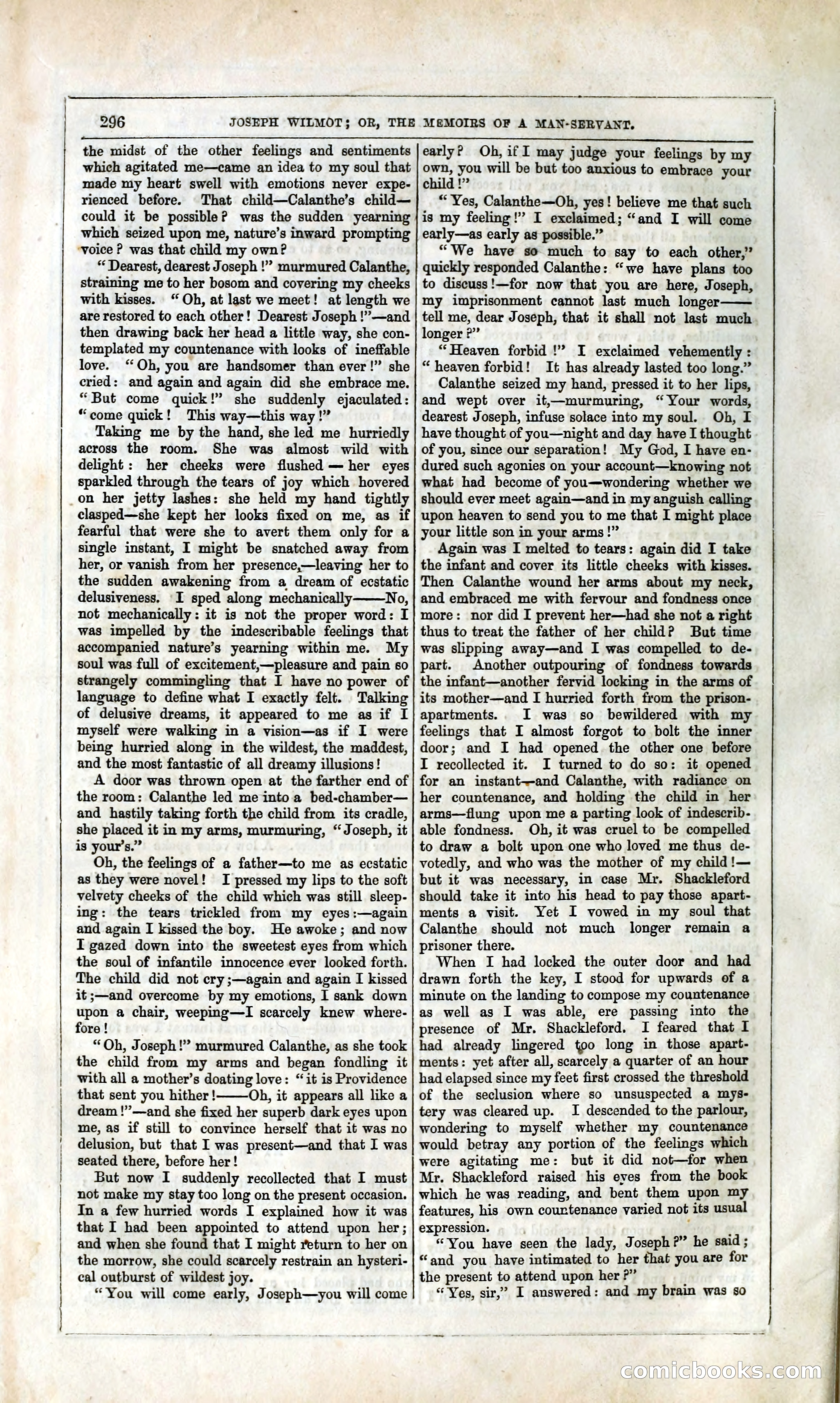
A restored page from Penny Dreadfuls, 1854. Page through the whole issue in the reader above.
📄 Transcribed text from this page (OCR, searchable)
Machine-transcribed from the original scan — historical spelling and the odd misread are preserved.
—— 296 the midst of the other feelings and sentiments which agitated me—came an idea to my soul that made my heart swell with emotions never expe- rienced before. That child—Calanthe’s child— could it be possible? was the sudden yearning which seized upon me, nature’s inward prompting ‘voice P was that child my own? * Dearest, dearest Joseph !”” murmured Calanthe, straining me to her bosom and covering my cheeks with kisses. “Oh, at last we meet! at length we are restored to each other! Dearest Joseph !”’—and then drawing back her head a little way, she con- templated my countenance with looks of ineffable love. ‘Oh, you are handsomer than ever!” she cried: and again and again did she embrace me. “But come quick!” she suddenly ejaculated: “come quick! This way—this way !” Taking me by the hand, she led me hurriedly across the room. She was almost wild with delight: her cheeks were flushed — her eyes sparkled through the tears of joy which hovered JOSEPH WILMOT; OR, THE _on her jetty lashes: she held my hand tightly clasped—she kept her looks fixed on me, as if fearful that were she to avert them only for a single instant, I might be snatched away from her, or vanish from her presence,—leaving her to the sudden awakening from a dream of ecstatic delusiveness. I sped along mechanically No, not mechanically: it is not the proper word: I was impelled by the indescribable feelings that accompanied nature’s yearning within me. My soul was full of excitement,—pleasure and pain so strangely commingling that I have no power of language to define what I exactly felt. Talking of delusive dreams, it appeared to me as if I myself were walking in a vision—as if I were being hurried along in the wildest, the maddest, and the most fantastic of all dreamy illusions! A door was thrown open at the farther end of the room: Calanthe led me into.a bed-chamber— and hastily taking forth the child from its cradle, she placed it in my arms, murmuring, “Joseph, it is your's.” Oh, the feelings of a father—to me as ecstatic as they were novel! I pressed my lips to the soft velvety cheeks of the child which was still sleep- ing: the tears trickled from my eyes :—again and again I kissed the boy. He awoke; and now I gazed down into the sweetest eyes from which the soul of infantile innocence ever looked forth. The child did not cry ;—again and again I kissed it ;—and overcome by my emotions, I sank down upon a chair, weeping—I scarcely knew where- fore ! “Oh, Joseph!” murmured Calanthe, as she took the child from my arms and began fondling it with all a mother’s doating love: “it is Providence that sent you hither! Ob, it appears all like a dream !”—and she fixed her superb dark eyes upon me, as if still to convince herself that it was no delusion, but that I was present—and that I was seated there, before her! But now I suddenly recollected that I must not make my stay too long on the present occasion. In a few hurried words I explained how it was that I had been appointed to attend upon her; and when she found that I might return to her on the morrow, she could scarcely restrain an hysteri- cal outburst of wildest joy. “You will come early, Joseph—you will come > ——— Ce Oe elle MEMOIRS OF A MAN-SERVANT., early? Oh, if I may judge your feclings by my own, you will be but too anxious to embrace your child !” “Yes, Calanthe—Oh, yes! believe me that such is my feeling!” I exclaimed; “and I will come early—as early as possible.” “We have so much to say to each other,” quickly responded Calanthe: “we have plans too to discuss!—for now that you are here, Joseph, my imprisonment cannot last much longer tell me, dear Joseph, that it shall not last much longer ?” “Heaven forbid !” I exclaimed vehemently : “ heaven forbid! It has already lasted too long.” Calanthe seized my hand, pressed it to her lips, and wept over it,—murmuring, “Your words, dearest Joseph, infuse solace into my soul. Oh, I have thought of you—night and day have I thought of you, since our separation! My God, I have en- dured such agonies on your account—knowing not what had become of you—wondering whether we should ever meet again—and in my anguish calling upon heaven to send you to me that I might place your little son in your arms!” Again was I melted to tears: again did I take the infant and cover its little cheeks with kisses. Then Calanthe wound her arms about my neck, and embraced me with fervour and fondness once more: nor did I prevent her—had she not a right thus to treat the father of her child? But time was slipping away—and I was compelled to de- part. Another outpouring of fondness towards the infant—another fervid locking in the arms of its mother—and I hurried forth from the prison- apartments. I was so bewildered with my feelings that I almost forgot to bolt the inner door; and I had opened the other one before I recollected it. I turned to do so: it opened for an instant--and Calanthe, with radiance on her countenance, and holding the child in her arms—flung upon me a parting look of indescrib- able fondness. Oh, it was cruel to be compelled to draw a bolt upon one who loved me thus de- votedly, and who was the mother of my child !— but it was necessary, in case Mr. Shackleford should take it into his head to pay those apart- ments a visit. Yet I vowed in my soul that Calanthe should not much longer remain a prisoner there. When I had locked the outer door and had drawn forth the key, I stood for upwards of a minute on the landing to compose my countenance as well as I was able, ere passing into the presence of Mr. Shackleford. I feared that I had already lingered too long in those apart- ments: yet after all, scarcely a quarter of an hour had elapsed since my feet first crossed the threshold of the seclusion where so unsuspected a mys- tery was cleared up. I descended to the parlour, wondering to myself whether my countenance would betray any portion of the feelings which were agitating me: but it did not—for when Mr. Shackleford raised his eves from the book which he was reading, and bent them upon my features, his own countenance varied not its usual expression. “You have seen the lady, Joseph?” he said; “and you have intimated to her that you are for the present to attend upon her P”’ ; “Yes, sir,’ I answered: and my brain was so ~~ EGhboo