
Penny Dreadfuls, 1854 · page 308 of 394
Joseph Wilmot, or, The Memoirs of a Man-Servant — page 308: what you’re looking at
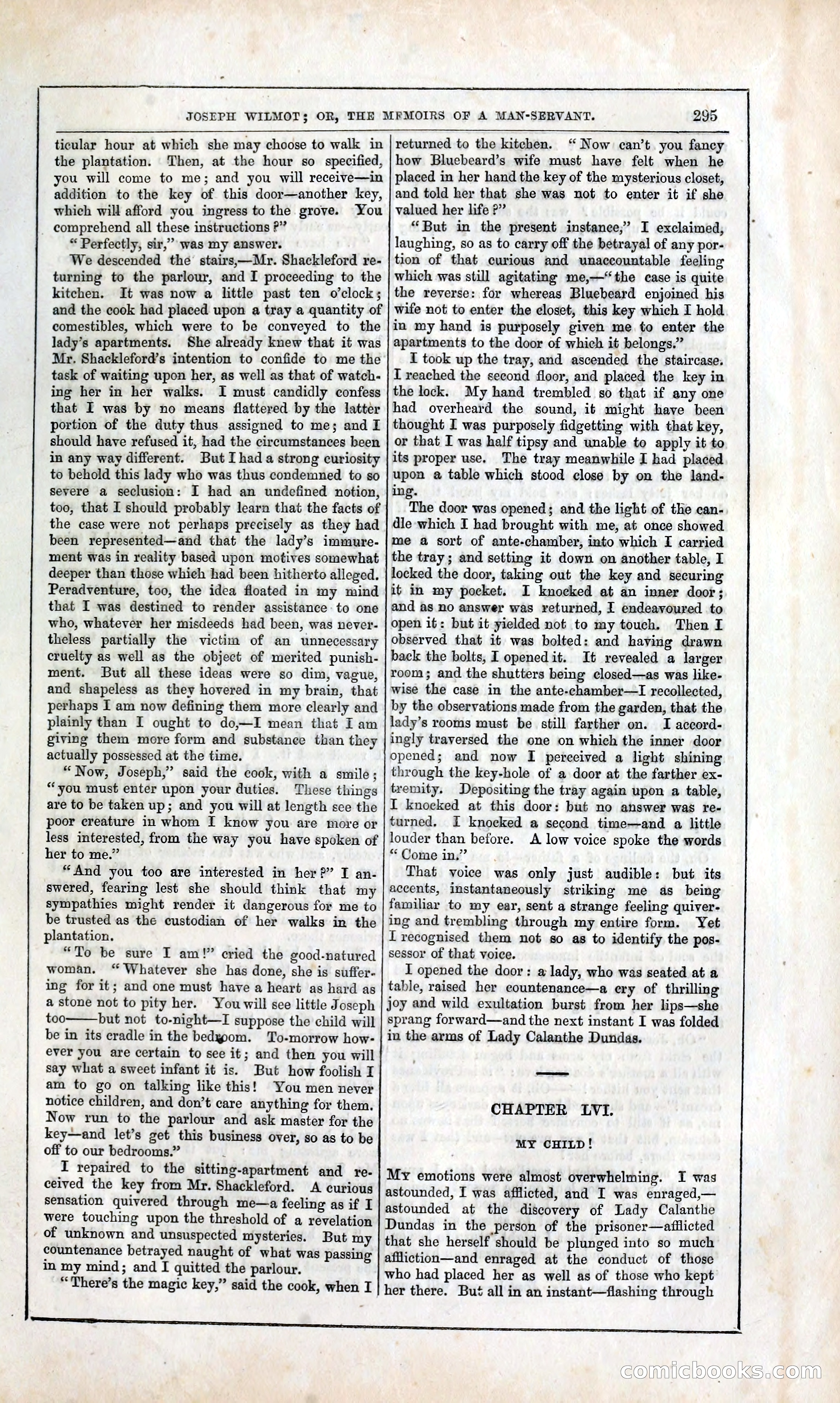
A restored page from Penny Dreadfuls, 1854. Page through the whole issue in the reader above.
📄 Transcribed text from this page (OCR, searchable)
Machine-transcribed from the original scan — historical spelling and the odd misread are preserved.
JOSEPH WILMOT3; OR, THE MFMOIRS OF A MAN-SERVANT. 295 ticular hour at which she may choose to walk in the plantation. Then, at the hour so specified, you will come to me; and you will receive—in addition to the key of this door—another key, which will afford you ingress to the grove. You comprehend all these instructions ?” “ Perfectly, sir,” was my enswer. We descended the stairs,—Mr. Shackleford re- turning to the parlour, and I proceeding to the kitchen. It was now a little past ten o'clock; and the cook had placed upon a tray a quantity of comestibles, which were to be conveyed to the lady’s apartments. She already knew that it was Mr. Shackleford’s intention to confide to me the task of waiting upon her, as well as that of watch. ing her in her walks. I must candidly confess that I was by no means flattered by the latter portion of the duty thus assigned to me; and I should have refused it, had the circumstances been in any way different. But I had a strong curiosity to behold this lady who was thus condemned to so severe a seclusion: I had an undefined notion, too, that I should probably learn that the facts of the case were not perhaps precisely as they had been represented—and that the lady’s immure- ment was in reality based upon motives somewhat deeper than those which had been hitherto alleged. Peradventure, too, the idea floated in my mind that I was destined to render assistance to one who, whatever her misdeeds had been, was never- theless partially the victim of an unnecessary cruelty as well as the object of merited punish- ment. But all these ideas were so dim, vague, and shapeless as they hovered in my brain, that perhaps I am now defining them more clearly and plainly than I ought to do—I mean that I am giving them more form and substanee than they actually possessed at the time. “Now, Joseph,” said the cook, with a smile; “you must enter upon your duties. These things are to be taken up; and you will at length see the poor creature in whom I know you are move or less interested, from the way you have spoken of her to me.” “And you too are interested in her?” I an- swered, fearing lest she should think that my sympathies might render it dangerous for me to be trusted as the custodian of her walks in the plantation. “To be sure I am!” cried the good-natured woman. “ Whatever she has done, she is suffer. ing for it; and one must have a heart as hard as a stone not to pity her. You will see little Joseph too but not to-night—I suppose the child will be in its cradle in the bedyoom. To-morrow how- ever you are certain to see it; and then you will say what a sweet infant it is. But how foolish I am to go on talking like this! You men never notice children, and don’t care anything for them. Now run to the parlour and ask master for the key—and let’s get this business over, so as to be off to our bedrooms.” A IT repaired to the sitting-apartment and re- ceived the key from Mr. Shackleford. A curious sensation quivered through me—a feeling as if I were touching upon the threshold of a revelation of unknown and unsuspected mysteries. But my countenance betrayed naught of what was passing im my mind; and I quitted the parlour. “There’s the magic key,” said the cook, when I re ek a CLO@OO returned to the kitchen. “Now can’t you fancy how Bluebeard’s wife must have felt when he placed in her hand the key of the mysterious closet, and told her that she was not to enter it if she valued her life ?” “But in the present instance,” I exclaimed, laughing, so as to carry off the betrayal of any por- tion of that curious and unaccountable feeling which was still agitating me,—the case is quite the reverse: for whereas Bluebeard enjoined his wife not to enter the closet, this key which I hold in my hand is purposely given me to enter the apartments to the door of which it belongs.” I took up the tray, and ascended the staircase. I reached the second floor, and placed the key in the lock. My hand trembled so that if any one had overheard the sound, it might have been thought I was purposely fidgetting with that key, or that I was half tipsy and unable to apply it to its proper use, The tray meanwhile I had placed upon a table which stood close by on the land- ing. The door was opened; and the light of the can- dle which I had brought with me, at once showed me a sort of ante-chamber, into which I carried the tray; and setting it down on another table, I locked the door, taking out the key and securing it in my pocket. I knocked at an inner door; and as no answer was returned, I endeavoured to open if: but it yielded not to my touch. Then I observed that it was bolted: and having drawn back the bolts, I opened it. It revealed a larger room; and the shutters being closed—as was like- wise the case in the ante-chamber—I recollected, by the observations made from the garden, that the lady’s rooms must be still farther on. I accord- ingly traversed the one on which the inner door opened; and now [I perceived a light shining through the key-hole of a door at the farther ex- tremity. Depositing the tray again upon a table, I knocked at this door: but no answer was re- turned. I knocked a second time—and a little louder than before. A low voice spoke the words * Come in,” That voice was only just audible: but its accents, instantaneously striking me as being familiar to my ear, sent a strange feeling quiver- ing and trembling through my entire form. Yet I recognised them not so as to identify the pos- sessor of that voice. I opened the door: a lady, who was seated at a table, raised her eountenance—a ery of thrilling joy and wild exultation burst from her lips—she sprang forward—and the next instant I was folded in the arms of Lady Calanthe Dundas. ~~ CHAPTER LVI. MY CHILD! My emotions were almost overwhelming. I was astounded, I was afflicted, and I was enraged,— astounded at the discovery of Lady Calanthe Dundas in the person of the prisoner—afilicted that she herself should be plunged into so much affliction—and enraged at the conduct of those who had placed her as well as of those who kept her there. But all in an instant—flashing through COUM S (CO) in