
Penny Dreadfuls, 1854 · page 306 of 394
Joseph Wilmot, or, The Memoirs of a Man-Servant — page 306: what you’re looking at
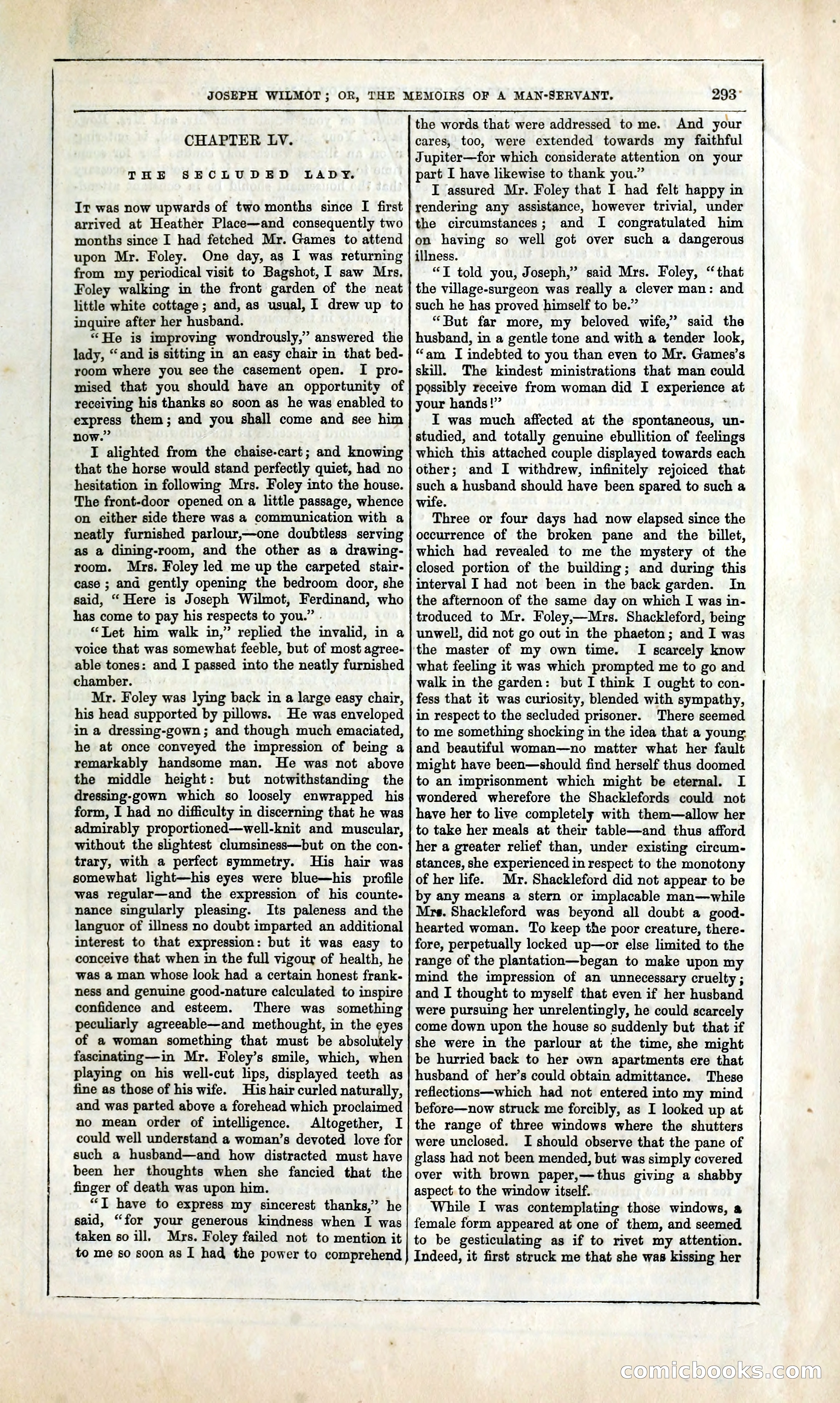
A restored page from Penny Dreadfuls, 1854. Page through the whole issue in the reader above.
📄 Transcribed text from this page (OCR, searchable)
Machine-transcribed from the original scan — historical spelling and the odd misread are preserved.
a er ew ow ae ee ee JOSEPH WILMOT; OR, THE MEMOIRS OF A MAN-SERVANT. 293° CHAPTER LV. THE SECLUDED LADY. It was now upwards of two months since I first arrived at Heather Place—and consequently two months since I had fetched Mr. Games to attend upon Mr. Foley. One day, as I was returning from my periodical visit to Bagshot, I saw Mrs. Foley walking in the front garden of the neat little white cottage; and, as usual, I drew up to inquire after her husband. “‘He is improving wondrously,” answered the lady, “and is sitting in an easy chair in that bed- room where you see the casement open. I pro- mised that you should have an opportunity of. receiving his thanks so soon as he was enabled to express them; and you shall come and see him now.” I alighted from the chaise-cart; and knowing that the horse would stand perfectly quiet, had no hesitation in following Mrs. Foley into the house. The front-door opened on a little passage, whence on either side there was a communication with a neatly furnished parlour,—one doubiless serving as a dining-room, and the other as a drawing- room. Mrs. Foley led me up the carpeted stair- case ; and gently opening the bedroom door, she said, “ Here is Joseph Wilmot, Ferdinand, who has come to pay his respects to you.” . “Let him walk in,” replied the invalid, in a voice that was somewhat feeble, but of most agree- able tones: and I passed into the neatly furnished chamber. Mr. Foley was lying back in a large easy chair, his head supported by pillows. He was enveloped in a dressing-gown ; and though much emaciated, he at once conveyed the impression of being a remarkably handsome man. He was not above the middle height: but notwithstanding the dressing-gown which so loosely enwrapped his form, I had no difficulty in discerning that he was admirably proportioned—well-knit and muscular, without the slightest clumsiness—but on the con- trary, with a perfect symmetry. His hair was somewhat light—his eyes were blue—his profile was regular—and the expression of his counte- nance singularly pleasing. Its paleness and the languor of illness no doubt imparted an additional interest to that expression: but it was easy to conceive that when in the full vigour of health, he was a man whose look had a certain honest frank. ness and genuine good-nature calculated to inspire confidence and esteem. There was something peculiarly agreeable—and methought, in the eyes of a woman something that must be absolutely fascinating—in Mr. Foley’s smile, which, when playing on his well-cut lips, displayed teeth as fine as those of his wife. His hair curled naturally, and was parted above a forehead which proclaimed no mean order of intelligence. Altogether, I could well understand a woman’s devoted love for such a husband—and how distracted must have been her thoughts when she fancied that the finger of death was upon him. “T have to express my sincerest thanks,” he said, “for your generous kindness when I was taken so ill. Mrs. Foley failed not to mention it to me so soon as I had the power to comprehend A — the words that were addressed to me. And your cares, too, were extended towards my faithful Jupiter—for which considerate attention on your part I have likewise to thank you.” I assured Mr. Foley that I had felt happy in rendering any assistance, however trivial, under the circumstances; and I congratulated him op having so well got over such a dangerous illness. “TI told you, Joseph,” said Mrs. Foley, “that the village-surgeon was really a clever man: and such he has proved himself to be.” “But far more, my beloved wife,’ said the husband, in a gentle tone and with a tender look, “am I indebted to you than even to Mr. Games’s skill. The kindest ministrations that man could possibly receive from woman did I experience at your hands!” I was much affected at the spontaneous, un- studied, and totally genuine ebullition of feelings which this attached couple displayed towards each other; and I withdrew, infinitely rejoiced that such a husband should have been spared to such a wife. Three or four days had now elapsed since the occurrence of the broken pane and the billet, which had revealed to me the mystery otf the closed portion of the building; and during this interval I had not been in the back garden. In the afternoon of the same day on which I was in- troduced to Mr. Foley,—Mrs. Shackleford, being unwell, did not go out in the phaeton; and I was the master of my own time. I scarcely know what feeling it was which prompted me to go and walk in the garden: but I think I ought to con- fess that it was curiosity, blended with sympathy, in respect to the secluded prisoner. There seemed to me something shocking in the idea that a young and beautiful woman—no matter what her fault might have been—should find herself thus doomed to an imprisonment which might be eternal. I wondered wherefore the Shacklefords could not have her to live completely with them—allow her to take her meals at their table—and thus afford her a greater relief than, under existing circum- stances, she experienced in respect to the monotony of her life. Mr. Shackleford did not appear to be by any means a stern or implacable man—while Mrs. Shackleford was beyond all doubt a good- hearted woman. To keep the poor creature, there- fore, perpetually locked up—or else limited to the range of the plantation—began to make upon my mind the impression of an unnecessary cruelty ; and I thought to myself that even if her husband were pursuing her unrelentingly, he could scarcely come down upon the house so suddenly but that if she were in the parlour at the time, she might be hurried back to her own apartments ere that husband of her’s could obtain admittance. These reflections—which had not entered into my mind before—now struck me forcibly, as I looked up at the range of three windows where the shutters were unclosed. I should observe that the pane of glass had not been mended, but was simply covered over with brown paper,—thus giving a shabby aspect to the window itself. While I was contemplating those windows, a female form appeared at one of them, and seemed to be gesticulating as if to rivet my attention. Indeed, it first struck me that she was kissing her GomiGbdooks (CO) im