
Penny Dreadfuls, 1854 · page 305 of 394
Joseph Wilmot, or, The Memoirs of a Man-Servant — page 305: what you’re looking at
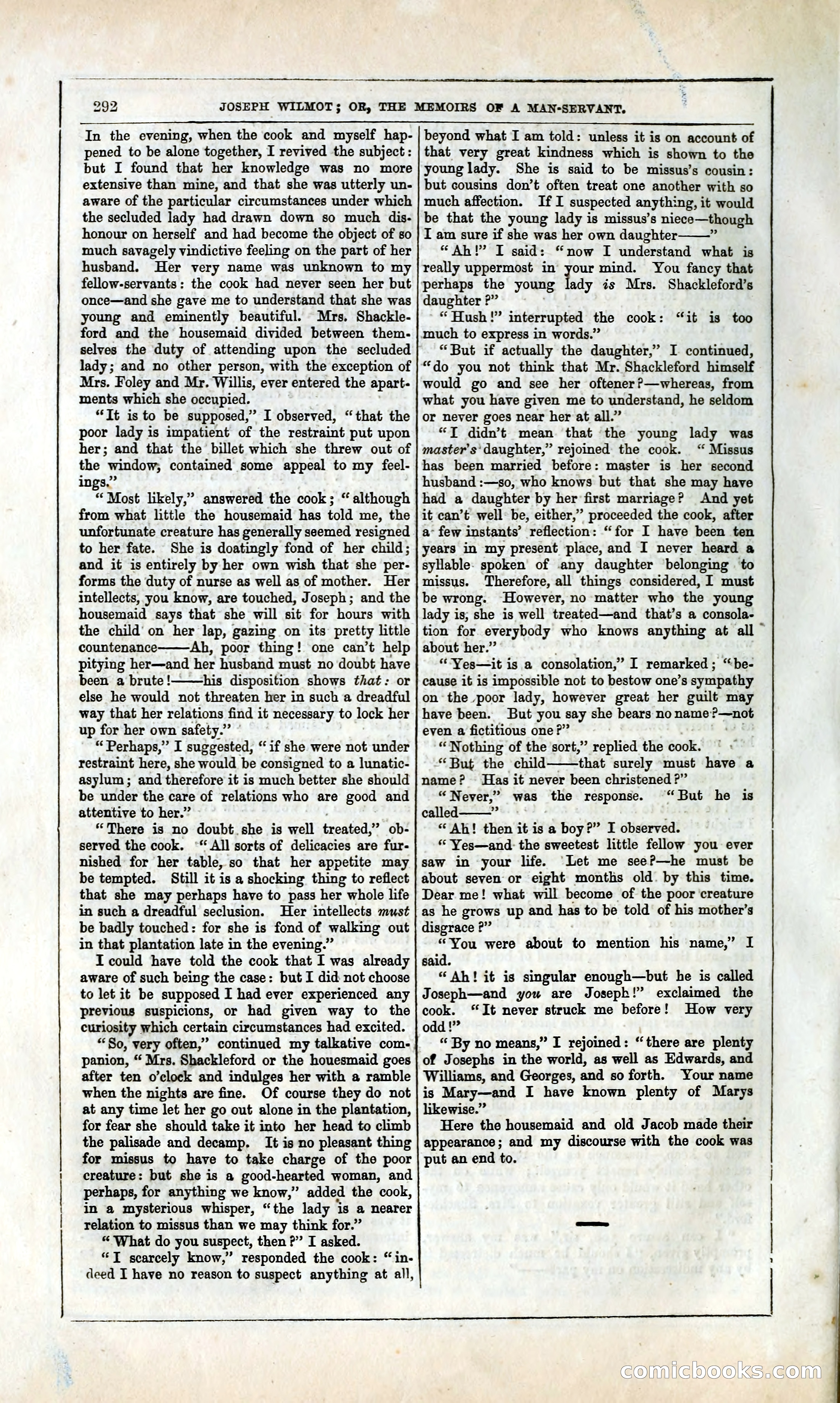
A restored page from Penny Dreadfuls, 1854. Page through the whole issue in the reader above.
📄 Transcribed text from this page (OCR, searchable)
Machine-transcribed from the original scan — historical spelling and the odd misread are preserved.
—— — eee —— eee —_——— 292 JOSEPH WILMOT; OR, THE MEMOIRS OF A MAN-SERVANT. In the evening, when the cook and myself hap- pened to be alone together, I revived the subject: but I found that her knowledge was no more extensive than mine, and that she was utterly un- aware of the particular circumstances under which the secluded lady had drawn down so much dis- honour on herself and had become the object of so much savagely vindictive feeling on the part of her husband. Her very name was unknown to my fellow-servants: the cook had never seen her but once—and she gave me to understand that she was young and eminently beautiful. Mrs. Shackle- ford and the housemaid divided between them- selves the duty of attending upon the secluded lady; and no other person, with the exception of Mrs. Foley and Mr. Willis, ever entered the apart- ments which she occupied. “It is to be supposed,” I observed, “that the poor lady is impatient of the restraint put upon her; and that the billet which she threw out of the window; contained some appeal to my feel- ings,” “Most likely,” answered the cook; “ although from what little the housemaid has told me, the unfortunate creature has generally seemed resigned to her fate. She is doatingly fond of her child; and it is entirely by her own wish that she per- forms the duty of nurse as well as of mother. Her intellects, you know, are touched, Joseph; and the housemaid says that she will sit for hours with the child’ on her lap, gazing on its pretty little countenance———-Ah, poor thing! one can’t help pitying her—and her husband must no doubt have been a brute! his disposition shows that: or else he would not threaten her in such a dreadful way that her relations find it necessary to lock her up for her own safety.” ’ “Perhaps,” I suggested, “if she were not under restraint here, she would be consigned to a lunatic- asylum; and therefore it is much better she should be under the care of relations who are good and attentive to her.” “There is no doubt. she is well treated, ” ob- served the cook. “All sorts of delicacies are fur- nished for her table, so that her appetite may be tempted. Still it is a shocking thing to reflect that she may perhaps have to pass her whole life in such a dreadful seclusion. Her intellects must be badly touched: for she is fond of walking out in that plantation late in the evening.” I could have told the cook that I was already aware of such being the case: but I did not choose to let it be supposed I had ever experienced any previous suspicions, or had given way to the curiosity which certain circumstances had excited. “So, very often,’ continued my talkative com- panion, “ Mrs. Shackleford or the houesmaid goes after ten o’clock and indulges her with a ramble when the nights are fine. Of course they do not at any time let her go out alone in the plantation, for fear she should take it into her head to climb the palisade and decamp. It is no pleasant thing for missus to have to take charge of the poor creature: but she is a good-hearted woman, and perhaps, for anything we know,” added the cook, in a mysterious whisper, “the lady is a nearer relation to missus than we may think for.” “ What do you suspect, then ?” I asked. “TI scarcely know,” responded the cook: “in- deed I have no reason to suspect anything at all, beyond what I am told: unless it is on account of that very great kindness which is shown to the young lady. She is said to be missus’s cousin: but cousins don’t often treat one another with so much affection. IfI suspected anything, it would be that the young lady is missus’s niece—though T am sure if she was her own daughter “Ah! I said: “now I understand what is really uppermost in your mind. You fancy that perhaps the young bia is Mrs. Shackleford’s daughter ?” “Hush!” interrupted the cook: “it is too much to express in words.” “But if actually the daughter,’ I continued, “do you not think that Mr. Shackleford himself would go and see her oftener?—whereas, from what you have given me to understand, he seldom or never goes near her at all.” “JT didn’t mean that the young lady was master’s’ daughter,” rejoined the cook. “ Missus has been married before: master is her second husband :—so, who knows but that she may have had a daughter by her first marriage? And yet it can’t well: be, either,’ proceeded the cook, after a~ few instants’ reflection: “for I have been ten years in my present place, and I never heard a syllable. spoken of any daughter belonging to missus. Therefore, all things considered, I must be wrong. “However, no matter whe the young lady is; she is well treated—and that’s a consola- tion for everybody who knows anything at all © about her.” | “ Yes—it is a consolation,’ I remarked; “be- cause it is impossible not to bestow one’s sympathy on the poor lady, however great her guilt may have been. But you say she bears no name: ee even a fictitious one?” “ Nothing of the sort,” replied the cook. “But the child— ‘that surely must have a name? Has it never been christened ?” “Never,” was the response. “But he is called “Ah! then it is a boy?” I observed. * Yes—and: the sweetest little fellow you ever saw in your life. Let me see?—he must be about seven or eight months old. by this time. Dear me! what will become of the poor creature as he grows up and has to be told of his mother’s disgrace ?” “You were about to mention his name,’ I said. “Ah! it is singular enough—but he is called Joseph—and you are Joseph!” exclaimed the cook. “It never struck me before! How very odd! 19> “ By no means,” I rejoined: “there are plenty of Josephs in the world, as well as Edwards, and Williams, and Georges, and so forth. Your name is Mary—and I have known plenty of Marys likewise.” Here the housemaid and old Jacob made their appearance; and my discourse with the cook was put an end to. CONNIE OOOKS (F() im