
Penny Dreadfuls, 1854 · page 145 of 394
Joseph Wilmot, or, The Memoirs of a Man-Servant — page 145: what you’re looking at
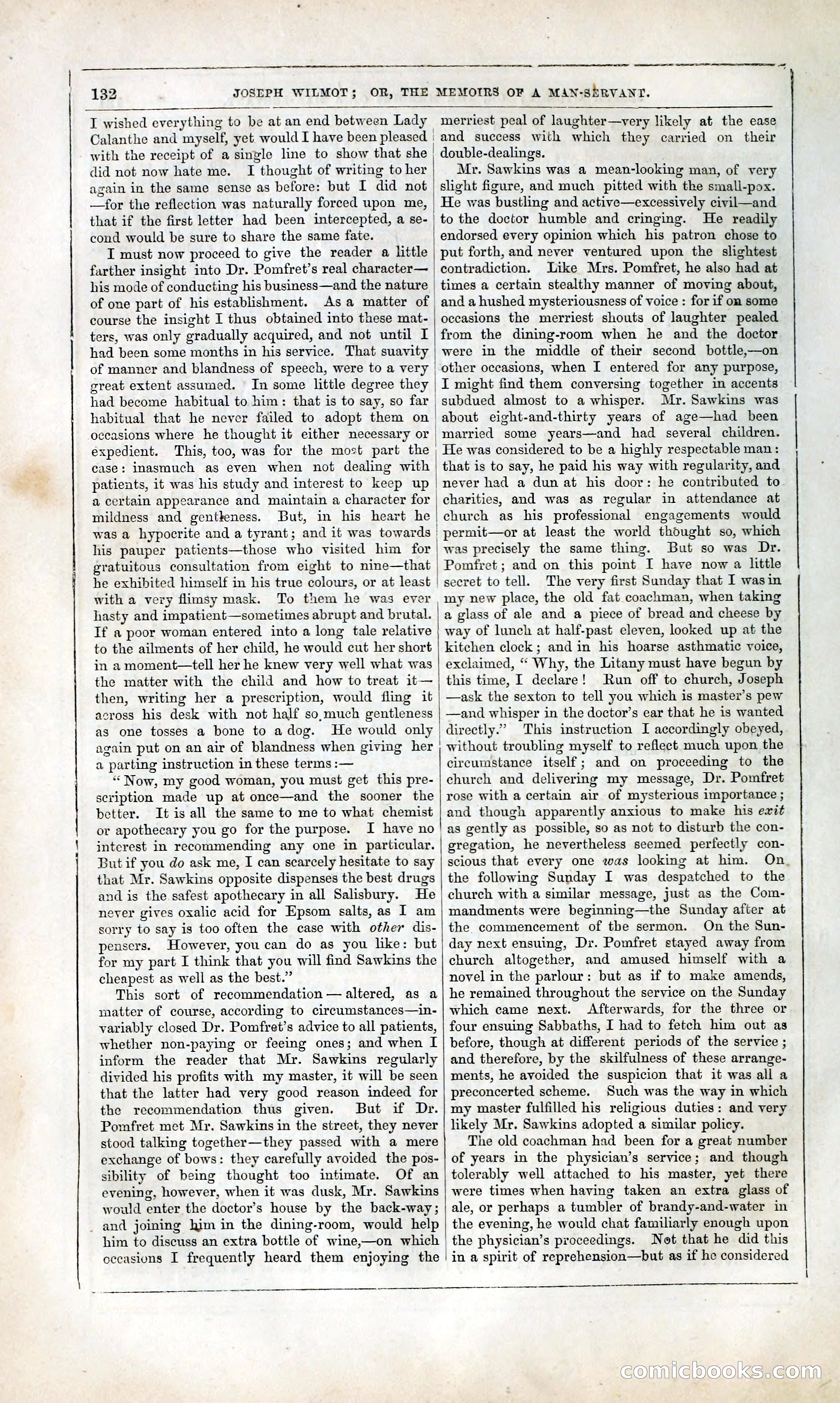
A restored page from Penny Dreadfuls, 1854. Page through the whole issue in the reader above.
📄 Transcribed text from this page (OCR, searchable)
Machine-transcribed from the original scan — historical spelling and the odd misread are preserved.
— — - 132 —— Se JOSEPH WILMOT; OR, THE MEMOIRS OF A MAN-SERVANT. I wished everything to be at an end between Lady merriest peal of laughter—very likely at the ease Calanthe and myself, yet would I have been pleased | and success with which they carried on their with the receipt of a single line to show that she | double-dealings. did not now hate me. I thought of writing to her Mr. Sawkins was a mean-looking man, of very again in the same sense as before: but I did not | slight figure, and much pitted with the small-pox. —for the reflection was naturally forced upon me, that if the first letter had been intercepted, a se- cond would be sure to share the same fate. I must now proceed to give the reader a little He was bustling and active—excessively civil—and 'to the doctor humble and cringing. He readily endorsed every opinion which his patron chose to put forth, and never ventured upon the slightest farther insight into Dr. Pomfret’s real character— | contradiction. Like Mrs. Pomfret, he also had at his mode of conducting his business—and the nature of one part of his establishment. Asa matter of course the insight I thus obtained into these mat- ters, was only gradually acquired, and not until I had been some months in his service. That suavity of manner and blandness of speech, were to a very great extent assumed. In some little degree they had become habitual to him: that is to say, so far | habitual that he never failed to adopt them on oceasions where he thought it either necessary or expedient. This, too, was for the most part the case: Inasmuch as even when not dealing with patients, it was his study and interest to keep up a certain appearance and maintain a character for mildness and gentleness. But, in his heart he was a hypocrite and a tyrant; and it was towards his pauper patients—those who visited him for | was precisely the same thing. | | ' times a certain stealthy manner of moving about, and a hushed mysteriousness of voice : for if on some occasions the merriest shouts of laughter pealed from the dining-room when he and the doctor were in the middle of their second bottle,—on other occasions, when I entered for any purpose, I might find them conversing together in accents subdued almost to a whisper. Mr. Sawkins was about eight-and-thirty years of age—had been married some years—and had several children. He was considered to be a highly respectable man: that is to say, he paid his way with regularity, and never had a dun at his door: he contributed to charities, and was as regular in attendance at church as his professional engagements would permit—or at least the world thought so, which But so was Dr. gratuitous consultation from eight to nine—that | Pomfret; and on this point I have now a little he exhibited himself in his true colours, or at least with a very flimsy mask. To them he was ever hasty and impatient—sometimes abrupt and brutal. If a poor woman entered into a long tale relative to the ailments of her child, he would cut her short in a moment—tell her he knew very well what was the matter with the child and how to treat it— then, writing her a prescription, would fling it across his desk with not half so,much gentleness as one tosses a bone to adog. He would only again put on an air of blandness when giving her a parting instruction in these terms :— “Now, my good woman, you must get this pre- scription made up at once—and the sooner the better. It is all the same to me to what chemist or apothecary you go for the purpose. I have no interest in recommending any one in particular. But if you do ask me, I can scarcely hesitate to say that Mr. Sawkins opposite dispenses the best drugs and is the safest apothecary in all Salisbury. He never gives oxalic acid for Epsom salts, as 1 am sorry to say is too often the case with other dis- pensers. However, you can do as you like: but for my part I think that you will find Sawkins the cheapest as well as the best.” This sort of recommendation — altered, as a matter of course, according to circumstances—in- variably closed Dr. Pomfret’s advice to all patients, whether non-paying or feeing ones; and when I inform the reader that Mr. Sawkins regularly divided his profits with my master, it will be seen that the latter had very good reason indeed for the recommendation thus given. But if Dr. Pomfret met Mr. Sawkins in the street, they never stood talking together—they passed with a mere exchange of bows: they carefully avoided the pos- sibility of being thought too intimate. Of an evening, however, when it was dusk, Mr. Sawkins would enter the doctor’s house by the back-way; _ and joining him in the dining-room, would help him to discuss an extra bottle of wine,—on which occasions I frequently heard them enjoying the iia — secret to tell. The very first Sunday that I wasin my new place, the old fat coachman, when taking a glass of ale and a piece of bread and cheese by way of lunch at half-past eleven, looked up at the kitchen clock; and in his hoarse asthmatic voice, exclaimed, “ Why, the Litany must have begun by this time, I declare! Run off to church, Joseph —ask the sexton to tell you which is master’s pew —and whisper in the doctor’s ear that he is wanted directly.” This instruction I accordingly obeyed, without troubling myself to reflect much upon the circumstance itself; and on proceeding to the church and delivering my message, Dr. Pomfret rose with a certain air of mysterious importance ; and though apparently anxious to make his exit as gently as possible, so as not to disturb the con- gregation, he nevertheless seemed perfectly con- scious that every one was looking at him. On_ the following Sunday I was despatched to the church with a similar message, just as the Com- mandments were beginning—the Sunday after at the commencement of the sermon. On the Sun- day next ensuing, Dr. Pomfret stayed away from church altogether, and amused himself with a novel in the parlour: but as if to make amends, he remained throughout the service on the Sunday which came next. Afterwards, for the three or four ensuing Sabbaths, I had to fetch him out as before, though at different periods of the service ; and therefore, by the skilfulness of these arrange- ments, he avoided the suspicion that it was all a preconcerted scheme. Such was the way in which my master fulfilled his religious duties: and very likely Mr. Sawkins adopted a similar policy. The old coachman had been for a great number of years in the physician’s service; and though tolerably well attached to his master, yet there were times when having taken an extra glass of ale, or perhaps a tumbler of brandy-and-water in the evening, he would chat familiarly enough upon the physician’s proceedings. Not that he did this in a spirit of reprehension—but as if he considered a _-— --- 0)(0)) Cc Ss.co