
Penny Dreadfuls, 1854 · page 144 of 394
Joseph Wilmot, or, The Memoirs of a Man-Servant — page 144: what you’re looking at
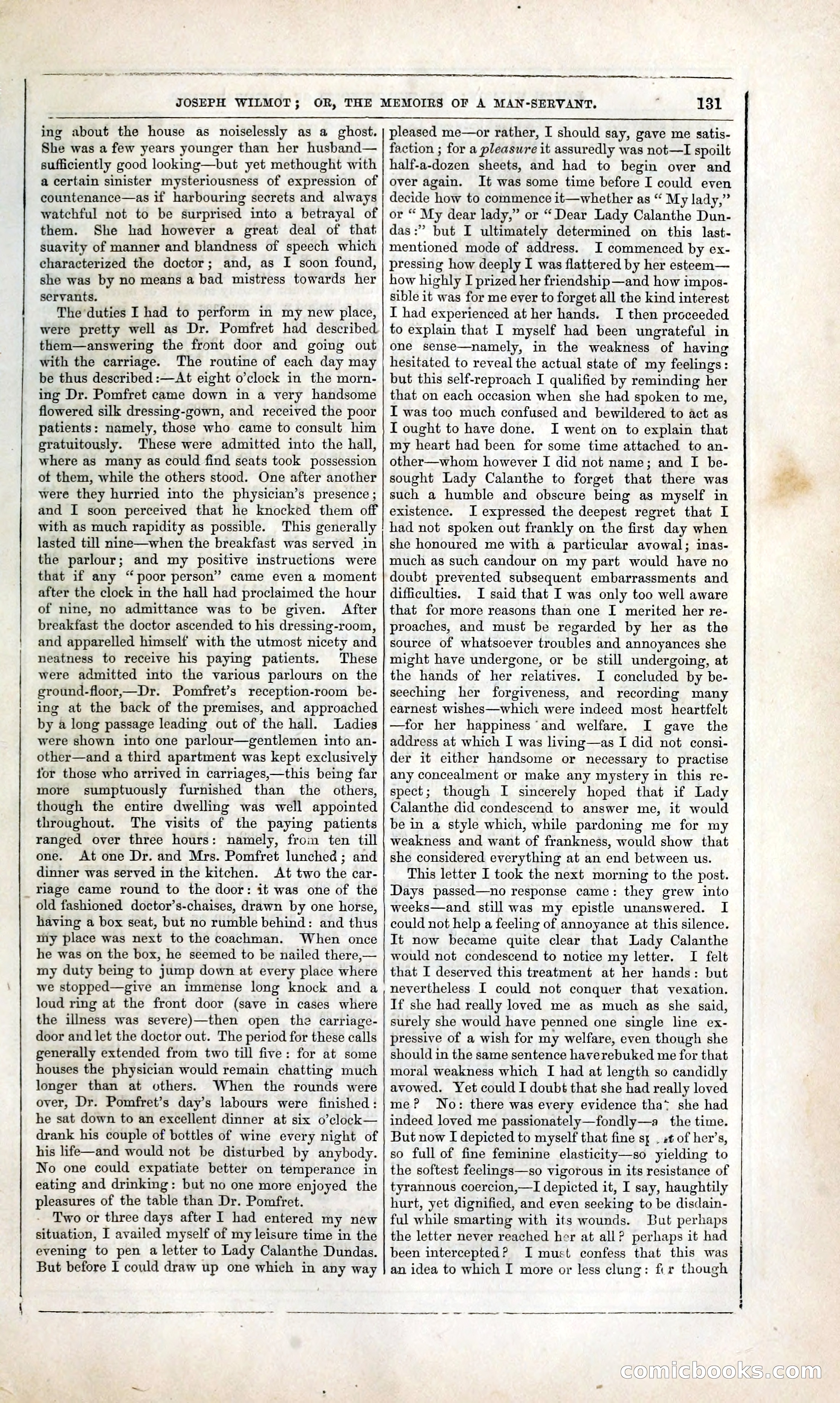
A restored page from Penny Dreadfuls, 1854. Page through the whole issue in the reader above.
📄 Transcribed text from this page (OCR, searchable)
Machine-transcribed from the original scan — historical spelling and the odd misread are preserved.
me RT © Serene anne ain . JOSEPH WILMOT ; — ing about the house as noiselessly as a ghost. She was a few years younger than her husband— sufficiently good looking—but yet methought with a certain sinister mysteriousness of expression of countenance—as if harbouring secrets and always watchful not to be surprised into a betrayal of them. She had however a great deal of that suavity of manner and blandness of speech which characterized the doctor; and, as I soon found, she was by no means a bad mistress towards her servants. The duties I had to perform in my new place, were pretty well as Dr. Pomfret had described them—answering the front door and going out with the carriage. The routine of each day may be thus described :—At eight o’clock in the morn- ing Dr. Pomfret came down in a very handsome flowered silk dressing-gown, and received the poor patients: namely, those who came to consult him gratuitously. These were admitted into the hall, where as many as could find seats took possession ot them, while the others stood. One after another were they hurried into the physician’s presence ; and I soon perceived that he knocked them off with as much rapidity as possible. This generally lasted till nine—when the breakfast was served in the parlour; and my positive instructions were that if any “poor person” came even a moment after the clock in the hall had proclaimed the hour of nine, no admittance was to be given. After breakfast the doctor ascended to his dressing-room, and apparelled himself with the utmost nicety and neatness to receive his paying patients. These were admitted into the various parlours on the ground-floor,—Dr. Pomfret’s reception-room be- ing at the back of the premises, and approached by a long passage leading out of the hall. Ladies were shown into one parlour—gentlemen into an- other—and a third apartment was kept exclusively for those who arrived in carriages,—this being far more sumptuously furnished than the others, though the entire dwelling was well appointed throughout. The visits of the paying patients ranged over three hours: namely, from ten till one. At one Dr. and Mrs. Pomfret lunched; and dinner was served in the kitchen. At two the car- riage came round to the door: it was one of the old fashioned doctor’s-chaises, drawn by one horse, having a box seat, but no rumble behind: and thus my place was next to the coachman. When once he was on the box, he seemed to be nailed there,— my duty being to jump down at every place where we stopped—give an immense long knock and a loud ring at the front door (save in cases where the illness was severe)—then open the carriage- door and let the doctor out. The period for these calls generally extended from two till five: for at some houses the physician would remain chatting much longer than at others. When the rounds were over, Dr. Pomfret’s day’s labours were finished : he sat down to an excellent dinner at six o’clock— drank his couple of bottles of wine every night of his life—and would not be disturbed by anybody. No one could expatiate better on temperance in eating and drinking: but no one more enjoyed the pleasures of the table than Dr. Pomfret. Two or three days after I had entered my new situation, I availed myself of my leisure time in the evening to pen a letter to Lady Calanthe Dundas. But before I could draw up one which in any way OR, THE MEMOIRS OF A MAN-SERVANT. ———— 131 pleased me—or rather, I should say, gave me satis- faction ; for a pleasure it assuredly was not—I spoilt half-a-dozen sheets, and had to begin over and over again. It was some time before I could even decide how to commence it—whether as “ My lady,” or “ My dear lady,” or “ Dear Lady Calanthe Dun- das :” but I ultimately determined on this last- mentioned mode of address. I commenced by ex- pressing how deeply I was flattered by her esteem— how highly I prized her friendship—and how impos- sible it was for me ever to forget all the kind interest I had experienced at her hands. I then proceeded to explain that I myself had been ungrateful in one sense—namely, in the weakness of having hesitated to reveal the actual state of my feelings: but this self-reproach I qualified by reminding her that on each occasion when she had spoken to me, I was too much confused and bewildered to act as I ought to have done. I went on to explain that my heart had been for some time attached to an- other—whom however I did not name; and I be- sought Lady Calanthe to forget that there was such a humble and obscure being as myself in existence. J expressed the deepest regret that I had not spoken out frankly on the first day when she honoured me with a particular avowal; inas- much as such candour on my part would have no doubt prevented subsequent embarrassments and difficulties. I said that I was only too well aware that for more reasons than one I merited her re- proaches, and must be regarded by her as the source of whatsoever troubles and annoyances she might have undergone, or be still undergoing, at the hands of her relatives. I concluded by be- seeching her forgiveness, and recording many earnest wishes—which were indeed most heartfelt —for her happiness “and welfare. I gave the address at which I was living—as I did not consi- der it either handsome or necessary to practise any concealment or make any mystery in this re- spect; though I sincerely hoped that if Lady Calanthe did condescend to answer me, it would be in a style which, while pardoning me for my weakness and want of frankness, would show that she considered everything at an end between us. This letter I took the next morning to the post. Days passed—no response came: they grew into weeks—and still was my epistle unanswered. I could not help a feeling of annoyance at this silence. It now became quite clear that Lady Calanthe would not condescend to notice my letter. I felt that I deserved this treatment at her hands: but nevertheless I could not conquer that vexation. If she had really loved me as much as she said, surely she would have penned one single line ex- pressive of a wish for my welfare, even though she should in the same sentence haverebuked me for that moral weakness which I had at length so candidly avowed. Yet could I doubt that she had really loved me? No: there was every evidence tha*~ she had indeed loved me passionately—fondly—a_ the time. But now I depicted to myself that fine sy . #t of her’s, so full of fine feminine elasticity—so yielding to the softest feelings—so vigorous in its resistance of tyrannous coercion,—lI depicted it, I say, haughtily hurt, yet dignified, and even seeking to be disdain- ful while smarting with its wounds. But perhaps the letter never reached her at all? perhaps it had been intercepted? JI must confess that this was an idea to which I more or less clung: fir though — —_ ett eee ee eee —-— nee eee ae OOO) S (CO) sh’ im