
Penny Dreadfuls, 1846 · page 70 of 399
The Mysteries of London, Vol. IV — page 70: what you’re looking at
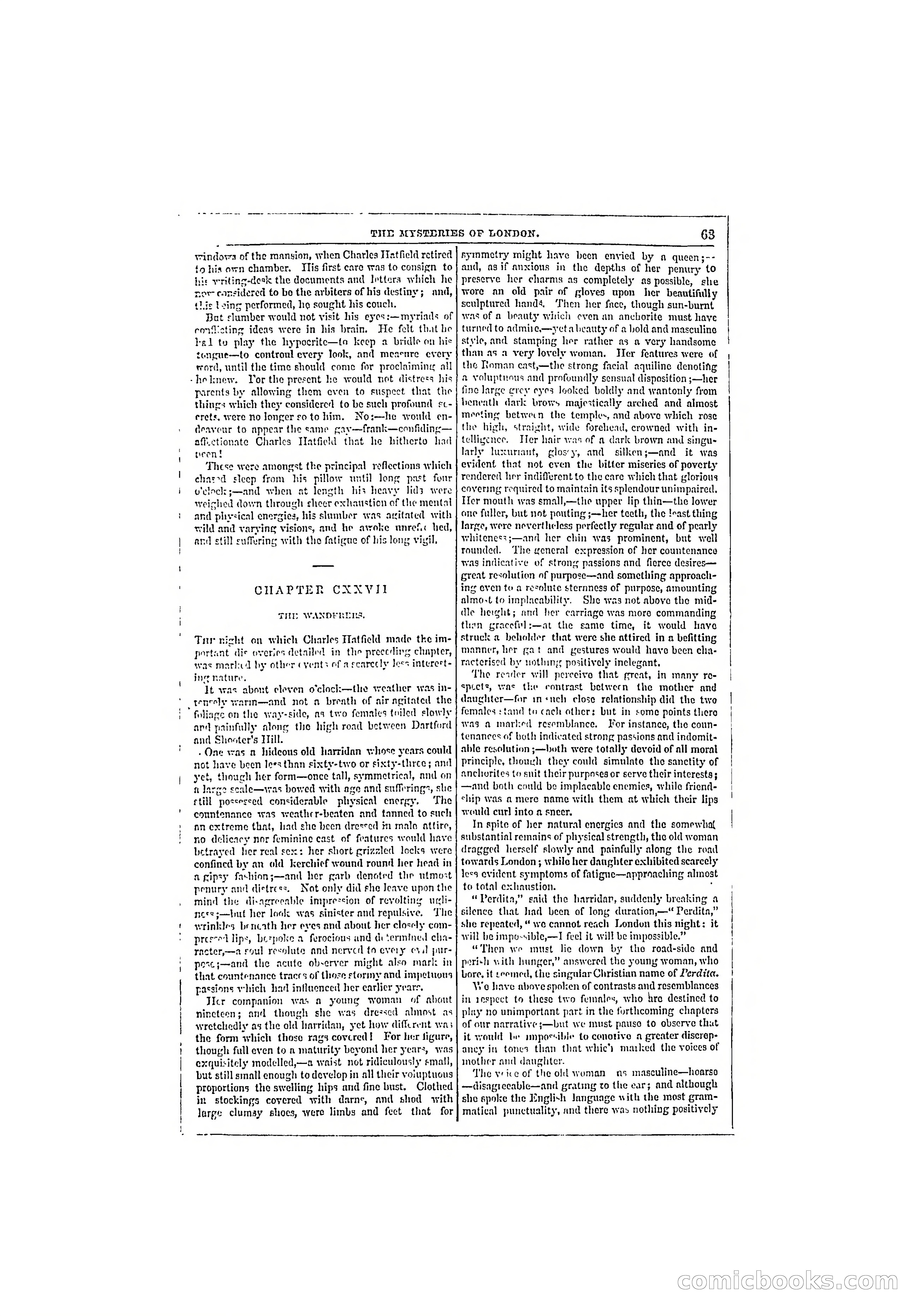
A restored page from Penny Dreadfuls, 1846. Page through the whole issue in the reader above.
📄 Transcribed text from this page (OCR, searchable)
Machine-transcribed from the original scan — historical spelling and the odd misread are preserved.
a et ee a ee rN, nm ae ee ee ae wee ee ees ome met ewe ee cm ane ee ae ree tee THE AYSLOERIES OF LONDON, -_ windows of the mansion, when Charles Hatfield retired 6g his own chamber. Ilis first care was to consign to his wriling-deak the documents and letters which he now cansidered to be the arbiters of his destiny; and, tlic teing performed, he sought his couch. Bat slumber would not visit his eyes:—myriads of coilicting ideas were in his brain. He felt that he bel te play the hypocrite—ta keep a bridle on his tongue-—to contronl every look, and meacnre cvery rord, until the time should come for proclaiming all -heknew. Yor the present he would not distress his parents by allowing them even to suspect that the things which they considered to be such profound ¢c- erets, were no longer rotohim. No:—he wold en- deayvour to appear the same gav-—~frank—confiding— aMf.ctionate Charles Ilatfield that dhe hitherto had peen! These were amongst the principal reflections which charted sleep from his pilloswy until long part fonr v'elock s—and when at length his heavy Jid3 were weiched down through sheer exhaustion of the mental and physical energies, his slumber was agitated with wild and varying visions, and he awoke anrefc hed, and still suffering with the fatigue of his long vigil, CHAPTER CXAAYVII THE WANDERERS, Tar nicht an which Charles TWatfield made the im- portant die ovaries detailed in the preecding chapter, wae marked hy other cyents of a ecarecly Jess interert- ing nature, It was abont cleven o’clock—the weather was in- reneely warm—and not a breath of air agitated the fuliage on the way-side, as two females toiled slowly and painfully along the high road between Dartford and Shoster’s Mill. . One was 2 hideous old harridan whose years could not have been lees than sixty-two or sixty-three; and yet, thouch her form—once tall, symmetrical, and on n large scale—wwas bowed with age and sufferings, she rtill possesced considerable physical energy. The conntenance was weather-beaten and tanned to such nn extreme that, had she been dresecd #1 malo attire, no delicacy nor feminine cast of features would have betrayed her real sex: her short grizzled locks were confined by an old kerchief wound round her head in agipsy fashions—and her garb denoted the utmost penury and dietrees. Not only did she Ieave upon the mind the disagreeable impression of revolting urgli- neces—buf her lok was sinister and repulsive. The wrinkles bencath her eves and about her closely com- preset lips, beepoke a ferocious and determined cha- racter,—a coul resolute and nervcd to every oval pur- porey—and the acute observer might also marl: in that countenance traces of Uhose stormy and impetuous passions which had influenced her earlier years. Her companion was a young woman of about nincteen; and though she was dressed almost as wretchedly as the old harridan, yet how different was the form which those rags covered! For her figure, though full even to a maturity beyond her years, was exquisitely modelled—a waist not ridiculously small, but still small enough to develop in all their voiuptuous proportions the swelling hips and fine bust. Clothed in stockings coyered with darn, and shod with large clumsy shoes, were limbs and fect that for —-_ ey re ee ot eee 63 syinmetry might have been envied by a queens-- aud, as if anxious in the depths of her penury to preserve her charms as completely as possible, she wore an old pair of gloves upon her beautifull y sculptured hand4, Then her face, though sun-burnt was of a beauty which even an anchorite must have turned to admiie—yeta beauty of a bold and masculine style, and stamping her rather as a very handsome than as a very lovely woman. Wer features were of the Noman cast,—the strong facial aquiline denoting a voluptrous and profuundly sensual disposition ;—her fine large grey eyes looked boldly and wantonly from henvath dark brows majestically arched and almost meeting betweon the temples, and above which rose the high, straight, wide forehead, crowned with in- telligenee. Her hair was of a dark brown and singu- larly luxuriant, glosy, and silkens—and it was evident that not even the bitter miseries of poverty rendered) her indifferent to the care which that glorious covering required to maintain its splendour unimpaired, Her mouth was small,—the upper lip thin—the lower one fuller, but not pouting ;—her teeth, the least thing large, were nevertheless perfectly recular and of pearly whiteness;—and her chin was prominent, but well rounded. The general expression of her countenance was indicative of strong passions and fierce desires— great resolution of purpose—and something approach- Ing even to a resolute sternness of purpose, amounting almost to implacability. She was not above the mid- dle heght; and her carriage was more commanding thin gracefil:—at the same time, if would have struck a behokler that were she attired in a befitting manner, her gat and gestures would have been cha- racterised by nothing positively inclegant, The reader will perceive that great, in many re- spictz, was the contrast between the mother and dauchter—for in «nuch close relationship did the twe females stand to cach other: but in some points thera wag a marked resemblance. Tor instance, the coun- tenanees of both indicated strong passions and indomit- able resolution ;—both were totally devoid of all moral principle, though they could simulate the sanctity of anchorites to suit their purposes or serve their interests —and both could bo implacable enemies, while friend- chip was a mere name with them at which their lips would curl into a sneer. In spite of her natural energics and the somewhat substantial remains of physical strength, the old woman dragged herself slowly and painfully along the road towards London ; while her daughter exhibited scarcely lees evident symptoms of fatigne—approaching almos to total exhaustion. ; *Perdita,” said the harridar, suddenly breaking a silence that had been of long duration,—“ Perdita,” she repeated, “ we cannot reach London this night: it will be impossible,—I feel it will be impossible.” “Then we must lie down by the road-side and perish with hunger,” answered the young woman, who Lore, it ceomed, the singuiar Christian name of Lerdita. 0 have above spoken of contrasts and resemblances in respect to these two females, who bre destined to play no unimportant part in the furthcoming chapters of our narrative ;—but we must pause to observe thut it would be ampossible to conotive a greater discrep- ancy in tones than that whic’) marked the voices of nother and daughter. The veice of the old woman ns masculine—hoarse —disngrecable—and grating to the ear; and although she spoke the English Janguage with the most gram- matical punctuality, and there was nothing positively | | (C(O) G DOO (SO)