
Penny Dreadfuls, 1846 · page 69 of 399
The Mysteries of London, Vol. IV — page 69: what you’re looking at
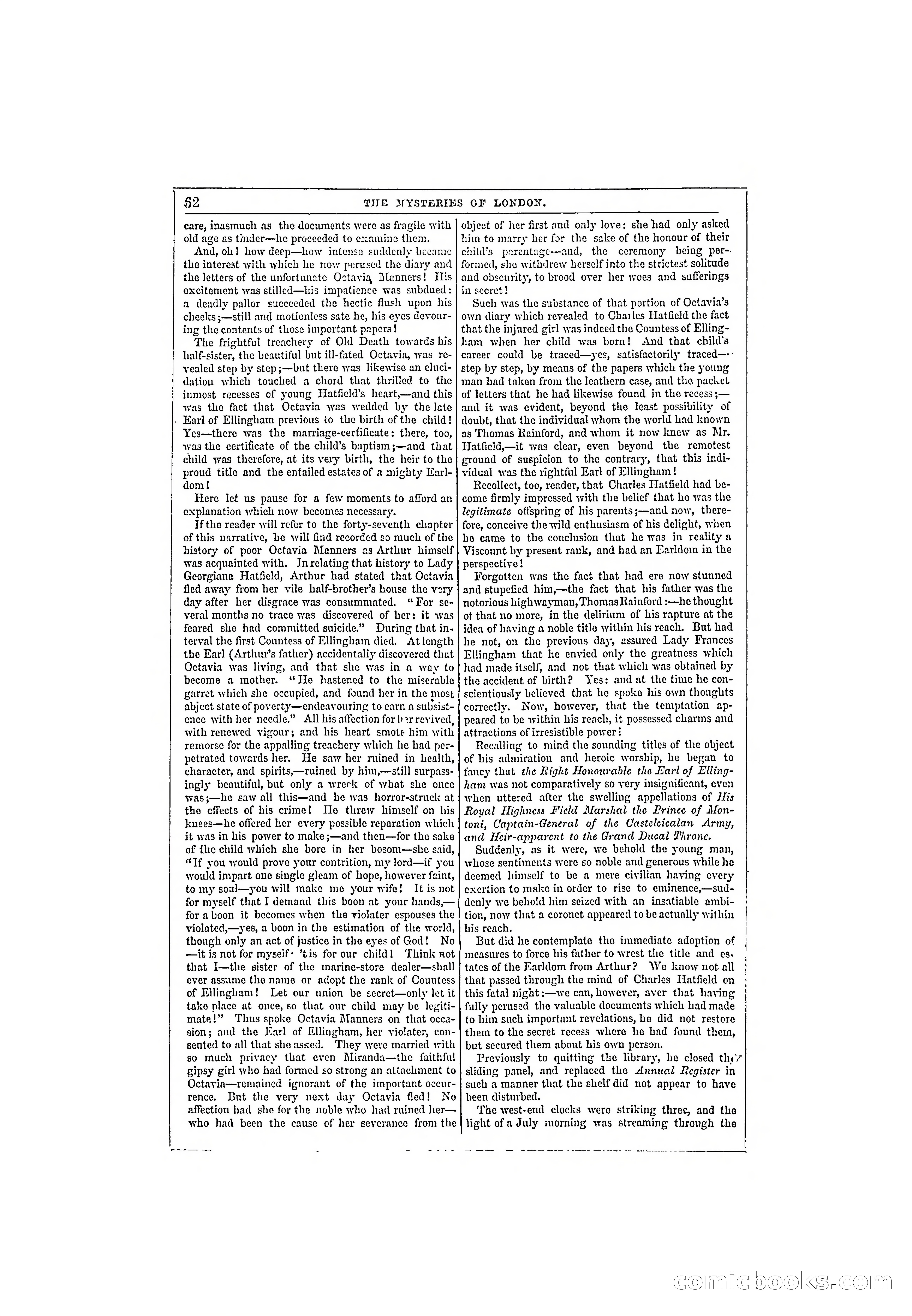
A restored page from Penny Dreadfuls, 1846. Page through the whole issue in the reader above.
📄 Transcribed text from this page (OCR, searchable)
Machine-transcribed from the original scan — historical spelling and the odd misread are preserved.
§2 TE MYSTERIES OF LONDON. care, inasmuch as the documents were as fragile with old age as tinder—he proceeded to examine them. And, oh! how deep—how intense suddenly became the interest with which he now perused the diary and the letters of the unfortunate Octavia Manners! Ilis excitement was stilled—his impatience was subdued: a deadly pallor succeeded the hectic flush upon his cheeks ;—still and motionless sate he, his eyes devour- ing the contents of those important papers! The frightful treachery of Old Death towards his half-sister, the beautiful but ill-fated Octavia, was re- vealed step by step;—but there was likewise an eluci- dation which touched a chord that thrilled to the inmost recesses of young Hatfield’s heart,—and this was the fact that Octavia was wedded by the late | Earl of Eltlingham previous to the birth of the child! Yes—there was the marriage-certificate: there, too, was the certificate of the child’s baptism;—and that child was therefore, at its very birth, the heir to the proud title and the entailed estates of a mighty Tarl- dom! Here Ict us pause for a few moments to afford an explanation which now becomes necessary. If the reader will refer to the forty-seventh chapter of this narrative, he will find recorded so much of the history of poor Octavia Menners 2s Arthur himself was acquainted with. Inrelating that history to Lady Georgiana Hatfield, Arthur had stated that Octavia fled away from her vile half-brother’s house the very day after her disgrace was consummated. “Tor se- veral months no trace was discovered of her: it was feared she had committed suicide.” During that in- terval the first Countess of Ellingham died. Atlength the Ear] (Arthur’s father) accidentally discovered that Octavia was living, and that she was in a way to become a mother. ‘He hastened to the miserable garret which she occupied, and found her in the most abject state of poverty—endeavouring to earn a subsist- ence with her needle.” All his affection for hr revived, with renewed vigour; and his heart smote him with remorse for the appalling treachery which he had per- petrated towards her. He saw her ruined in health, character, and spirits,—ruined by him,—still surpass- ingly beautiful, but only a wreck of what she once was ;—he saw all this—and he was horror-struck at the effects of his crime! Ie threw himself on his knees—he offered her every possible reparation which it was in his power to make ;—and then—for the sake of the child which she bore in her bosom—she said, “Tf you would prove your contrition, my lord—if you would impart one single gleam of hope, however faint, to my soul—you will make me your wife! It is not for myself that I demand this boon at your hands,— for aboon it becomes when the violater espouses the violated,—yes, a boon in the estimation of the world, though only an act of justice in the eyes of God! No —it is not for myseif: *tis for our child! Think not that I—the sister of the marine-store dealer—shall ever assume the name or adopt the rank of Countess of Eilingham! Let our union be secret—only let it tako place at once, so that our child may be legiti- mate!” Thus spoke Octavia Manners on that occa- sion; and the Larl of Ellingham, her violater, con- sented to all that shoasxed. They were married with s0 much privacy that even Miranda—the faithful gipsy girl who had formed so strong an attachment to Octavia—remained ignorant of the important occur- rence. But the very next day Octavia fled! No affection had she for the noble who had ruined her— who had been the cause of her severance from the object of her first and only love: she had only asked him to marry her for the sake of the honour of their child’s parentagc-—and, the ceremony being per-- formed, she withdrew herself into the strictest solitude and obscurity, to brood over her woes and sufferings in secret! Such was the substance of that portion of Octavia’s own diary which revealed to Charles Hatfield the fact that the injured girl was indeed the Countess of Elling- ham when her child was born! And that child's career conld be traced—yes, satisfactorily traced—-- step by step, by means of the papers which the young man had taken from the leathern case, and the pachet of letters that he had likewise found in the recess ;— and it was evident, beyond the least possibility of doubt, that the individual whom the world had known as Thomas Rainford, and whom it now knew as Mr. Hatfield,—it was clear, even beyond the remotest ground of suspicion to the contrary, that this indi- vidual was the rightful Earl of Hilingham! Recollect, too, reader, that Charles Hatfield had be- come firmly impressed with the belief that he was the legitimate offspring of his parents ;—and now, there- fore, conceive the wild enthusiasm of his delight, when he came to the conclusion that he was in reality a Viscount by present rank, and had an Earldom in the perspective! Forgotten was the fact that had ere now stunned and stupefied him,—the fact that his father was the notorious highwayman, Thomas Rainford :—he thought ot that no more, in the delirium of his rapture at the idea of having a noble title within his reach. But had he not, on the previous day, assured Lady Frances Ellingham that he envied only the greatness which had made itself, and not that which was obtained by the accident of birth? Yes: and at the time he con- scientiously believed that he spoke his own thoughts correctly. Now, however, that the temptation ap- peared to be within his reach, it possessed charms and attractions of irresistible power: Recalling to mind the sounding titles of the object of his admiration and heroic worship, he began to fancy that the Right Honourable the Earl of Elling- ham was not comparatively so very insignificant, even when uttered after the swelling appcellations of Jiis Roual Highness Field Marshal the Prince of Mon- toni, Captain-General of the Castelcicalan Army, and Heir-apparent to the Grand Ducal Throne. Suddenly, as it were, we behold the young man, whose sentiments were so noble and generous while he deemed himself to be a mere civilian having every exertion to make in order to rise to eminence,—sud- denly we behold him seized with an insatiable ambi- tion, now that a coronet appeared to be actually within his reach. But did he contemplate the immediate adoption of measures to force his father to wrest the title and es. tates of the Earldom from Arthur? We know not all that passed through the mind of Charles Hatfield on this fatal night:—we can, however, aver that having fully perused the valuable documents which had made to him such important revelations, he did not restore them to the secret recess where he had found them, but secured them about his own person. Previously to quitting the library, he closed they sliding panel, and replaced the dirnuad Register in such a manner that the shelf did not appear to have been disturbed. ‘The west-end clocks were striking three, and the light of a July morning was streaming throngh the — ee ee —_— me tee ee ee ee EConnicloooks oe ee ee ee en, oe we (SO)