
Penny Dreadfuls, 1846 · page 35 of 399
The Mysteries of London, Vol. IV — page 35: what you’re looking at
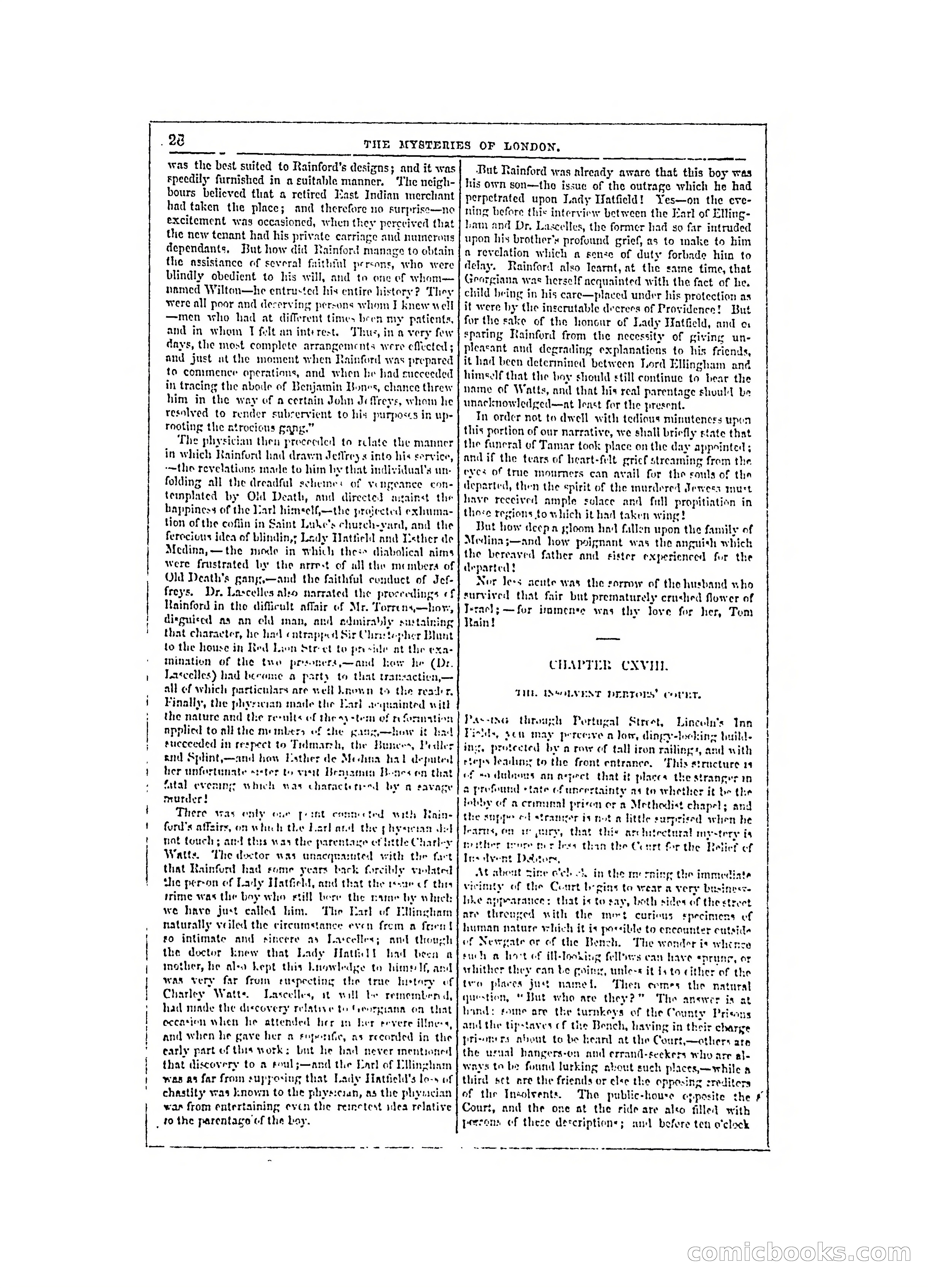
A restored page from Penny Dreadfuls, 1846. Page through the whole issue in the reader above.
📄 Transcribed text from this page (OCR, searchable)
Machine-transcribed from the original scan — historical spelling and the odd misread are preserved.
ieee we — —— see ae ee ee wee re oe eee 28 ett — was the best suited to Rainford’s designs; and it was Epecdilyy furnished in a suitable manner. ‘The neigh- bours believed that a retired East Indian merchant had taken the place; and therefore no surprise—no excitement was occasioned, when they perceived that the new tenant had his private carriage and numerous dependants, But how did Rainford manage to obtain the nssisiance of several faithinl persons, who were blindly obedient to his will, and to one ef whom— named Wilton—he entrusted his entire history? They were all poor and deserving persons whom J knew well —men who had at diferent times been my patients, and in whom T felt an interest. Thus, ina very few days, the most complete arrangements were effected 3 and just at the moment when Rainford was prepared to commence operations, and when he had succeeded in tracing the abode of Benjamin Bones, chance threw him in the way of a certain John Ji Mfrevs, who he resolved to render subservient to his purposes in up- rooting the atrocious pang.” The physician then preceeded toa rclate the manner in which HRainford had drawn Jetlrey s into his service, ‘~the revelations made to him hy that individual's un- folding all the dreadful schemes of vengeance con- templated by Old Death, and directed ayainst the happiness of the Marl himeetf¥—the prolected exhuma- tion of the coflin in Saint Luke's church-vard, and the ferocious idea of blindin,s Lady Tattield and Usther de Medina,—the mode in which thes dabolical aims Were frustrated by the arm of all the members of Old Death's pang,—and the faithful conduct of Jef- froys. Dr. Lascelles aloo narrated the proceedings f Rainford in tho difficult affair of Mr. Torrens-how, disguiecd as an eld man, and edinirably sustaining that character, he had catrappud Sir Chnstepher Blunt fo the house in Red Lion Street to preite at the exa- mination of he two prsonerty—and how he (Dr. Laccelles) had beeame a parts to that uansaction— all ef which particulars are well Lnown to the reader, Finally, the phyrician made the Earl acquainted with the nature and the results of the syste of mn ormation applicl toalithe members of the gats—how it bad tuceceded in respect to Trdmarh, the Bunces, Pedler end Splinty—and how Esther de Medina hal demited her unfortunate steter to wert Beniamia Bonesen that fatal evening: which was chatactetiesd by a savage murder! There was only one post cannected with Rain- furd’s affeiry, on whieh the Larland the phyeeian del nat touch; ard ths was the parentare of hittle Charley Watts. ‘The doctor was unsequamtel with the fact that Rainford had some years back forcibly violated she peron of Lady Uatfield, and that the rage cf thes mime was the boy who etill bere the name by whick we have just called him. The Earl of Elingham naturally veiled the circumstance even from a foen! ro intimate and sincere as Larcefles; amd though the doctor knew that Lady Hathilf had beca a nother, he aleo hept this Lnowledge to himself, and was very far frum euspecting the tre hetery af Charley Watts. Lascelles, at wall be remember d, had minte the diccovery relative to Goorgiina on tliat eceation when he attended her ain her severe fines, and when he gave her a tepernfic, as recorded in the early part of this work: but he had never mentioned that discovery to a reoulj;—and the Earl of Ellingham was as far from supposing that Lady Hatfeld's lo-s of chastity was known to the physician, as the pliviiclan war from eniertaining evin the remnctest udea relative fo the parentage of the boy, a eT AN LO OEE TO EE SIRES A itm A Sn tl Rg “A Rat a I IE TS IT ee maa a en THE MYSTERIES OF LONDON, ae Sy > © oS ome But Rainford was already aware that this boy was his own son—tho issue of the outrage which he had perpetrated upon Lady Datfield! Yes—on the eve- ning before thie interview between the Earl of ENing- Lam and Dr, Lascelles, the former had so far intruded upon his brother's profound grief, as to make to him a revelation which a sense of duty forbade hin to delay. Rainford also Tearnt, at the same time, that Georgiana was herself acquainted with the fact of he. child being in his care—placed under his protection as it were by the inscrutable decrees of Providence! But forthe sake of the honour of Lady Watfield, and oa sparing Rainford from the necessity of giving une pleacant and degrading explanations to his friends, it had been determined between Lord Ellingham and himeelf that the boy should still continue to bear the name of Watts, and that his real parentage should be unacknowledged—at lenst for the present. Tn order not to dwell with tedious minutences upon this portion of our narrative, we shall briefly state that the funeral of Tamar took place on the day appointed ; and if the tears of heart-felt grief streaming from the eyes of tme moumers can avail fur the sons of tha departed, then the spirit of the murdered Jewees murt have received ample solace and full propitiation in thos regions fo which it had taken wing! But how deepa gloom had fallen upon the family of Medina;—and how poignant was the anguidh which the bereaved father and cister experienced fur the departed! Nor Jess acute was the sorrow of the husband who survived that fair but prematurely crunched flower of Teracls —for immense was thy Jove for her, Tom Nain! CHAPTER CXVH,. TUE UNSeoLVENT prrroms’ contr. Pascstng through Portugal Street, Linceln's Inna Bisidsy, seu may percesve a low, dingy -lockine buihl- ng, protected by a row of tall iron railings, and with eteps Jeadiny: to the front entrance. ‘his structure 1 Pea duliors an aspect that if placce the strangers an a profund tate ofuncertainty as te whether it be the lobby of a crimunal priton or a Methodist chapels and the suppe ed stranver is not a hitte surprised when he fears, on oir yuirv, that thie architectural mystery is tether troce ges dees than the Coort fr the Relier ef Insclvent Dabtor, At about tine wel oh in the me sning the immediate virinity of Che Court begins to wear a very business. Lhe appearance: that isto say, both sides of the street ar’ througed with the meg curieus specimens of human nature which it is pocdlly to encounter cutaide of Newgate ar of the Bench. The wonder is whence tuch a hactof itl-fooking fellows can have «prune, or whither they can be goin, unle-s it fs to cither of the two places just namet Then comes the natural question, “But who are they?” The anaes in at hand: some are the turnkeys of the County: Prisons andthe tipstaves cf the Bench, having in their charge privoners about to be heanl at the Court—aothers are the usual hangers-on and errand-seekers who arr al- vays ta be found lurking about such places—owhile a third set are the friends or clee the opposing erediters of the Insolvents. Tho public-houre opposite the Court, and the one at the ride are alco filled with persons of these dercriptions; aml before ten o'clock ee a a ee (CO JOO SS (CO)