
Penny Dreadfuls, 1846 · page 297 of 399
The Mysteries of London, Vol. IV — page 297: what you’re looking at
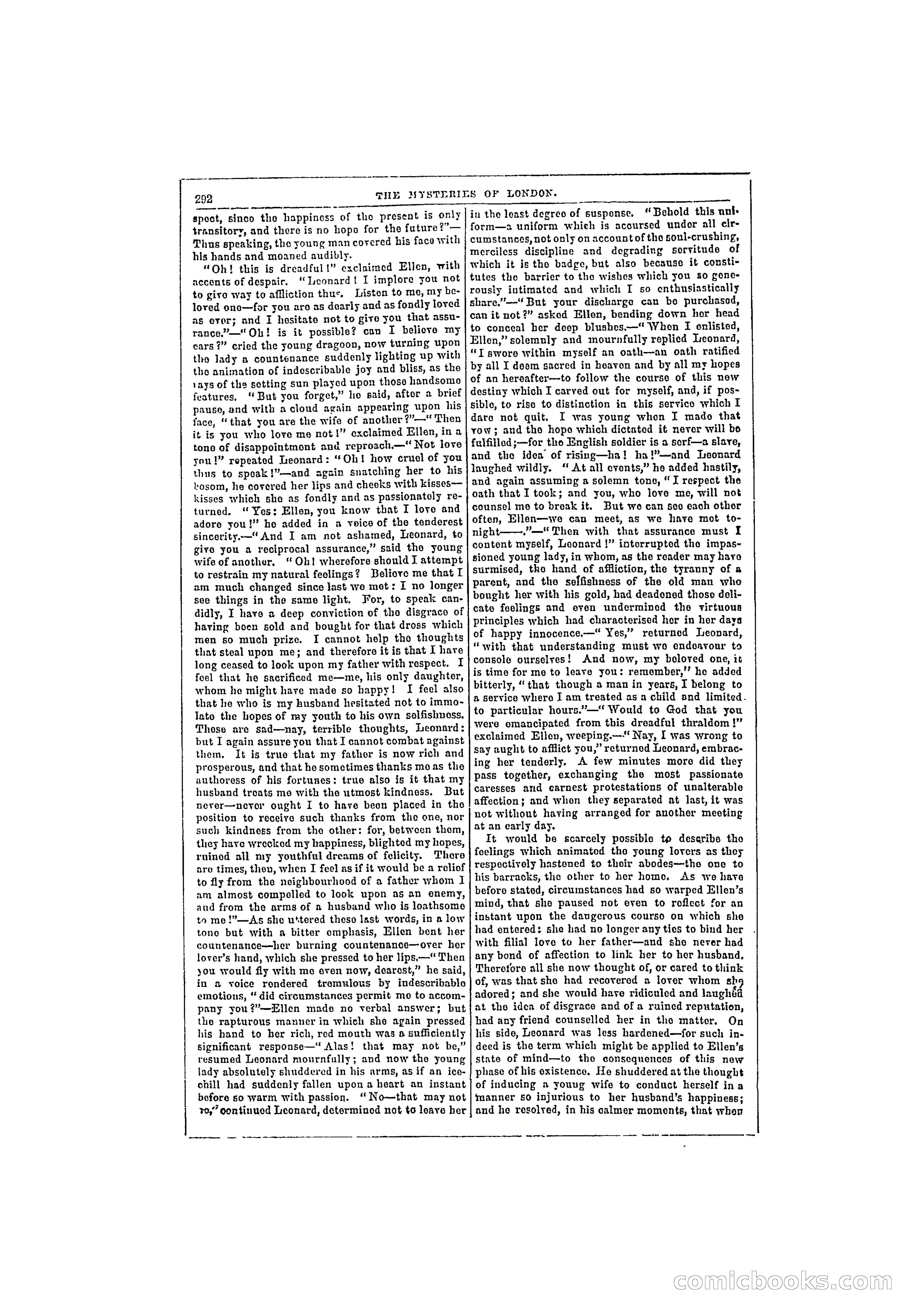
A restored page from Penny Dreadfuls, 1846. Page through the whole issue in the reader above.
📄 Transcribed text from this page (OCR, searchable)
Machine-transcribed from the original scan — historical spelling and the odd misread are preserved.
292 THE MYSTERIES OF LONDON. ed eed spoct, sinco the happiness of the present is only transitory, and there is no hopo for the future i Thus speaking, the young man corcred his face with his hands and moaned audibly. “Oh! this is dreadful!” exclaimed Elien, with necents of despair. “Isconard! I implore you not to givo way to affliction thus. Listen to me, my be- loved ono—for you are as dearly and as fondly loved as ever; and I hositate not to give you that assu- rance2”—" Oh! is it possible? can I beliove my ears?” cried the young dragoon, now turning upon tho lady a countenance suddenly lighting up with tho animation of indescribable joy and bliss, as the rays of the sotting sun played upon those handsomo features. “ But you forget,” he said, after a brief pause, and with a cloud again appearing upon his face, “that you are the wife of another ?”—‘ Then it is you who love me not!” exclaimed Ellen, in a tone of disappointmont and reproach.—" Not love youl”? repeated Leonard: “Oh! how cruel of you thus to spoak!”—and again snatching her to his bosom, he covered her lips and cheeks with kisses— kisses which she as fondly and as passionately re- turned. “Yes: Ellen, you know that I love and adore you!” he added in a voice of the tenderest sincerity.—“* And I am not ashamed, Leonard, to give you a reciprocal assurance,” said the young wife of another. “Ob! wherefore should I attempt to restrain my natural feelings? Believe me that I 2m much changed since last we met: I no longer see things in the same light. For, to speak can- didly, I have a deep conviction of tho disgraco of having boen sold and bought for that dross which men 50 much prize. I cannot help the thoughts that steal upon me; and therefore it is that I have long ceased to look upon my father with respect. I foel that he sacrificed me—me, his only daughter, whom he might have made so happy! I feel also that he who is my husband hesitated not to immo- lato the hopes of my youth to his own solfishnoss. Those are sad—nay, terrible thoughts, Leonard: but I again assure you that I cannot combat against them. It is true that my fathor is now rich and prosperous, and that he sometimes thanks mo as the authoress of his fortunes: true also is it that my husband treats me with the utmost kindness. But never—nevor ought I to have beon placed in the position to receive such thanks from the one, nor such kindness from the other: for, between them, they have wrecked my happiness, blighted my hopes, ruined all my youthful dreams of felicity. Thore are times, they, when I feel as if it would be a reliof to fly from the neighbourhood of a father whom I am almost compelled to look upon as an enemy, aud from the arms of a husband whio is loathsome to moe !”—As she uttered theso last words, in a low tono but with a bitter omphasis, Ellen bent her countenance—her burning countenance—over hor lover’s hand, which she pressed to her lips,—“ Then you would fly with mo even now, dearest,” he said, in a voice rendered tremulous by indescribablo emotions, “ did circumstances permit mo to accom- pany you?’—Elien made no verbal answer; but the rapturous manner in which she again pressed his hand to her rich, red mouth was a sufficiently significant response—“ Alas! that may not be,” resumed Leonard mournfully; and now the young lady absolutely shuddered in his arms, as if an ice- chill had suddenly fallen upon a heart an instant before so warm with passion. “ No—that may not 30,” continued Leonard, determiuod not to leave her in the least degree of suspense, “Behold this unt form—a uniform which is acoursed undor all clr- cumstances, not only on accountof the soul-crushing, merciless discipline and degrading sorvitude of which it is the badge, but also because it consti- tutes the barrier to the wishes which you so gone- rously iutimated and which I so enthusiastically share,’—* But your discharge can be purchasod, can it not?” asked Ellen, bending down her head to conceal her deop blushes.——“ Whon I enlisted, Ellen,” solemnly and mournfully replied Leonard, “T swore within myself an oath—an oath ratified by all I deom sacred in heaven and by all my hopes of an hereafter—to follow the course of this new destiny which I carved out for myself, and, if pos- sible, to rise to distinction in this service which I dare not quit. I was young when I mado that vow; and the hopo which dictated it never will bo fulfilled ;—for the English soldier is a serf—a slare, and the idea of rising—ha! ha!”—and Leonard laughed wildly. “ At all events,” he added hastily, and again assuming a solemn tone, “I respect the oath that I took; and you, who love me, will not counsol me to break it. But wo can see each other often, Ellen—we can meet, as we have mot to- night——.”—""Then with that assurance must I content myself, Leonard !” interrupted the impas- sioned young lady, in whom, as the reader may have surmised, tho hand of affliction, the tyranny of a parent, and the selfishness of the old man who bought her with his gold, had deadoned those deli- cate feelings and even undermined the virtuoua principles which had characterised her in her days of happy innocence.—“ Yes,” returned Leonard, “with that understanding must wo endoavour to console ourselves! And now, my beloved one, it is time for me to leave you: remember,’’ he added bitterly, “that though a man in years, I belong to a re eS A a service where 1 am treated as a child and limited. to particular hours.”’— Would to God that you were omancipated from this dreadful thraldom !” exclaimed Ellen, weeping.—-‘ Nay, I was wrong to say aught to afflict you,” returned Leonard, embrac- ing her tenderly. A few minutes more did they pass together, exchanging the most passionate caresses and earnest protestations of unalterable affection; and whon they separated at last, it was not without having arranged for another meeting at an early day. It would be scarcely possible tp describe tho feelings which animated the young lovers as they respectively hastened to thoir abodes—the one to his barracks, the other to her home. As we have before stated, circumstances had so warped Ellen’s mind, that she paused not even to roflect for an instant upon the dangerous course on which she had entered: she had no longer any ties to bind her with filial love to her father—and she never had any bond of affection to link her to hor husband. Therefore all she now thought of, or cared to think of, was that she had recovered a lover whom shq adored; and she would have ridiculed and laughéd at the idea of disgrace and of a ruined reputation, had any friend counselled her in the mattor. On his side, Leonard was less hardened—for such in- deed is the term which might be applied to Elien’s state of mind—to tho consequences of this new phase of his oxistence. He shuddered at the thought of inducing a youug wife to conduct herself ina manner 50 injurious to her husband’s happiness; and he resolred, in his calmer moments, that when =e Oo ———_- Mater om (CO) 5} — GIOOKS (CO) >