
Penny Dreadfuls, 1846 · page 296 of 399
The Mysteries of London, Vol. IV — page 296: what you’re looking at
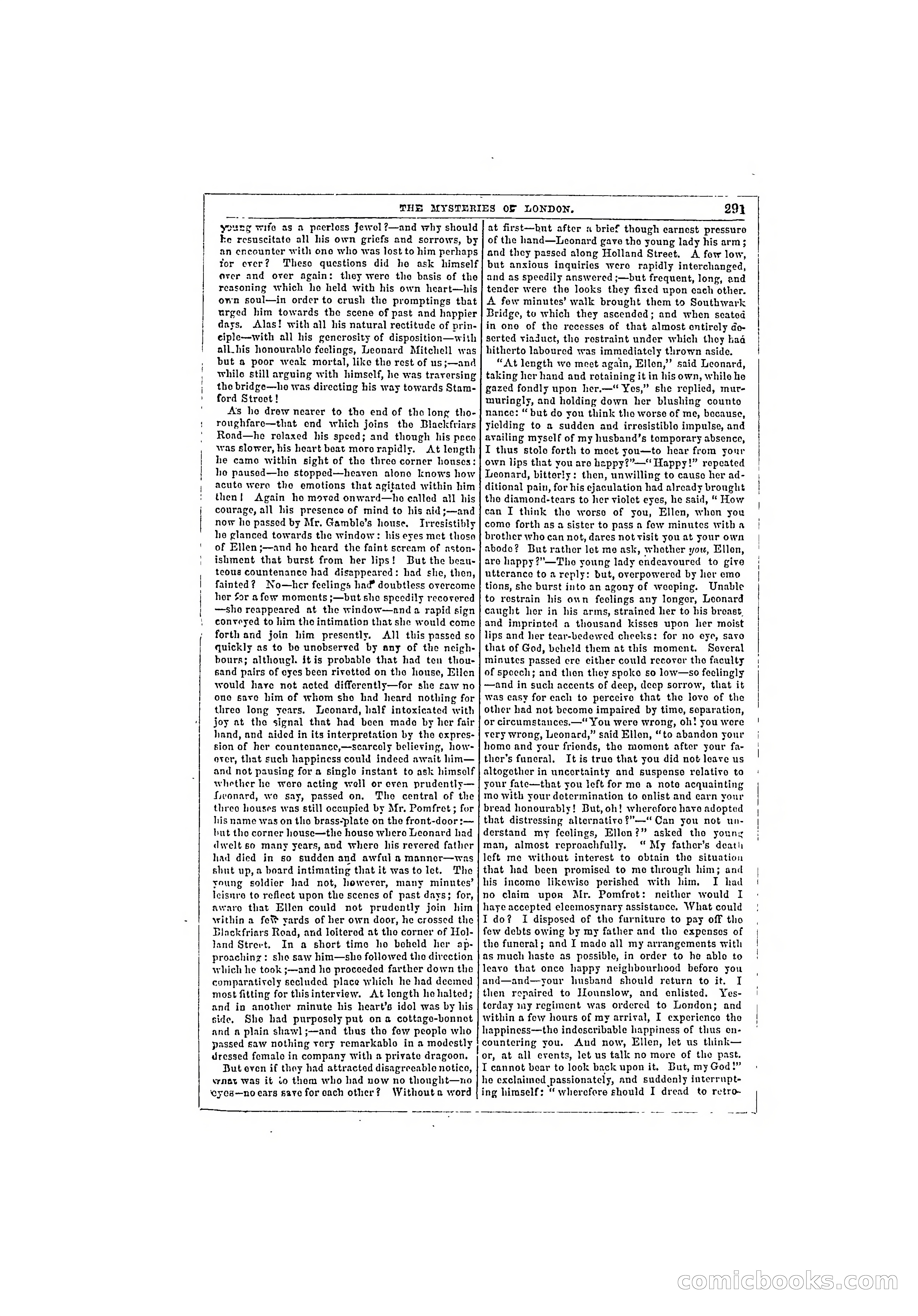
A restored page from Penny Dreadfuls, 1846. Page through the whole issue in the reader above.
📄 Transcribed text from this page (OCR, searchable)
Machine-transcribed from the original scan — historical spelling and the odd misread are preserved.
= ee — Se et ee THE MYSTERIES OF LONDON. —_—e - yourg wife as a peerless Jfewol?—and why should ke resuscitate all his own griefs and scrrows, by an encounter with one who was lost to him perhaps tor ever? Theso questions did he ask himself over and over again: they were the basis of the reasoning which he held with his own heart—his own soul—in order to crush the promptings that urged him towards the scene of past and happier dass. Alas! with all his natural rectitude of prin- ciple—with all his generosity of disposition—with all_his honourable feelings, Leonard Mitchell was but a poor weak mortal, like the rest of us;—and while still arguing with himself, he was traversing the bridge—he was directing his way towards Stam- ford Street! As he drew nearer to tho end of tho long tho- roughfare—that end which joins the Blackfriars Rond—he relaxed his speed; and though his pece was slower, his heart beat mororapidly. At length he camo within sight of the three corner houses: hoe paused—he stopped—heaven alone knows how acute were the emotions that agitated within him then! Again ho moved onward—ho ealled all his courage, all his presence of mind to his aid ;-——and now ho passed by Mr. Gamble’s house, Irresistibly he glanced towards the window: his eyes met those of Ellen:—and ho heard the faint scream of aston- ishment that burst from her lips! But the beau- teous countenance had disappeared: had she, then, fainted? No—her feelings had’ doubtless overcome hor for afew moments ;—but she speedily recovered —sho reappeared at the window—nand a rapid sign conveyed to him the intimation that she would come forth and join him presently. All this passed so quickly as to be unobserved by any of the ncigh- bours; although itis probable that had ten thou- sand pairs of eyes been rivotted on the house, Ellen would have not acted differently—for she saw no one save him of whom sho bad heard nothing for threo long years. Jsconard, half intoxicated with joy at the signal that had been mado by her fair hand, and aided in its interpretation by the oxpres- sion of her countenance,—scarcoly believing, how- ever, that such happiness could indeed await him— and not pausing for a singlo instant to ask himsolf whether he wero acting well or even prudently— Ssveonard, we say, passed on, The central of the threo houses was still occupied by Mr. Pomfret; for lis name was on the brass-plate on the front-door:— but tho corner house—the house whero Leonard had dwelt 60 many years, and where his revered father had died in so sudden and awful 5 mannor—was shut up, a board intimating that it was to let. The young soldier had not, however, many minutes’ Ieisnre to reflect upon the scenes of past days; for, aware that Ellen could not prudently join him within a fei® yards of her own door, he crossed the Blackfriars Road, and loitered at the corner of Ho}- land Street. In a short time ho beheld her ap- proaching: she saw him—she followed thie direction which he took ;—and he proceeded farther down the comparatively secluded place which he had deemed most fitting for thisinterview. At length he halted; and in another minute his heart’s idol was by his side, Shoe had purposely put ona cottage-bonnot and a plain shawl ;—and thus tho few people who passed saw nothing vory remarkablo in a modestly dressed female in company with a private dragoon. But even if they had attracted disagreeable notice, vrnat was it vo them who had now no thought—no cyes—no ears save for cach other? Withouta word en ee me et er ee ee 293 at first—but after « brief though earnest pressure of the hand—Leonard gave the young lady his arm; and they passed along Holland Street. A fow low, but anxious inquiries wero rapidly interchanged, and as specdily answered ;—but frequent, long, and tender were the looks they fixed upon each other. A few minutes’ walk brought them to Southwark Bridge, tou which they ascended; and when seated in one of the recesses of that almost entirely do- serted viaduct, the restraint under which thoy haa hitherto laboured was immediately thrown aside. “At length wo meet again, Ellen,” said Leonard, taking lier hand and rotaining it in his own, while he gazed fondly upon her.—“ Yes,” she replied, mur- muringly, and holding down her blushing counto nance: “but do you think tho worse of me, because, yielding to a sudden and irrosistiblo impulse, and availing myself of my husband’s tomporary absence, I thus stolo forth to mect you—to hear from your own lips that you are heppy?”—" Happy!” ropeated Leonard, bitterly: then, unwilling to cause her ad- ditional pain, for his ejaculation had already brought the diamond-tears to her violet eyes, he said, “ How can I think tho worse of you, Ellen, whon you come forth as a sister to pass a fow minutes with a brother who can not, dares not visit you at your own abode? But rather let me ask, whether you, Ellen, are happy ?"—Tho young lady endeavoured to give utterance toareply: but, overpowered by her emo tions, she burst into an agony of weeping. Unable to restrain his awn feolings any longer, Loonard caught her in his arms, strained her to his breast and imprinted a thousand kisses upon her moist lips and her tear-bedewed cheeks: for no eye, savo that of God, beheld them at this moment. Several minutes passed cre either could recover tho faculty of spocch; and thon they spoke so low—so feelingly ~—and in such accents of deep, deep sorrow, that it was casy for each to perceive that the love of the other had not become impaired by time, separation, or circumstances.—“ You were wrong, oh! you were very wrong, Leonard,” said Ellen, “to abandon your homo and your friends, the momont after your fa- ther’s funeral. Itis truo that you did not leave us altogether in uncertainty and suspense relativo to your fate—that you Ieft for me a note acquainting mo with your determination to onlist and earn your bread honourably! But, oh! wherefore havo adopted that distressing alternativo ?”’—" Can you not un- derstand my feolings, Ellon?” asked the young man, almost reproachfully. “ My father’s death left me without interest to obtain tho situation that had been promised to me through him; and his income likewise perished with him. I had no claim upor Mr. Pomfrot: neither would I haye accepted eleemosynary assistance. What could I do? I disposed of tho furniture to pay off thio few debts owing by my father and tho expenses of the funeral; and I mado all my arrangements with as much haste as possible, in order to he ablo to leavo that once happy neighbourhood before you and—and—your husband should return to it. I then repaired to JZounslow, and enlisted. Yes- terday 11y reriment was ordered to London; and Within a few hours of my arrival, I experience the happiness—the indescribable happiness of thus en- countering you. And now, Ellen, let us think— or, at all events, let us talk no more of the past. I cannot bear to look back upon it. But, my God?” he exclaimed passionately, and suddenly interrupt- ing himself: “ wherefore should I dread to retro oo —— - —~ as +, (C(O) (C DOO <S LL (SO)