
Penny Dreadfuls, 1846 · page 273 of 399
The Mysteries of London, Vol. IV — page 273: what you’re looking at
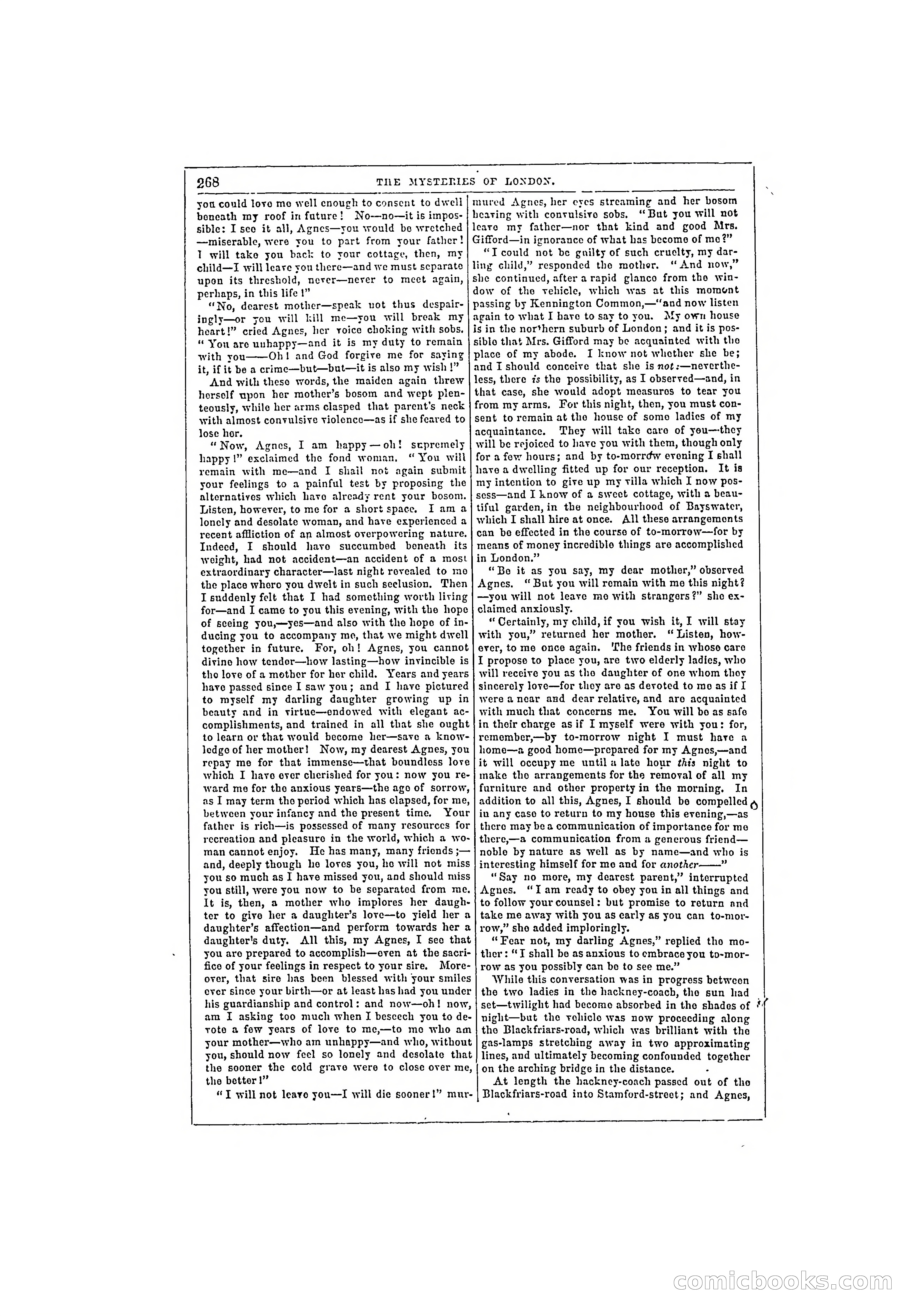
A restored page from Penny Dreadfuls, 1846. Page through the whole issue in the reader above.
📄 Transcribed text from this page (OCR, searchable)
Machine-transcribed from the original scan — historical spelling and the odd misread are preserved.
ge 268 you could love me well cnough to consent to dwell beneath my roof in future! No--no—it is impos- sible: I seo it all, Agnes—you would be wretched —miserable, were you to part from your father! T will take you back to your cottage, then, my child—I will leave you there-——and we must scparate upon its threshold, never—nerer to meet again, perhaps, in this life 1” “No, dearest mother—speak not thus despair- ingly—or jou will kill me—you will break my heart!” cried Agnes, her voice choking with sobs. “ You are unhappy—and it is my duty to remain with you Oh! and God forgive me for saying it, if it be a crime—but—but—it is also my wish |” And with these words, the maiden again threw herself upon her mother’s bosom and wept plen- teously, while her arms clasped that parent's neck with almost convulsive violence—as if she feared to lose hor. “Now, Agnes, I am happy—oh! sepremely happy!” exclaimed the fond woman, “ You will remain with me—and I shait not again submit your feelings to a painful test by proposing the alternatives which have already rent your bosom. Listen, however, to me for a short space. I am a lonely and desolate woman, and have experienced a recent affliction of an almost overpowering nature. Indeed, I should have succumbed beneath its weight, had not accident—an accident of a most extraordinary character—last night revealed to mo the place whoero you dwelt in such seclusion, Then I suddenly felt that I had something worth living for—and I came to you this evening, with the hope of seeing you,—yes—and also with the hope of in- ducing you to accompany me, that we might divell torether in future. For, oh! Agnes, you cannot divine how tender—how lasting—how invincible is tho love of a mother for her child. Years and years have passed since I saw you; and I have pictured to myself my darling daughter growing up in beauty and in virtue—endowed with elegant ac- complishments, and trained in all that she ought to learn or that would become her—save a know- ledge of her mother! Now, my dearest Agnes, you repay me for that immense—that boundless love which I have ever clicrished for you: now you re- ward me for the anxious years—the age of sorrow, as I may term tho period which has clapsed, for me, between your infancy and the present time. Your father is rich—is possessed of many resources for recreation and pleasure in the world, which a wo- man cannot enjoy. He has many, many friends ;— and, deeply though he loves you, ho will not miss you so much as J have missed you, and should miss you still, were you now to be separated from me. It is, then, a mother who implores her daugh- ter to give her a daughter’s love—to yield her a daughter’s affection—and perform towards her a daughter's duty. All this, my Agnes, I see that you are prepared to accomplish—even at the sacri- fice of your feelings in respect to your sire. More- over, that sire has been blessed with your smiles ever since your birth—or at least has had you under his guardianship and control: and now—oh! now, am I asking too much when I beseech you to de- yote a few years of love to me,—to me who am your mother—who am unhappy—and who, without you, should now feel so lonely and desolate that the sooner the cold grave were to close over me, the better!” “TY will not leavyo you—TI will die sooner!” mur- THE MYSTENIES OF LONDON, mured Agnes, her eyes streaming and her bosom hearing with convulsive sobs. “But you will not leare my father—nor that kind and good Mrs. Gifford—in ignorance of what has become of me?” “T could not be guilty of such cruelty, my dar- ling child,” responded the mother. ‘“ And now,” she continued, after arapid glanco from the win- dow of the vehicle, which was at this moment passing by Kennington Common,—‘and now listen again to what I have to say to you. My own house is in the northern suburb of London; and it is pos- sible that Mrs. Gifford may be acquainted with tho place of my abode. I know not whether she be; and I should conceive that she is not :—neverthe- less, there is the possibility, as I observed—and, in that case, she would adopt measures to tear you from my arms. For this night, then, you must con- sent to remain at the house of somo ladies of my acquaintance. They will take care of you—they will be rejoiced to have you with them, though only for a few hours; and by to-morrdw evoning I shall have a dwelling fitted up for our reception. It is my intention to give up my villa which I now pos- sess—and I know of a sweet cottage, with a beau- tiful garden, in the neighbourhood of Bayswater, which I shall hire at once. All these arrangements can be effected in the course of to-morrew—for by means of money incredible things are accomplished in London.” “Boe it as you say, my dear mother,” obsorved Agnes. “ But you will remain with me this night? —you will not leave me with strangers?” sho ex- claimed anxiously. “Certainly, my child, if you wish it, I will stay with you,” returned her mother. “ Listen, how- ever, to me once again. ‘The friends in whose caro I propose to place you, are two elderly ladies, who will receive you as the daughter of one whom thoy sincerely love—for thoy are as devoted to mo as if I Were a near and dear relative, and are acquainted with much that concerns me. You will bo as safe in their charge as if I myself were with you: for, remember,—by to-morrow night I must have a home—a good home—prepared for my Agnos,—and it will occupy me until alate hour this night to make the arrangements for the removal of all my furniture and other property in the morning, In addition to all this, Agnes, I should be compelled a in any case to return to my house this evening,—as there may be a communication of importance for me there,—a communication from a generous friend— noble by nature as well as by name—and who is interesting himself for me and for another is “Say no more, my dearest parent,” interrupted Agnes. “Iam ready to obey you in all things and to follow your counsel: but promise to return and take me away with you as early as you can to-nor- row,” she added imploringly. “Fear not, my darling Agnes,” replied the mo- ther: “JI shall be as anxious to embrace you to-mor- row as you possibly can be to see me.” While this conversation was in progress between the two ladies in the hackney-coacb, the sun had set—twilight had become absorbed in the shades of vight—but the vehicle was now procecding along the Blackfriars-road, which was brilliant with the gas-lamps stretching away in two approximating lines, and ultimately becoming confounded together on the arching bridge in the distance. : At length the hackney-coach passed out of tho Blackfriars-road into Stamford-street; and Agnes, “_- a a econmlelooolks (CO)