
Penny Dreadfuls, 1846 · page 272 of 399
The Mysteries of London, Vol. IV — page 272: what you’re looking at
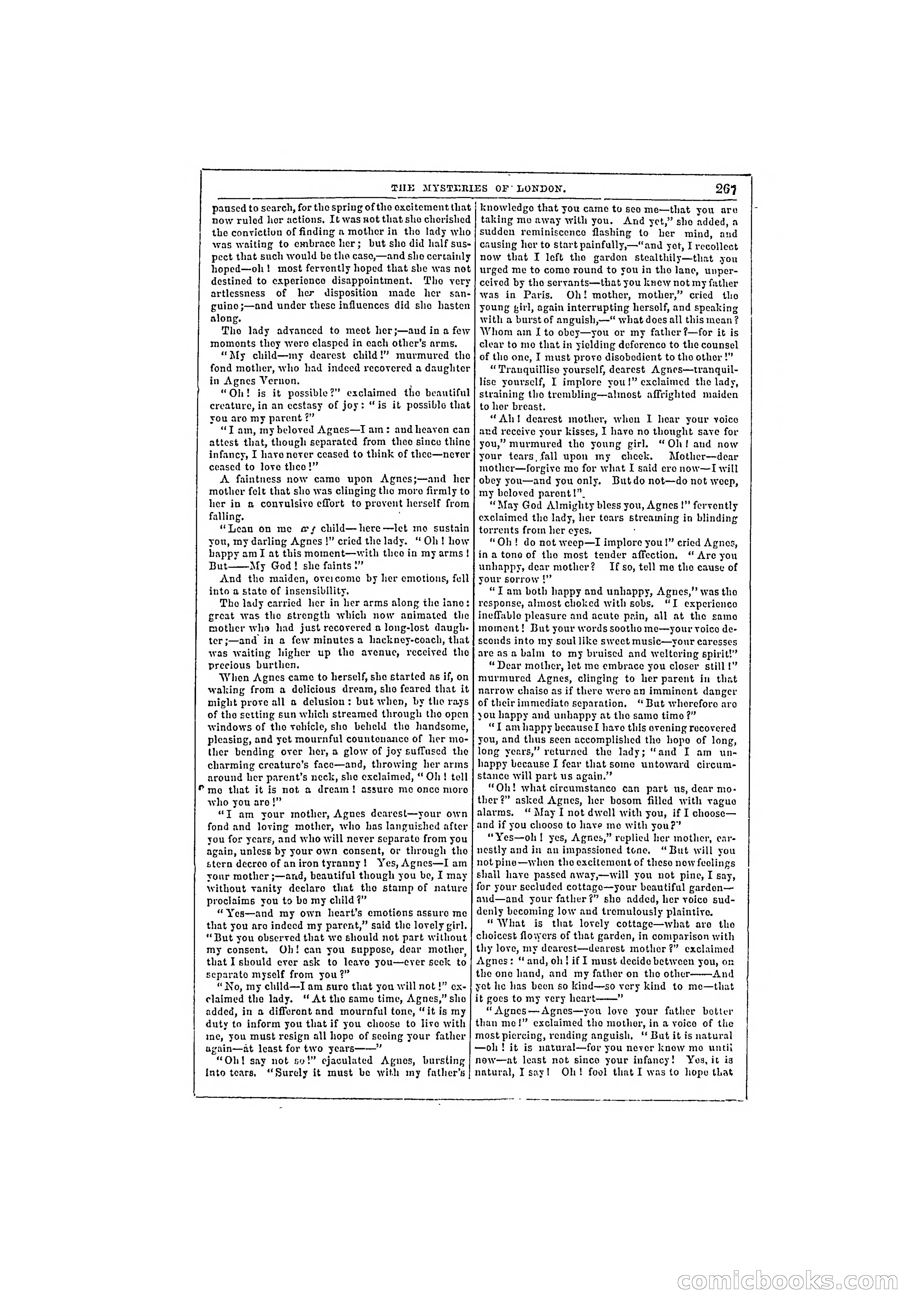
A restored page from Penny Dreadfuls, 1846. Page through the whole issue in the reader above.
📄 Transcribed text from this page (OCR, searchable)
Machine-transcribed from the original scan — historical spelling and the odd misread are preserved.
aaa ee MYSTIRNIES OF LONDON. THE 267 paused to search, for the spring of the oxcitement that | knowledgo that you came tu seo me—that you are now ruled her actions, It was not that sho cherished the conviction of finding a mother in the lady who was waiting to embrace her; but she did half sus- pect that such would be the caso,—and shie certainly hoped—ol! most fervently hoped that she was not destined to experience disappointment. The very artlessness of her disposition made her san- guino ;—and under these influences did slio hasten along. Tho lady advanced to meot her ;—and in a few momonts thoy were clasped in each other’s arms. “My child—my dearest child!” murmured tho fond mother, who had indeed recovered a daughter in Agnes Vernon. . “Oh! is it possible?” exclaimed tho beautiful creature, in an ecstasy of joy: “is it possible that you aro my parent 2” “T am, my beloved Agnes—I am: and heavon can attest that, though separated from theo since thine infancy, I have nover ceased to think of thece—nevor ceased to love theo!” A. faintness now came upon Agnes;—and her mother felt that sho was clinging the more firmly to her in a convulsivo effort to provent herself from falling. | “Lean on me wy child— here —Iet mo sustain you, my darling Agnes !” cried the lady. “ Oh! how bappy am I at this moment—with thco in my arms! But——-My God! she faints °” And the maiden, oreicome by her emotions, fell into a State of insensibllity, The lady carried her in her arms along the iane: great was tho strength which now animated tlic mother who had just recovered a long-lost daugh- ter;—and in a few minutes a hackney-coach, that was waiting higher up tho avenuc, received the precious burthen. When Agnes came to herself, sho started as if, on waking from a delicious dream, sho feared that it night prove all a delusion: but when, by tho rays of the setting sun which streamed through tho open windows of tho vehicle, sho beheld the handsome, pleasing, and yct mournful countenance of her mo- ther bending over her, a glow of joy suffused the charming creaturo’s facc—and, throwing her arms around her parent’s neck, she exclaimed, “Oh! tell © mo that it is not a dream! assure mo once more who you aro !” “YT am your mother, Agnes dearest—your own fond and loving mother, who bas languished after you for ycars, and who will never separate from you again, unless by your own consent, or through tho stern decree of anirontyranny! Yes, Agnes—I am your mother ;—and, beautiful though you be, I may Without vanity declaro that the stamp of nature proclaims you to be my child?” “Yes—and my own heart’s emotions assuro me that you aro indecd my parent,” said the lovely girl. “But you observed that we should not part without my consent, Oh! can you suppose, dear mother, that I should ever ask to leave you—cver scck to separato myself from you ?” “No, my child—Iam suro that you will not!” cx- claimed the lady. ‘ At tho same time, Agnes,” sho added, in a different and mournful tone, “it is my duty to inform you that if you choose to live with ine, you must resign all hopo of secing your father again—at least for two years——” “Oh! say not so!” ejaculated Agnes, bursting Into tears, “Surely it must be with my father’s taking me away will you. And yet,” sho added, a sudden reminiscence flashing to her mind, and causing her to start painfully,—‘and yet, I recollect now that I left tho gardon stealthily—that you urged me to come round to sou in the lane, unper- ceived by the servants—that you knew not my father was in Paris. Oh! mother, mother,” cried tho young girl, again interrupting hersolf, and speaking with a burst of anguish,— what does all this mean ? Whom ain I to obey—you or my father ?—for it is clear to mo that in yielding deference to the counsel of tle one, I must prove disobedient to the other !” “Trauquillise yourself, dearest Agnes—tranquil- lise yourself, I implore you!” exclaimed the lady, straining tho trembling—almost affrighted maiden to her breast. “Ah! dearest mother, when I hear your voice ard receive your kisses, I have no thought save for you,” murmured tho young girl “Oh! and now your tears, fall upon my cheek. Mother—dear mother—forgive me for what I said ere now~—I will obey you—and you only. Butdo not—do not weep, my beloved parent!”. “Nay God Almighty bless you, Agnes !” fervently exclaimed the lady, her tears streaming in blinding torrents from her eyes. “Oh! do not weep—I implore you!” cried Agnes, ina tone of the most tender affection. “ Are you unhappy, dear mother? If so, tell me tle cause of your sorrow !” * Jam both happy and unhappy, Agnes,” was tho response, almost choked with sobs. “I experience ineffable pleasure and acute pain, all at the samo moment! But your words sootho me—your voico de- sconds into my soul like swect music—your caresses are asa balm to my bruised and weltering spirit!” “Dear mother, let me embrace you closer still!” murmured Agnes, clinging to her parent in that narrow chaise as if there were an imminont danger of their immediate separation. “ But whorefore aro you happy and unhappy at tho samo time ?” “T am happy because! have this ovening recovered you, and thus seen accomplished the hope of long, long years,” returned the Iady; “and I am un- happy because I fear that some untoward circum- stance will part us again.” “Oh! what circumstanco can part us, dear mo- ther?” asked Agnes, her bosom filled with vague alarms. “ May I not dwell with you, if I choose— and if you choose to have mo with you?” “Yes—oh! yes, Agnes,” replied her mother, car- nestly and in an impassioned tone, “But will you not pine—when tho oxcitemont of theso now feelings shall have passed away,—will you not pine, I say, for your secluded cottage—your beautiful gardon— aud—and your father?” she added, her voice sud- denly becoming low and tremulously plaintive. “What is that lovely cottage—what aro the choicest flowers of that garden, in comparison with thy love, my dearest—dearest mother?” exclaimed Agnes: “and, oh! if I must decide between you, on the one hand, and my father on the other——And yot lie has been so kind—so very kind to me—that it gocs to my very heart——” “ Agnes—aAgnes—you love your father botter than me!” exclaimed the mother, in a voice of the most piercing, rending anguish, ‘* But it is natural —oh! it is natural—for you never knew me untii now-——at least not since your infancy! Yos, it ia natural, Isay! Oh! fool that I was to hope that a (C(O) (C DOO <S LL (SO)