
Penny Dreadfuls, 1846 · page 259 of 399
The Mysteries of London, Vol. IV — page 259: what you’re looking at
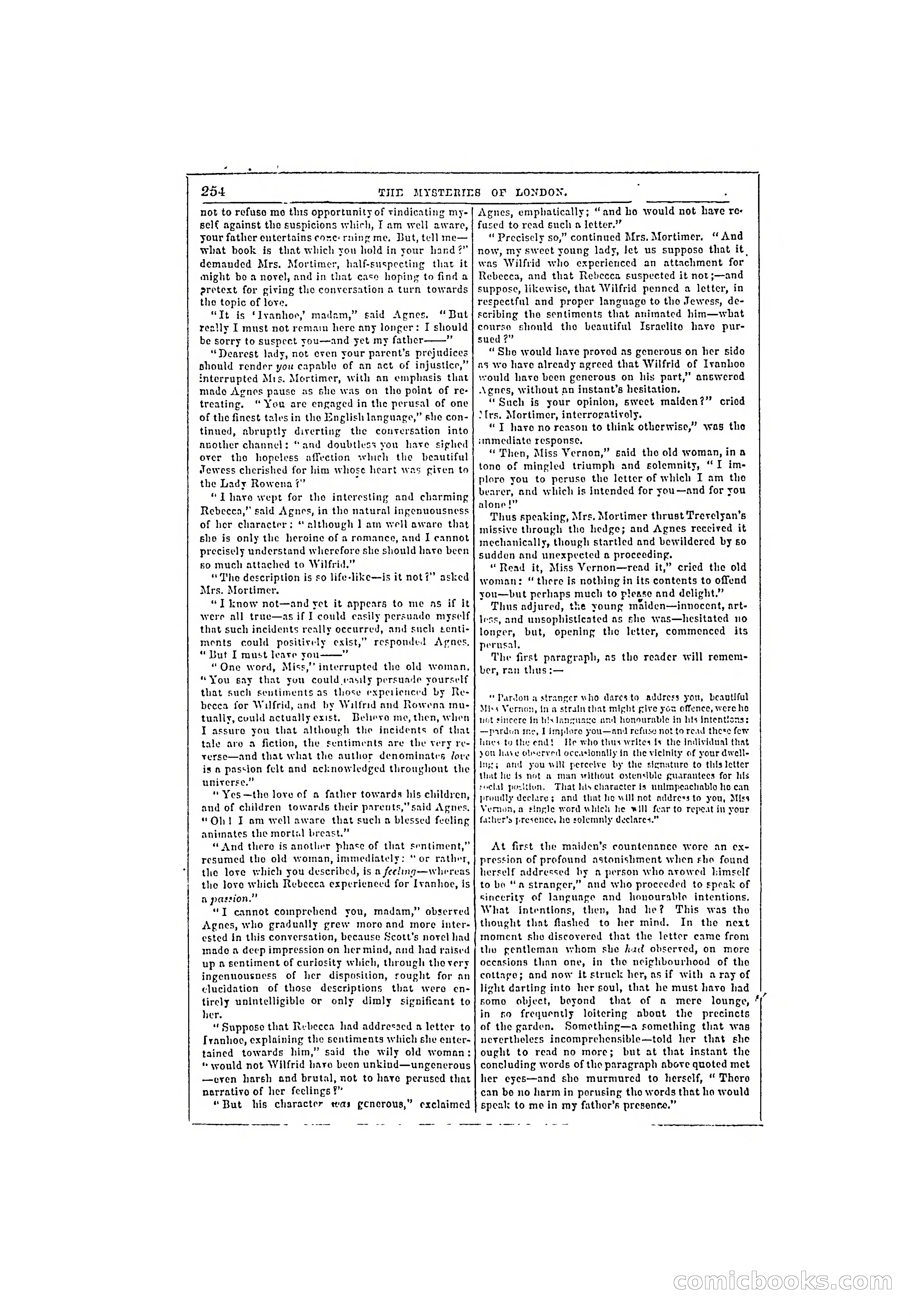
A restored page from Penny Dreadfuls, 1846. Page through the whole issue in the reader above.
📄 Transcribed text from this page (OCR, searchable)
Machine-transcribed from the original scan — historical spelling and the odd misread are preserved.
e Pap AE a A 254 not to refuse mo this opportunity of vindicating my- self against the suspicions which, Iam well aware, your father entertains cone: rning me, But, tell me— what book is that which you hold in your hand?” demanded Mrs. Mortimer, half-suspecting that it might bo a novel, and in that case hoping to find a eretext for giving the conversation a turn towards the topic of love. “Tt is ‘Ivanhoe,’ madam,” said Agnes. “ But rec!ly I must not remain here any longer: I should be sorry to suspeet you—and yet my father ” “Dearest lady, not even your parent’s prejudices should render you capable of an act of injustice,” interrupted Mrs. Mortimer, with an emphasis that mado Agnes pause as she was on tho point of re- treating. “ You are engaged in the perusal of one of the finest talesin the English language,” she con- tinued, abruptly diverting the conversation into another channel: “and doubtless you have sighed over tho hopcless affection which the beautiful Jewess cherished for him whose heart was given to the Lady Rowena ¢” “Thavoe wept for the interesting and charming Rebecca,” said Agnes, in tho natural ingenuousness of her character: “although ] am well aware that she is only the heroine of a romance, and I cannot precisely understand wherefore she should have been so much attached to Wilfrid.” “Tho description is so life-like—is it not?’ asked Mrs. Mortimer. “JT know not—and yet it appears to me as if it were all truc—as if I could easily persuado myself that such incidents really occurred, and such tenti- ments could positively exist,” responded Agnes, * But I must leave you “One word, Miss,” interrupted the old woman, “You say that you could easily persuade yourself that such sentiments as those experlenced by Re- becea for Wilfrid, and by Walfrid and Rowena mu- tually, could actually exist. Behevo me, then, when I assure you that although the incidents of that tale aro a fiction, the sentiments are the very re- verse—and that what the author denominates love isn passion felt and acknowledged throughout the universe.” “Yes—the love of a father towards his children, and of children towards their parents,’ said Agnes, “Oht I am well aware that such o blessed fecling animates the mortal breast.” “And there is another phase of that sentiment,” resumed tho old woman, immediately: “or rather, the love which you described, is a feeding—whereas tho love which Rebecca experienced for Ivanhoe, is a passion.” “T cannot comprehend you, madam,” observed Agnes, who gradually grew moro and more inter- ested in this conversation, because Scott’s novel had made a deep impression on her mind, and had raised up a sentiment of curlosity which, through tho very ingenuousness of her disposition, rought for an elucidation of those descriptions that wero cn- tircly unintelligible or only dimly significant to her. “Suppose that Rebecea had addressed a letter to Ivanhoo, explaining the sentiments which she enter- tained towards him,” said tho wily old woman: * would not Wilfrid have beon unkind—ungenerous —cven harsh and brutal, not to have perused that narrativo of her feelings %” “But his character was gencrous,” exclaimed THE MYSTERIES OF LONDON. ‘ Agnes, emphatically; “and ho would not have re- fused to read such a Iectter.” “Precisely so,” continued Mrs. Mortimer, “ And now, my sweet young lady, Iet us suppose that it, was Wilfrid who experienced an attachment for Rebecca, and that Rebecca suspected it not ;—and suppose, likewise, that Wilfrid penned a Ietter, in respectful and proper languago to tho Jewess, de- scribing the sentimonts that animated him—whbat courso shonld the beautiful Israelito have pur- sucd ?” “ Sho would have proyvod as generous on her sido as wo have already agreed that Wilfrid of Ivanhoo would have been gencrous on his part,” answerod Agnes, without an instant’s hesitation. “Such is your opinion, sweet maiden?” criod ‘{rs. Mortimer, interrogativoly. “TJ havo no reason to think otherwise,” was the immediate response. “Then, Miss Vernon,” said the old woman, ina tono of mingled triumph and solemnity, “ I ime plore you to peruso the letter of which I am the bearer, and which is Intended for you—and for you nlone !” Thus speaking, Mrs. Mortimer thrust Trevelyan’s missive through tho hedge; and Agnes reccived it mechanically, though startled and bewildered by 50 sudden and unexpected a proceeding. “Read it, Miss Vernon—read it,” cried the old woman: “there is nothing in its contents to offend you—but perhaps much to please and delight.” Thus adjured, the young malden—innocent, art- less, and unsophisticated as she was—hesitated no longer, but, opening the Ietter, commenced its perusal, The first paragraph, as tho reader will remem- ber, ran thus:— “Pardon a stranger who dares to address you, beautiful Miss Vernon, ina strain that might give you offence, were ho not sincere In tis danguage and honournbdle in his intentions: —pardoun ime, Limplore you—and refuse not to read these few lines tothe end! He who thus writes fs the individual that yon Ihave observed occasionally in the vicinity of your dwell- Ings ond you will pereeive by the siensture to this letter that he is not a man without ostensible guarantees for hits rockal positon, That his character ts unlmpeachablo ho can proudly declare; and thathe will not addressto you, Sf{ls¢ Vernon, a single word which he will fear to repeat in your father’s presence, ho solemnly declares.” At first the maiden’s countenance wore an ex- pression of profound astonishment when sho found herself addressed by a person who avowed himsclf to bo “a stranger,” and who procecded to speak of sincerity of Janguage and honourable intentions. What intentions, then, had he? This was tho thought that flashed to her mind. In the next moment sho discoverod that the letter came from the gentleman whom she had observed, on more occasions than one, in tho neighbourhood of the cottage; and now it struck her, as if with a ray of light darting into her soul, that he must havo had some object, beyond that of a mere lounge, in so frequently loitering obont the precincts of the garden. Something—a something that was nevertheless incomprehensible—told her that she ought to read no more; but at that instant the concluding words of the paragraph above quoted met her eyes—and sho murmured to herself, “ Thoro can be no harm in porusing tho words that ho would speak to mein my fathor’s presence.” ~ - --—-— —_—— en ~ ——— _— woe ee eee el _~_ _ ws mo ete EConnicloooks (SO)