
Penny Dreadfuls, 1846 · page 258 of 399
The Mysteries of London, Vol. IV — page 258: what you’re looking at
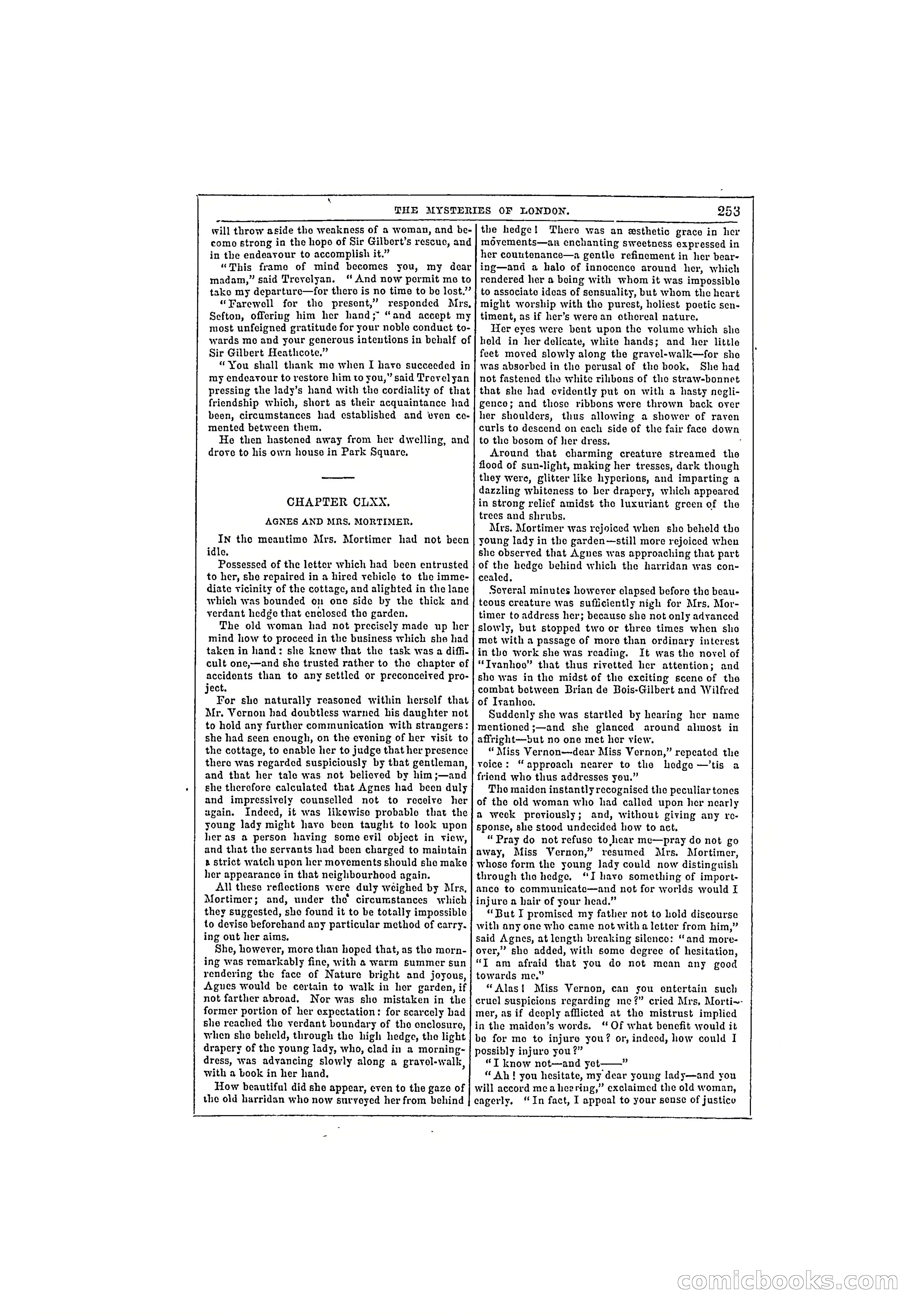
A restored page from Penny Dreadfuls, 1846. Page through the whole issue in the reader above.
📄 Transcribed text from this page (OCR, searchable)
Machine-transcribed from the original scan — historical spelling and the odd misread are preserved.
THE MYSTERIES OF LONDON. will throw aside the weakness of a woman, and be- como strong in the hopo of Sir Gilbert’s rescue, and in the endeavour to accomplish it.” “This frame of mind becomes you, my dear madam,” said Trevelyan. “ And now permit me to take my departure—for there is no time to be lost.” “Farewell for tho present,’ responded Mrs, Sefton, offering him her hand;~ “and accept my most unfeigned gratitude for your noble conduct to- wards me and your gencrous inteutions in behalf of Sir Gilbert Heathcote.” “You shall thank me when I have succeeded in my endeavour to restore him to you,” said Trevelyan pressing the lady’s hand with the cordiality of that friendship which, short as their acquaintance had been, circumstances had established and vven ce- mented between them. He then hastened away from her dwelling, and drove to his own house in Park Square, CHAPTER CLXX. AGNES AND MRS. MORTIMER. IN the meantime Mrs. Mortimer had not been idle. Possessed of the letter which had been entrusted to her, she repaired in a hired vehicle to the imme- diate vicinity of the cottage, and alighted in the lane which was bounded on one side by the thick and verdant hedge that enclosed the garden. The old woman had not precisely made up her mind how to proceed in the business which she had taken in hand: she knew that the task was a diffi. cult one,—and she trusted rather to the chapter of accidents than to any settled or preconceived pro- ject. For sho naturally reasoned within herself that Mr. Vernon had doubtless warned bis daughter not to hold any further communication with strangers: she had seen enough, on the evening of her visit to the cottage, to enable her to judge that her presence there was regarded suspiciously by that gentleman, and that her tale was not belicved by him ;—and she therefore calculated that Agnes had been duly and impressively counselled not to receive her zpain. Indeed, it was likewiso probable that the young lady might have been taught to look upon her as a person having some evil object in view, and that the servants had been charged to maintain a strict watch upon her movements should she make her appearance in that neighbourhood again. All these reflections were duly weighed by Mrs, Mortimer; and, under the circumstances which they suggested, sho found it to be totally impossible to deyise beforehand any particular method of carry. ing out her aims, She, however, more than hoped that, as the morn- ing was remarkably fine, with a warm summer sun rendering the face of Nature bright and joyous, Agues would be certain to walk in hor garden, if not farther abroad. Nor was she mistaken in the former portion of her expectation: for scarcely bad she reached the verdant boundary of tho enclosure, when she beheld, through the high hedge, the light drapery of the young lady, who, clad in a morning- dress, was advancing slowly along a gravol-walk, with a book in her hand, How beautiful did she appear, even to the gaze of the old harridan who now survoyed her from behind eagerly. 253 the hedge! There was an esthetic grace in her moyvements—ar enchanting sweetness expressed in her countenance—a gentle refinement in her bear- ing—and a halo of innocence around her, which rendered her a boing with whom it was impossible to associate ideas of sensuality, but whom the heart might worship with the purest, holiest poetic sen- timent, as if her’s were an othereal nature. Her eves were bent upon the volume which she held in her delicate, white hands; and her little feet moved slowly along the gravel-walk—for she was absorbed in the perusal of the book, She had not fastened the white rilbons of tho straw-bonnet that she had evidently put on with a hasty negli- gence; and those ribbons were thrown back over her shoulders, thus allowing a shower of raven curls to descend on each side of the fair face down to the bosom of her dress, Around that charming creature streamed the flood of sun-light, making her tresses, dark thongh they were, glitter like hyperions, and imparting a darzling whiteness to ber drapery, which appeared in strong relicf amidst the luxuriant green of the trees and shrubs, Mrs. Mortimer was rejoiced when she beheld tho young lady in the garden—still more rejoiced when she observed that Agnes was approaching that part of the hedge behind which the harridan was con- cealed. Several minutes however elapsed before the beau- teous creature was sufficiently nigh for Mrs, Mor- timer to address her; because she not only advanced slowly, but stopped two or three times when sho met with a passage of more than ordinary interest in tho work she was reading. It was the novel of “Tvanhoo” that thus rivotted her attention; and sho was in the midst of the exciting scene of the combat botween Brian de Bois-Gilbert and Wilfred of Ivanhoe. Suddenly she was startled by hearing her name mentioned ;—and she glanced around almost in affright—but no one met her view. “Miss Vernon—dear Miss Vernon,” repeated the voice: “approach nearer to tle hedge —’tis a friend who thus addresses you.” The maiden instantly recognised the peculiar tones of the old woman who had called upon her nearly a week proviously; and, without giving any re- sponse, she stood undecided how to act. “Pray do not refuse to hear me—pray do not go away, Miss Vernon,” resumed Mrs. Mortimer, whose form the young lady could now distinguish through the hedge. “I have something of import- ance to communicate—and not for worlds would I injure a hair of your head.” “But I promised my father not to hold discourse with any one who came not with a letter from him,” said Agnes, at length breaking silenco: “and more- over,” she added, with some degree of hesitation, “T am afraid that you do not mean any good towards me.” “Alas! Miss Vernon, can sou ontertain such cruel suspicions regarding me?” cried Mrs, Morti~- mer, as if deoply afflicted at the mistrust implied in the maidon’s words. ‘ Of what benefit would it be for mo to injure you? or, indeed, how could I possibly injure you 2” “T know not—and yet——” “Ah! you hesitate, my dear young lady—and you will accord mca heering,” exclaimed the old woman, “Tn fact, I appeal to your sense of justice LS LL I FO A tr Fh (C(O) (C DOO <S LL (SO)