
Penny Dreadfuls, 1846 · page 190 of 399
The Mysteries of London, Vol. IV — page 190: what you’re looking at
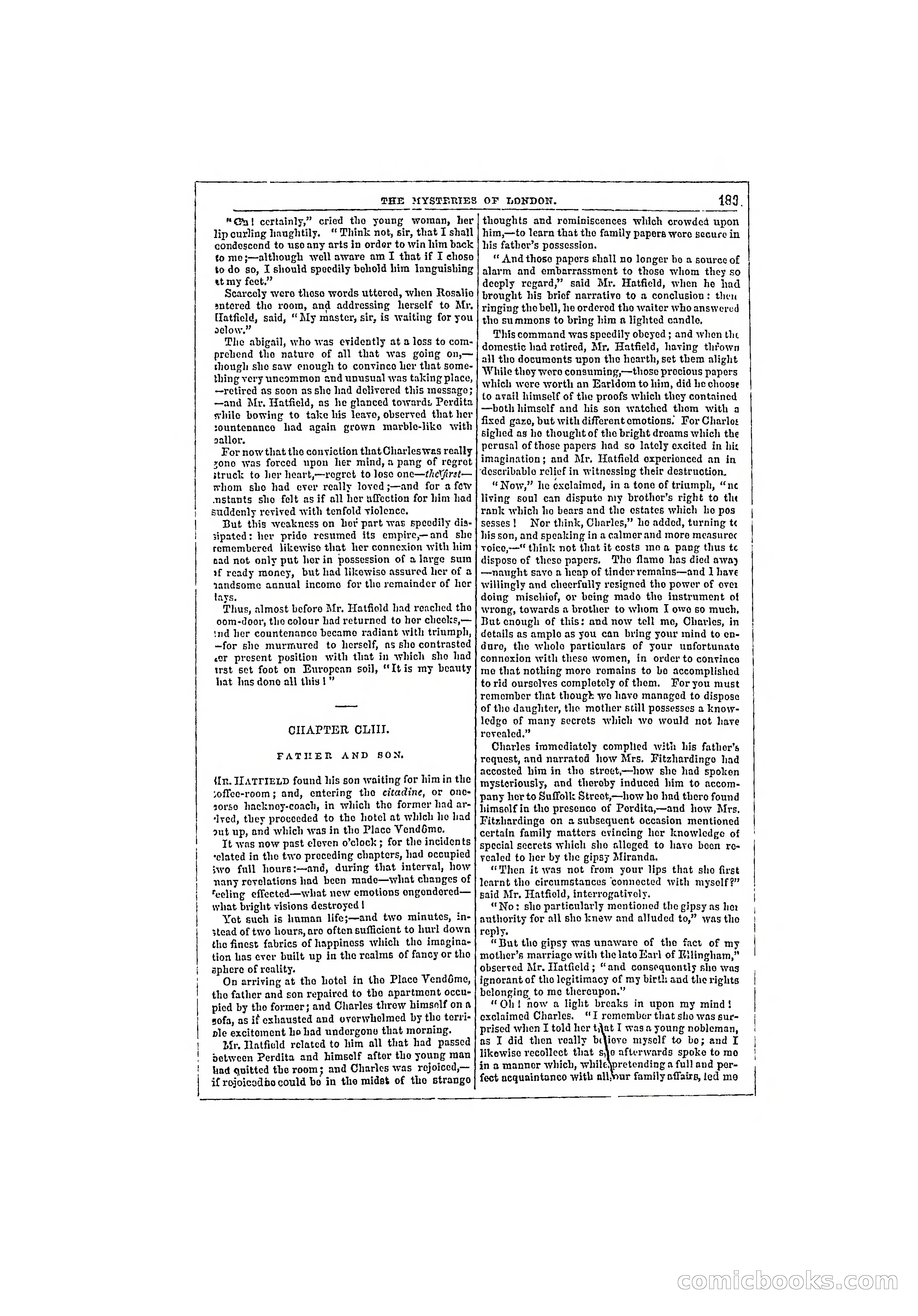
A restored page from Penny Dreadfuls, 1846. Page through the whole issue in the reader above.
📄 Transcribed text from this page (OCR, searchable)
Machine-transcribed from the original scan — historical spelling and the odd misread are preserved.
oe a ne, — er ne ee a Ie ~~ Ee eet ae mie, a‘be "my! certainly,” cried the young woman, her lip curling haughtily. ‘ Think not, sir, that I shall condescend to use any arts in order to win him back to me;—although well aware am I that if I choso to do so, I should speedily behold him languishing et my feet.” Scarcely were those words uttered, when Rosalie sntered the room, and addressing herself to Mr. Hatfield, said, ‘My master, sir, is waiting for you oelow.” The abigail, who was evidently at a loss to com- prebend the nature of all that was going on,— though she saw enough to convince her that some- thing very uncommon end unusual was taking place, —retired as soon as she had delivered this messago; —and Mr. Watfield, as he glanced towards Perdita while bowing to take his leave, observed that her countenance had again grown marble-like with aallor. For now that the conviction that Charles was really zono was forced upon her mind, a pang of regret struck to her heart,—rogret to lose onc—theYirst— whom sho had ever really loved ;—and for a few nstants sho felt as if all her affection for him had suddenly revived with tenfold violence. But this weakness on hot part was specdily dis- sipated: her pride resumed its empire,—and she romembered likewise that her connexion with him nad not only put her in possession of a large sum vf ready money, but had likewiso assured her of a 1andsome annual income for tle remainder of her lays. Thus, almost before Mr. Hatfiold had reached the oom-door, the colour had returned to her cheeks,— ‘nd her countenanco became radiant with triumph, —for she murmured to herself, as sho contrasted esr present position with that in which she had rst set foot on European soi], “itis my beauty hat has done all this 1” at CHAPTER CLIT. FATILER AND SON, {In. ITATTIELD found his son waiting for himin the soffee-room; and, entering the citadine, or ones sorse hacknoy-coach, in which tho former had ar- ‘Ived, they proceeded to the hotel at which he had gut up, and which was in tho Place Vend6mo. Tt was now past eleven o’clock ; for the incidents ‘clated in the two preceding chapters, had occupied nwo fnil hours:—and, during that interval, how nany revelations had been made—what changes of fecling effected—what new emotions ongendered— what bright visions destroyed | Yet such is human life;—and two minutes, in- stead of two hours, aro often sufficient to hurl down the finest fabrics of happiness which tho imagina- tion las ever built up in the realms of fancy or tho sphere of reality. On arriving at tho hotel in the Place Vendéme, tho father and son repaired to the apartment occu- picd by the former; and Charles threw himself ona sofa, as if exhausted and overwhelmed by the terri- ple excitement he had undergone that morning. Mr, Datficld related to him all that had passed detween Perdita and himself after the young man had quitted the room; and Charles was rejoiced, — if rojoicodbe could bo in the midst of the strange ae aad THE MYSTERIES OF LONDON. 489. thoughts and rominiscences which crowded upon him,—to learn that the family papers were secure in his father’s possession. * And those papers shall no longer be a source of alarm and embarrassment to those whom they so deeply regard,” said Mr. Hatfield, when he had brought his brief narrative to a conclusion: then ringing the bell, he ordered the waiter who answered the summons to bring him a lighted candle, This command was speedily obeyed; and when the domestic had rotired, Mr. Hatfield, having thfown all the documents upon the hearth, set them alight While thoy wore consuming,—those precious papers which were worth an Earldom to him, did he choose to avail himself of the proofs which they contained —both himself and his son watched them with a fixed gazo, but with differentcmotions. For Charles sighed ag he thought of the bright droams which the perusal of those papers had so lately excited in his imagination; and Mr. Hatfield experienced an in ‘describablo relief in witnessing their destruction. “ Now,” he exclaimed, in a tone of triumph, “ne living soul can dispute my brother’s right to the rank which ho bears and the estates which he pos sesses! Nor think, Charles,” he added, turning te his son, and speaking in a calmerand more measurec yoico,-—* think not that it costs moa pang thus tc dispose of these papers, Tho flame has died away —naught savo a heap of tinder remains—and J have willingly and cheerfully resigned tho power of over doing mischiof, or being mado the instrument of wrong, towards a brother to whom I] owe so much, But enough of this: and now tell me, Charles, in details as ample as you can bring your mind to en- dure, the whole particulars of your unfortunate connexion with these women, in order to convince me that nothing moro romains to bo accomplished torid oursolyes completely of them. For you must remomber that thougk wo have managed to dispose of the daughter, the mother still possesses a know- ledgo of many secrets which we would not have revealed.” Charlies immediately complied with his father’s request, and narratod how Mrs. Fitzhardingo had accosted him in the street,—how she had spoken mysteriously, and theroby induced him to accom- pany her to Suffolk Street,—how he had thero found himsolf in the presence of Pordita,—and how Mrs, Fitzhardinge on a subsequent occasion mentioned certain family matters ecvincing her knowledge of special secrets which she alleged to hare been re- yealed to her by the gipsy Miranda. “Then it was not from your Hps that sho first learnt tho circumstances connected with mysolf?? said Mr. Hatfield, interrogatively. “No: sho particularly mentioned the gipsy as her authority for all sho knew and alluded to,” was the reply. “But the gipsy was unaware of the fact of my mother’s marriage with the late Karl of Kilingham,” observed Mr. Hatfield; “and consequontlys she was ignorant of tho legitimacy of my birth aud the rights belonging to me thereupon.” “Oh! now a light breaks in upon my mind! exclaimed Charles. “I remember that sho was sur- e afterwards spoke to mo in a manner which, while\pretending a full and per- fect acquaintanco with all,wur family offaira, led me CON SS