
Penny Dreadfuls, 1846 · page 189 of 399
The Mysteries of London, Vol. IV — page 189: what you’re looking at
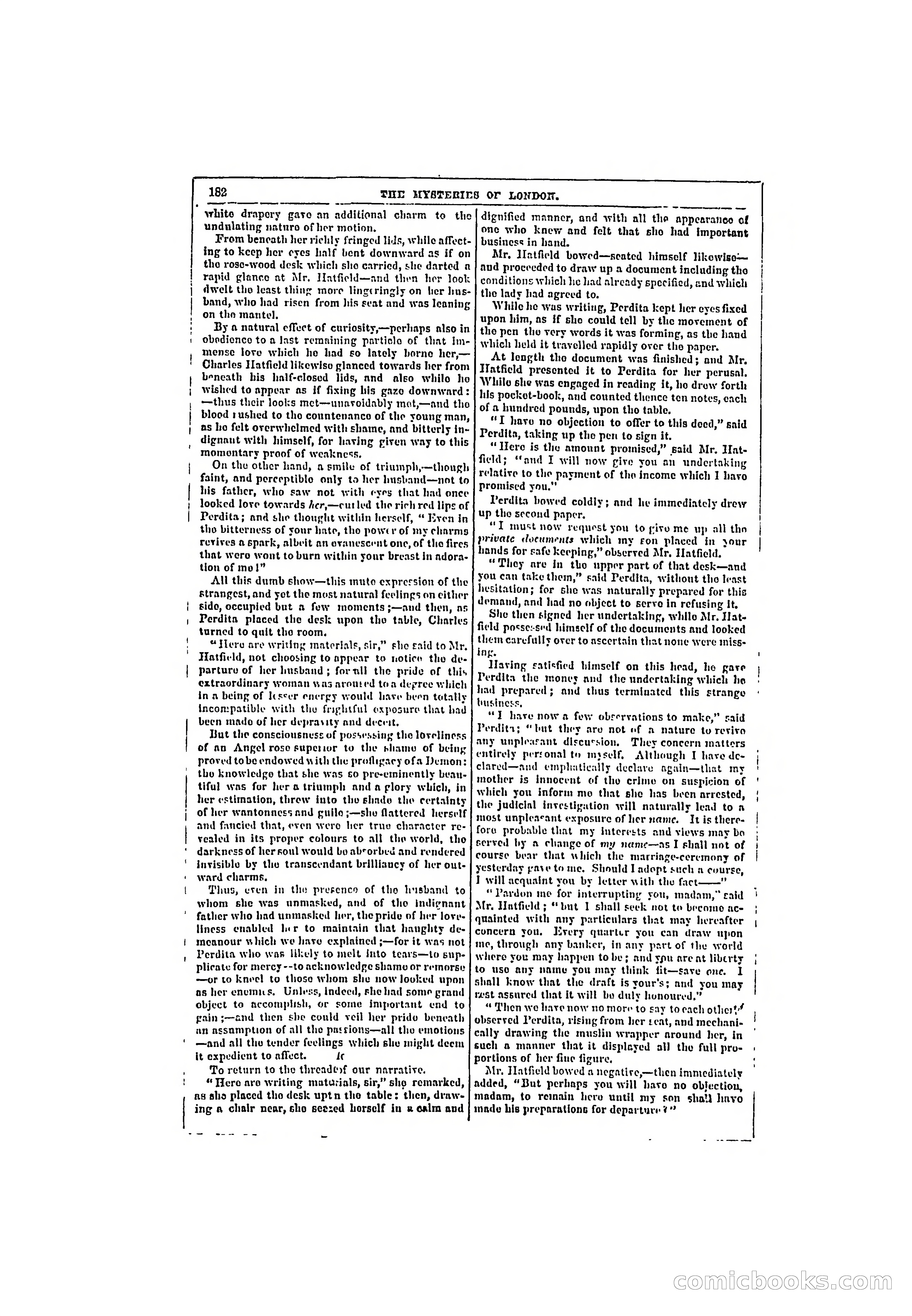
A restored page from Penny Dreadfuls, 1846. Page through the whole issue in the reader above.
📄 Transcribed text from this page (OCR, searchable)
Machine-transcribed from the original scan — historical spelling and the odd misread are preserved.
nn - ree eee 182 numer OS oe ee Oe ee white drapory gave an additional charm to the undulating naturo of her motion. From bencath her richly fringed lids, while affect- ing to keep her eyes half bent downward as if on tho rose-wood desk which sho carried, she darted a rapid glance at Mr. Hatficld—and then her look dwelt the least thing more lingctringly on her hus- band, who had risen from his seat and was leaning on the mantel. By o natural effect of curiosity,—perhaps also in obedience to a Jast remnining particle of that Im- mense love which he had so lately borne her,— Charles Hatfield likewise glanced towards her from beneath his half-closed lids, and also whilo ho wished to appear as if fixing his gazo downward: —thus their looks met—unavoidably mat,—and tho blood rushed to tho countenance of the young man, as ho felt overwhelmed with shame, and bitterly in- dignant with himself, for having piven way to this momentary proof of weakness. On the other hand, a smile of triumph,—though faint, and perceptible only to her husband—not to his father, who saw not with eyes that had once looked love towards her,—cutled the rich red lips of Pordita; and she thought within herself, “Even in tho bitterness of sour hate, the powcr of my charms revives a spark, albeit an ovanescent one, of the fires that wero wont to burn within your breast in adora- tion of mol” All this dumb show—this mute expression of the Strangest, and yet the most natural feelings on cither sido, occupied but a few moments ;—and then, as Perdita placed the desk upon tho table, Charles turned to quit tho room. * $lere are writing materials, sir,” sho eaid to Mr. Hatfield, not choosing to appear to notice tho de- parture of her husband; forall the pride of this extraordinary woman was aroured toa degree which ina being of Icscer energy would have been totally incompatible with the frightful oxposure that had been mado of her depravity and deceit, But the consciousness of possessing the loveliness of an Angel rose supenor to the shame of being proved tobe endowed ith the profligacy ofa Demon: tho knowledgo that she was so pre-eminently beau- tiful was for hers triumph anda glory which, in her estimation, threw into the shado the certainty of her wantonness and guile ;—she flattered herself and fancied that, even wero her true character re- vealed in its proper colours to all the world, tho darkness of hersoul would bo abrorbed and rendered invisible by the transcendant brilliaucy of her out- ward charms, Thus, eten in the presenco of tho husband to whom she was unmasked, and of tho indignant father who had unmasked her, the pride of her love. lincss enabled ler to maintain that hanglty de- meanour Shick we have explained ;—for it was not Perdita who was likely to melt into tears—to snp- plicate for mercy --to acknowledge shame or remorse —or to kneel to those whom she now looked upon as her enemns, Unless, indeed, she had some grand object to accomplish, or some important end to pain s—and then she contd veil her pride beneath an assamption of all the pnssions—all the emotions —and all the tender feelings which she might deem it expedient to affect. Ic To return to the thread@f our narrative. “Hero are writing matacials, sir,” sho remarked, ns sho placed the desk uptn tho tables: then, drawe ing a chair near, sho sezed horself in » calm and + eee THE MYSTERICFS OF LONDON. one who knew and felt that sho had important business in band. Mr, IIstfield bowed—scated himself likewise-~ and proceeded to draw up a document including tho conditions which he had already specified, and which the lady had agreed to. While he was writing, Perdita kept her eyes fixed upon him, as if she could tell by the movement of the pen the very words it was forming, as the hand Which held it travelled rapidly over the paper. At length the document was finished; ond Mr. HMatficld presented it to Perdita for her perusal, Whilo she was engaged in reading it, ho drow forth his pockot-book, and counted thence ten notes, cach of a hundred pounds, upon tho table. “TI havo no objection to offer to this deed,” said Perdita, taking up the pen to sign it. “Here is the amount promised,” said Mr. Hat- dignified manner, and with all the appcaraneo of | field; “and I will now give you an undertaking relative to the payment of the income which I havo Promised you.” Perdita bowed coldly; and he immediately drew up the second paper. “TI must now request you to givy me up all tho rd private documents which my fon placed in your | hands for cafe keeping,” observed Mr, Hatfield. “They are in tho upper part of that desk—aud you can take them,” sald Perdita, without tho least hesitation; for she was naturally prepared for this demand, and had no object to serve in refusing It. She then signed her undertaking, while Mr. Hat- field posse:sed himself of the documents and looked them carefulls over to ascertain that none were iniss- ing. ! Waving satisfied himself on this head, he gave | Perdita the mones and the undertaking which he had prepared; and thus terminated this strange | lusiness, “YT have now a few observations to make,” said Perdita; “but they aru not of a nature to revivo any unplearant discutsion, They concern matters entirely personal to myself, Although I have de- clared—and emphatically declare ogain—that my mother is innocent of tho erlme on suspicion of Which you inform mo that she has been arrested, the judicial investiyation will naturally lead to a most unpleacant exposure of her name. It is there- fore probable that my interests and views may bo served by a change of my name—as I shall not of course bear that which the marringe-ceremony of yesterday pave to me, Should I adopt such a course, J will acquaint you by letter with the fact——” ; “Pardon ine for interrupting you, madam,” caid | Mr. Hatfield; “but I shall seek not te become ace 3 quainted with any particulars that may hereafter | concern you. Jvery quarter you can draw upon me, through any banker, in any part of the world where you may happen to be; and ypu are at liberty | to uso any name you may think fit—save one I] Shall know that the draft is your's; and you may test assured that it will bo duly honoured.” “Then we have now no more to say toeach othet4 observed Perdita, rising from her seat, and mechani- cally drawing the muslin wrapper around her, in such a manner that it displayed all the full pro- | portions of her fine figure, ' Mr, Hatfield bowed a negatire,—then immediately added, “But perhaps you will have no objection, madam, to reinain here until my son shat) havo made his preparations for departure ¢” - ~—— « - = ee GIOOKS (CO) (CO)