
Penny Dreadfuls, 1901 · page 125 of 400
I Forbid the Banns! — page 125: what you’re looking at
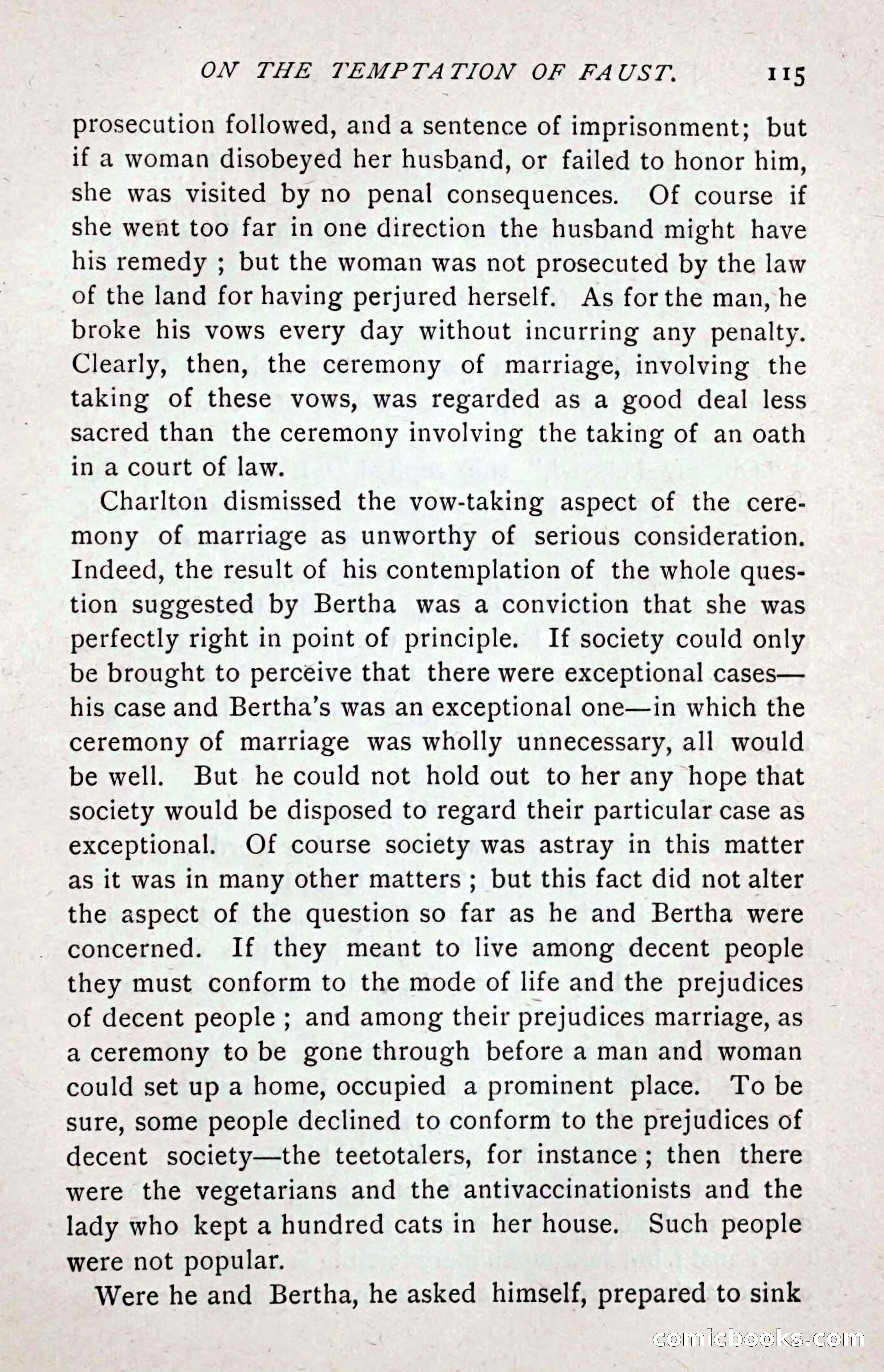
A restored page from Penny Dreadfuls, 1901. Page through the whole issue in the reader above.
📄 Transcribed text from this page (OCR, searchable)
Machine-transcribed from the original scan — historical spelling and the odd misread are preserved.
ON THE TEMPTATION OF FAUST. 115 prosecution followed, and a sentence of imprisonment; but if a woman disobeyed her husband, or failed to honor him, she was visited by no penal consequences. Of course if she went too far in one direction the husband might have his remedy ; but the woman was not prosecuted by the law of the land for having perjured herself. As forthe man, he broke his vows every day without incurring any penalty. Clearly, then, the ceremony of marriage, involving the taking of these vows, was regarded as a good deal less sacred than the ceremony involving the taking of an oath in a court of law. Charlton dismissed the vow-taking aspect of the cere- mony of marriage as unworthy of serious consideration. Indeed, the result of his contemplation of the whole ques- tion suggested by Bertha was a conviction that she was perfectly right in point of principle. If society could only be brought to perceive that there were exceptional cases— his case and Bertha’s was an exceptional one—in which the ceremony of marriage was wholly unnecessary, all would be well. But he could not hold out to her any hope that society would be disposed to regard their particular case as exceptional. Of course society was astray in this matter as it was in many other matters ; but this fact did not alter the aspect of the question so far as he and Bertha were concerned. If they meant to live among decent people they must conform to the mode of life and the prejudices of decent people ; and among their prejudices marriage, as a ceremony to be gone through before a man and woman could set up a home, occupied a prominent place. To be sure, some people declined to conform to the prejudices of decent society—the teetotalers, for instance; then there were the vegetarians and the antivaccinationists and the lady who kept a hundred cats in her house. Such people were not popular. Were he and Bertha, he asked himself, prepared to sink CORNICLIOOKS (€(@)