
Penny Dreadfuls, 1901 · page 124 of 400
I Forbid the Banns! — page 124: what you’re looking at
A restored page from Penny Dreadfuls, 1901. Page through the whole issue in the reader above.
📄 Transcribed text from this page (OCR, searchable)
Machine-transcribed from the original scan — historical spelling and the odd misread are preserved.
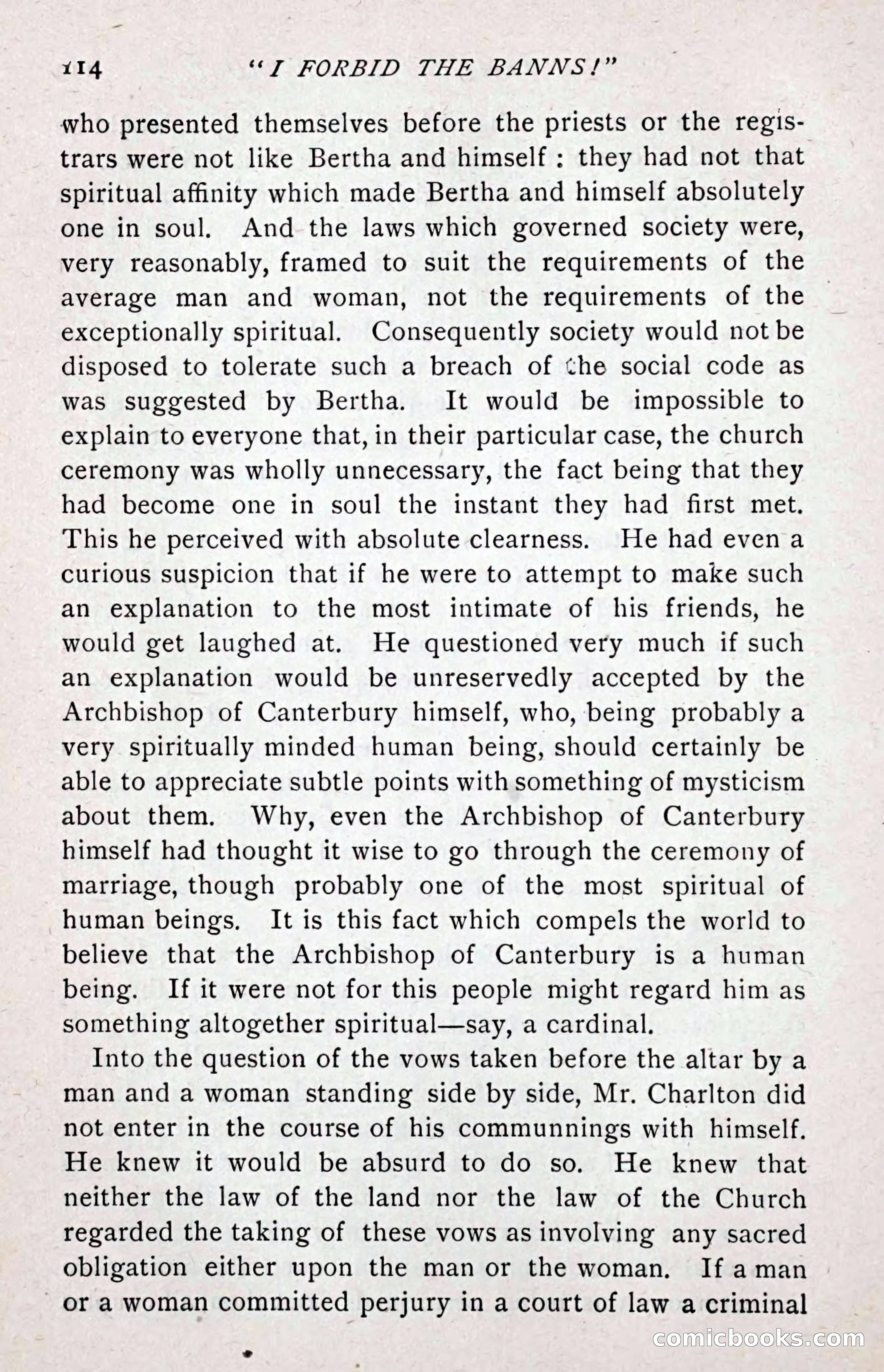
114 ‘7 FORBID THE BANNS!” who presented themselves before the priests or the regis- trars were not like Bertha and himself: they had not that spiritual affinity which made Bertha and himself absolutely one in soul. And the laws which governed society were, very reasonably, framed to suit the requirements of the average man and woman, not the requirements of the exceptionally spiritual. Consequently society would not be disposed to tolerate such a breach of the social code as was suggested by Bertha. It would be impossible to explain to everyone that, in their particular case, the church ceremony was wholly unnecessary, the fact being that they had become one in soul the instant they had first met. This he perceived with absolute clearness. He had evena curious suspicion that if he were to attempt to make such an explanation to the most intimate of his friends, he would get laughed at. He questioned very much if such an explanation would be unreservedly accepted by the Archbishop of Canterbury himself, who, being probably a very spiritually minded human being, should certainly be able to appreciate subtle points with something of mysticism about them. Why, even the Archbishop of Canterbury himself had thought it wise to go through the ceremony of marriage, though probably one of the most spiritual of human beings. It is this fact which compels the world to believe that the Archbishop of Canterbury is a human being. If it were not for this people might regard him as something altogether spiritual—say, a cardinal. Into the question of the vows taken before the altar by a man and a woman standing side by side, Mr. Charlton did not enter in the course of his communnings with himself. He knew it would be absurd to do so. He knew that neither the law of the land nor the law of the Church regarded the taking of these vows as involving any sacred obligation either upon the man or the woman. If aman or a woman committed perjury in a court of law a criminal CONNIELOOKS (E©)