
Penny Dreadfuls, 1856 · page 34 of 399
Ellen Percy; or, The Memoirs of an Actress — page 34: what you’re looking at
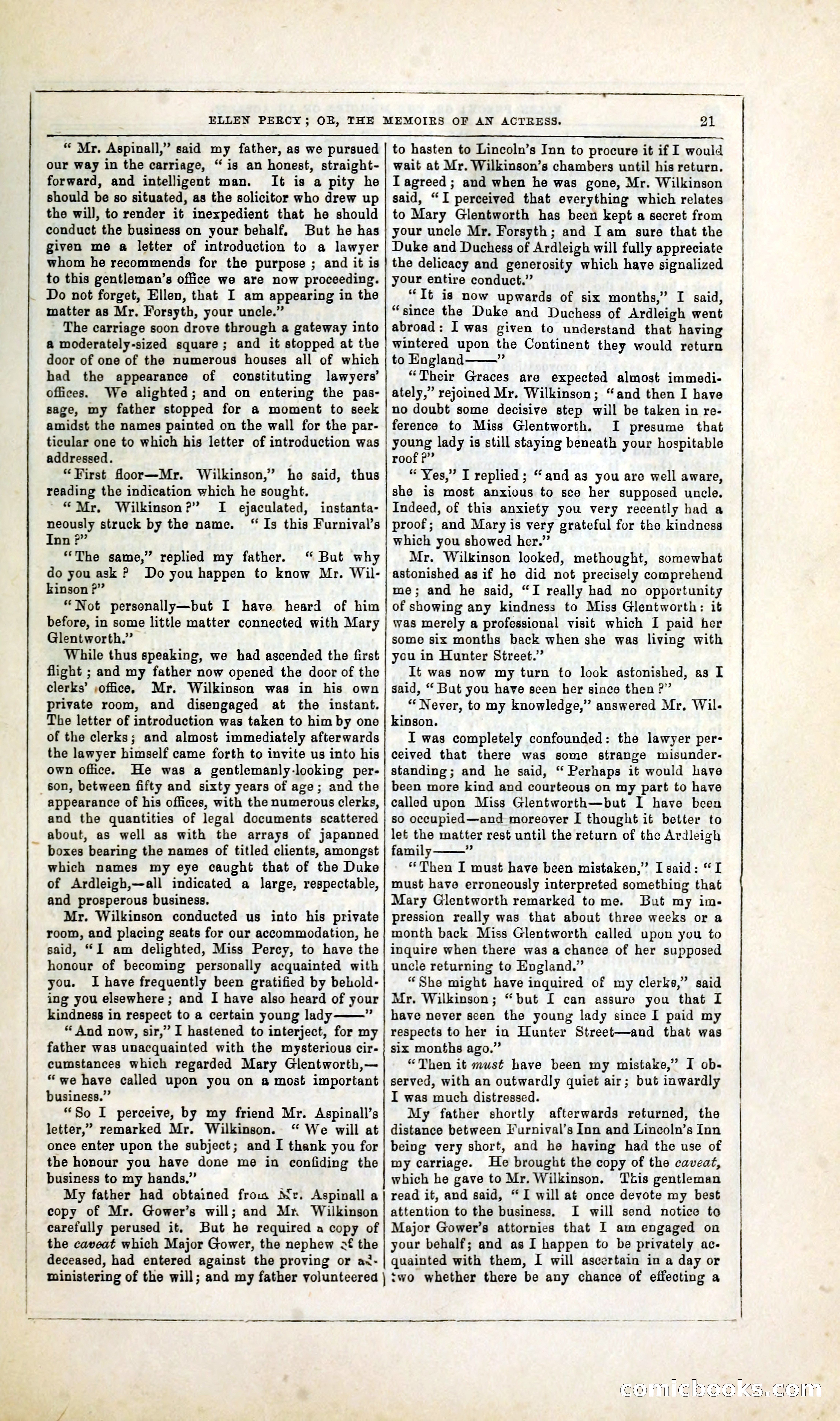
A restored page from Penny Dreadfuls, 1856. Page through the whole issue in the reader above.
📄 Transcribed text from this page (OCR, searchable)
Machine-transcribed from the original scan — historical spelling and the odd misread are preserved.
ELLEN PERCY; OR, THE MEMOIERS OF AN ACTRESS. 21 “ Mr. Aspinall,” said my father, as we pursued our way in the carriage, “is an honest, straight- forward, and intelligent man. It is a pity he should be so situated, as the solicitor who drew up the will, to render it inexpedient that he should conduct the business on your behalf. But he has given me a letter of introduction to a lawyer whom he recommends for the purpose ; and it is to this gentleman’s office we are now proceeding. . Do not forget, Ellen, that I am appearing in the matter as Mr. Forsyth, your uncle.” The carriage soon drove through a gateway into a moderately-sized square; and it stopped at the door of one of the numerous houses all of which had the appearance of constituting lawyers’ offices. We alighted; and on entering the pas- sage, my father stopped for a moment to seek amidst the names painted on the wall for the par- ticular one to which his letter of introduction was addressed. “First floor—Mr. Wilkinson,” he said, thus reading the indication which he sought. “Mr, Wilkinson?” I ejaculated, instanta- neously struck by the name. “ Is this Furnival’s Inn ?” “The same,” replied my father. “ But why do you ask ? Do you happen to know Mr. Wil- kinson ?” “Not persenally—but I have heard of him before, in some little matter connected with Mary Glentworth.” While thus speaking, we had ascended the first flight ; and my father now opened the door of the clerks’ ,office. Mr. Wilkinson was in his own private room, and disengaged at the instant. The letter of introduction was taken to him by one of the clerks; and almost immediately afterwards the lawyer himself came forth to invite us into his own office. He was a gentlemanly-looking per- son, between fifty and sixty years of age; and the appearance of his offices, with the numerous clerks, and the quantities of legal documents scattered about, as well as with the arrays of japanned boxes bearing the names of titled clients, amongst which names my eye caught that of the Duke of Ardleigh,—all indicated a large, respectable, and prosperous business. Mr. Wilkinson conducted us into his private room, and placing seats for our accommodation, he said, “I am delighted, Miss Percy, to have the honour of becoming personally acquainted with you. I have frequently been gratified by bebold- ing you elsewhere ; and I have also heard of your kindness in respect to a certain young lady ig “ And now, sir,” I hastened to interject, for my father was unacquainted with the mysterious cir- cumstances which regarded Mary Glentworth,— “we have called upon you on a most important business.” “So I perceive, by my friend Mr. Aspinall’s letter,” remarked Mr. Wilkinson. “ We will at once enter upon the subject; and I thank you for the honour you have done me in confiding the business to my hands.” My father had obtained from Mr. Aspinall a copy of Mr. Gower’s will; and Mr Wilkinson carefully perused it. But he required a copy of the caveat which Major Gower, the nephew 2£ the deceased, had entered against the proving or ax- to hasten to Lincoln’s Inn to procure it if I would wait at Mr. Wilkinson’s chambers until his return. I agreed ; and when he was gone, Mr. Wilkinson said, “I perceived that everything which relates to Mary Glentworth has been kept a secret from your uncle Mr. Forsyth; and I am sure that the Duke and Duchess of Ardleigh will fully appreciate the delicacy and generosity which have signalized your entire conduct.” “It is now upwards of six months,” I said, “since the Duke and Duchess of Ardleigh went abroad: L was given to understand that having wintered upon the Continent they would return to England i “Their Graces are expected almost immedi- ately,” rejoined Mr, Wilkinson; “and then I have no doubt some decisive step will be taken in re- ference to Miss Glentworth. I presume that young lady is still staying beneath your hospitable roof ?” “Yes,” I replied; “and as you are well aware, she is most anxious to see her supposed uncle. Indeed, of this anxiety you very recently had a proof; and Mary is very grateful for the kindness which you showed her.” Mr. Wilkinson looked, methought, somewhat astonished as if he did not precisely comprehend me; and he said, “I really had no opportunity of showing any kindness to Miss Glentworth: it was merely a professional visit which I paid her some six months back when she was living with you in Hunter Street.” It was now my turn to look astonished, as I said, “ But you have seen her since then ?” “Never, to my knowledge,” answered Mr. Wil- kinson. I was completely confounded: the lawyer per- ceived that there was some strange misunder- standing; and he said, “ Perhaps it would have been more kind and courteous on my part to have called upon Miss Glentworth—but I have been so occupied—and moreover I thought it better to let the matter rest until the return of the Ardleigh family 2 “Then I must have been mistaken,” Isaid: “I must have erroneously interpreted something that Mary Glentworth remarked to me. But my im- pression really was that about three weeks or a month back Miss Glentworth called upon you to inquire when there was a chance of her supposed uncle returning to England.” “She might have inquired of my clerks,” said Mr. Wilkinson; “but I can assure you that I have never seen the young lady since I paid my respects to her in Hunter Street—and that was six months ago.” “Then it must have been my mistake,” I ob- served, with an outwardly quiet air; but inwardly I was much distressed. My father shortly afterwards returned, the distance between Furnival’s Inn and Lincoln’s Inn being very short, and he haying had the use of my carriage. He brought the copy of the caveat, which he gave to Mr. Wilkinson. This gentleman read it, and said, “I will at once devote my best attention to the business. I will send notice to Major Gower’s attornies that I am engaged on your behalf; and as I happen to be privately ac- quainted with them, I will ascertain in a day or ministering of the will; and my father volunteered | :wo whether there be any chance of effecting a Oe eee — ee a ee | _-— — — _ - — -_— COMMU ———S oO OOO)LK (SO)