
Penny Dreadfuls, 1856 · page 33 of 399
Ellen Percy; or, The Memoirs of an Actress — page 33: what you’re looking at
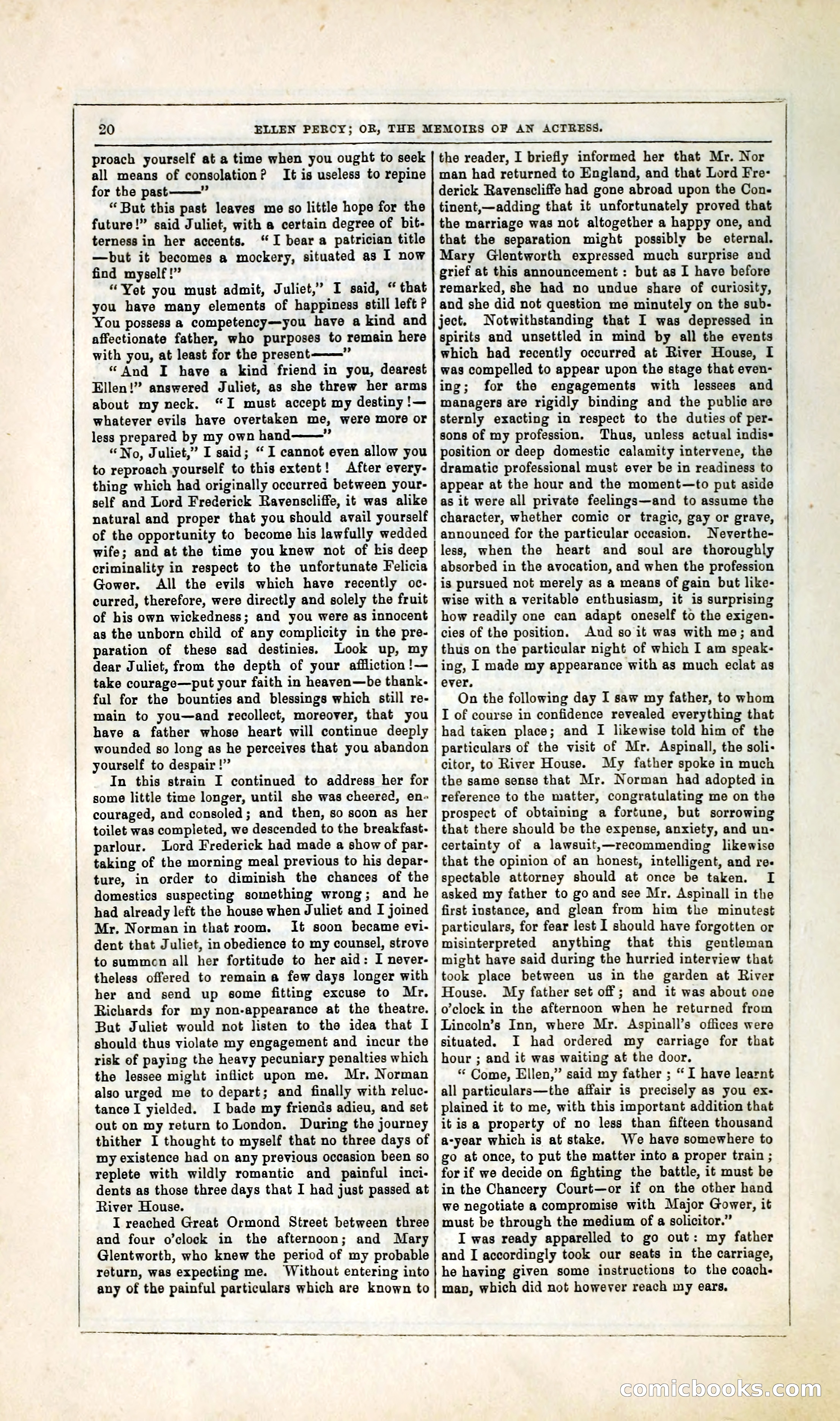
A restored page from Penny Dreadfuls, 1856. Page through the whole issue in the reader above.
📄 Transcribed text from this page (OCR, searchable)
Machine-transcribed from the original scan — historical spelling and the odd misread are preserved.
| 20 ELLEN PERCY; OR, THE MEMOIRS OF AN ACTRESS. en proach yourself at a time when you ought to seek all means of consolation? It is useless to repine for the past a “But this past leaves me so little hope for the future!” said Juliet, with a certain degree of bit- terness in her accents. “I bear a patrician title —but it becomes a mockery, situated as I now find myself!” “Yet you must admit, Juliet,” I said, “ that you have many elements of happiness still left ? You possess a competency—you have a kind and affectionate father, who purposes to remain here with you, at least for the present " “And I have a kind friend in you, dearest Ellen!” answered Juliet, as she threw her arms about my neck. “I must accept my destiny '— whatever evils have overtaken me, were more or less prepared by my own hand o “No, Juliet,” I said; “ I cannot even allow you to reproach yourself to this extent! After every- thing which had originally occurred between your- self and Lord Frederick Ravenscliffe, it was alike natural and proper that you should avail yourself of the opportunity to become his lawfully wedded wife; and at the time you knew not of kis deep criminality in respect to the unfortunate Felicia Gower. All the evils which have recently oc- curred, therefore, were directly and solely the fruit of his own wickedness; and you were as innocent as the unborn child of any complicity in the pre- paration of these sad destinies. Look up, my dear Juliet, from the depth of your affliction !— take courage—put your faith in heaven—be thank- ful for the bounties and blessings which still re- main to you—and recollect, moreover, that you have a father whose heart will continue deeply wounded so long as he perceives that you abandon yourself to despair !” In this strain I continued to address her for some little time longer, until she was cheered, en» couraged, and consoled; and then, so soon as her toilet was completed, we descended to the breakfast- parlour. Lord Frederick had made a show of par- taking of the morning meal previous to his depar- ture, in order to diminish the chances of the domestics suspecting something wrong; and he had already left the house when Juliet and I joined Mr. Norman in that room. It soon became evi- dent that Juliet, in obedience to my counsel, strove to summen all her fortitude to her aid: I never- theless offered to remain a few days longer with her and send up some fitting excuse to Mr. Richards for my non-appearance at the theatre. But Juliet would not listen to the idea that I should thus violate my engagement and incur the risk of paying the heavy pecuniary penalties which the lessee might inflict upon me. Mr. Norman also urged me to depart; and finally with reluc- tance I yielded. I bade my friends adieu, and set out on my return to London. During the journey thither I thought to myself that no three days of my existence had on any previous occasion been so replete with wildly romantic and painful inci- dents as those three days that I had just passed at River House. I reached Great Ormond Street between three and four o’clock in the afternoon; and Mary Glentworth, who knew the period of my probable return, was expecting me. Without entering into any of the painful particulars which are known to the reader, I briefly informed her that Mr. Nor man had returned to England, and that Lord Fre- derick Ravenscliffe had gone abroad upon the Con- tinent,—adding that it unfortunately proved that the marriage was not altogether a happy one, and that the separation might possibly be eternal. Mary Glentworth expressed much surprise and grief at this announcement: but as I have before remarked, she had no undue share of curiosity, and she did not question me minutely on the sub- ject. Notwithstanding that I was depressed in spirits and unsettled in mind by all the events which had recently occurred at River House, I was compelled to appear upon the stage that even- ing; for the engagements with lessees and managers are rigidly binding and the public are sternly exacting in respect to the duties of per- sons of my profession. Thus, unless actual indis= position or deep domestic calamity intervene, the dramatic professional must ever be in readiness to appear at the hour and the moment—to put aside as it were all private feelings—and to assume the character, whether comic or tragic, gay or grave, announced for the particular occasion. Neverthe- less, when the heart and soul are thoroughly absorbed in the avocation, and when the profession is pursued not merely as a means of gain but like- wise with a veritable enthusiasm, it is surprising how readily one can adapt oneself to the exigen- cies of the position. And so it was with me; and thus on the particular night of which I am speak- ing, I made my appearance with as much eclat as ever. On the following day I saw my father, to whom I of course in confidence revealed everything that had taken place; and I likewise told him of the particulars of the visit of Mr. Aspinall, the soli- citor, to River House. My father spoke in much the same sense that Mr. Norman had adopted in reference to the matter, congratulating me on the prospect of obtaining a fortune, but sorrowing that there should be the expense, anxiety, and un- certainty of a lawsuit,—recommending likewise that the opinion of an honest, intelligent, and ree spectable attorney should at once be taken. I asked my father to go and see Mr. Aspinall in the first instance, and glean from him the minutest particulars, for fear lest I should have forgotten or misinterpreted anything that this gentleman might have said during the hurried interview that took place between us in the garden at River House. My father set off; and it was about one o’clock in the afternoon when he returned from Lincoln’s Inn, where Mr. Aspinall’s offices were situated. I had ordered my carriage for that hour ; and it was waiting at the door. * Come, Ellen,” said my father ; “ I have learnt all particulars—the affair is precisely as you ex- plained it to me, with this important addition that it is a property of no less than fifteen thousand a-year which is at stake. We have somewhere to go at once, to put the matter into a proper train ; for if we decide on fighting the battle, it must be in the Chancery Court—or if on the other hand we negotiate a compromise with Major Gower, it must be through the medium of a solicitor.” I was ready apparelled to go out: my father and I accordingly took our seats in the carriage, he having given some instructions to the coach- map, which did not however reach my ears. (COMNALCE