
Penny Dreadfuls, 1856 · page 192 of 399
Ellen Percy; or, The Memoirs of an Actress — page 192: what you’re looking at
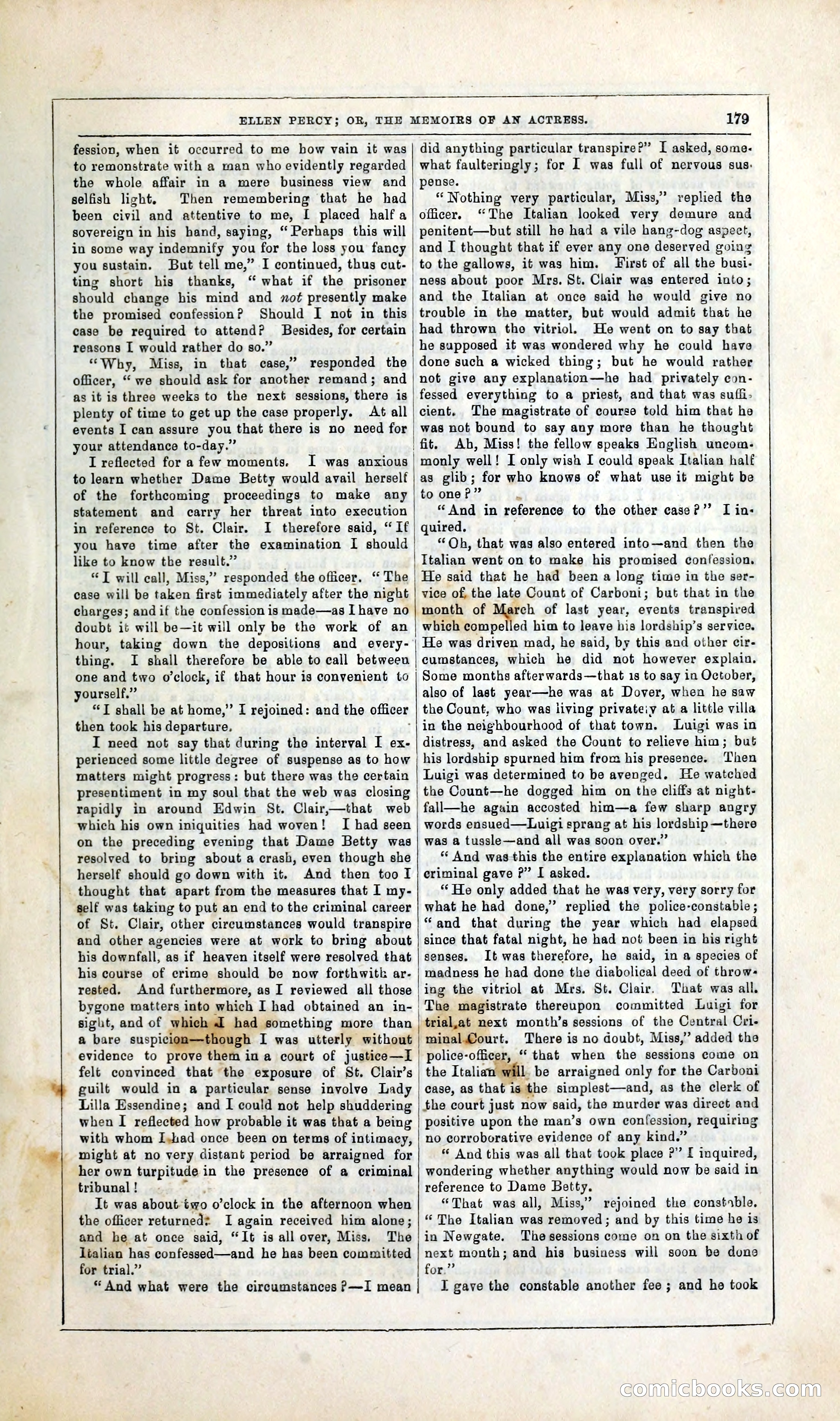
A restored page from Penny Dreadfuls, 1856. Page through the whole issue in the reader above.
📄 Transcribed text from this page (OCR, searchable)
Machine-transcribed from the original scan — historical spelling and the odd misread are preserved.
fession, when if occurred to me bow vain it was to remonstrate with a man who evidently regarded the whole affair in a mere business view and selfish light. Then remembering that he had been civil and attentive to me, I placed halfa sovereign in his hand, saying, “ Perhaps this will in some way indemnify you for the loss you fancy you sustain. But tell me,” I continued, thus cut- ting short his thanks, “ what if the prisoner should change his mind and zot presently make the promised confession? Should I not in this case be required to attend? Besides, for certain reasons [ would rather do so.” ‘““Why, Miss, in that case,” responded the officer, “ we should ask for another remand; and as it is three weeks to the next sessions, there is plenty of time to get up the case properly. At all events I can assure you that there is no need for your attendance to-day.” I reflected for a few moments. I was anxious to learn whether Dame Betty would avail herself of the forthcoming proceedings to make any statement and carry her threat into execution in reference to St. Clair. I therefore said, “If you have time after the examination I should like to know the result.” “T will call, Miss,’ responded the officer. “ The case will be taken first immediately after the night charges; andif the confession is made—as I have no doubt it will be—it will only be the work of an hour, taking down the depositions and every- thing. I shall therefore be able to call between one and two o'clock, if that hour is convenient to yourself,” “T shall be at home,” I rejoined: and the officer then took his departure. I need not say that during the interval I ex- perienced some little degree of suspense as to how matters might progress: but there was the certain presentiment in my soul that the web was closing rapidly in around Edwin St. Clair,—that web which his own iniquities had woven! I had seen on the preceding evening that Dame Betty was resolved to bring about a crash, even though she herself should go down with it. And then tool thought that apart from the measures that 1 my- self was taking to put an end to the criminal career of St. Clair, other circumstances would transpire and other agencies were at work to bring about his downfall, as if heaven itself were resolved that his course of crime should be now forthwitk ar- rested. And furthermore, as I reviewed all those bygone matters into which I had obtained an in- sight, and of vk ch «l had something more than iclon—th ough I was utterly without evidence to prove them i in a court of justice—I | felt convinced that the exposure of St. Clair’s guilt would in a particular sense involve Lady Lilla Essendine; and I could not help shuddering when I reflected how probable it was that a being with whom I,had once been on terms of intimacy, - might at no very distant period be arraigned for her own turpitude in the presence of a criminal tribunal ! It was about-two o’clock in the afternoon when the officer returned? I again received him alone; and he at once said, “It is all over, Miss. The lialian has confessed—and he has been committed for trial.” “And what were the circumstances ?—I mean ELLEN PERCY; OR, THE MEMOIRS OF AN ACTRESS. | fit. 179 —— did anything particular transpire?” I asked, some. what faulteringly; for I was full of nervous sus: pense. “ Nothing very particular, Miss,” replied the officer. “The Italian looked very demure and penitent—but still he had a vile hang-dog aspect, and I thought that if ever any one deserved going to the gallows, it was him. Jirst of all the busi- ness about poor Mrs. St. Clair was entered into; and the Italian at once said he would give no trouble in the matter, but would admié that he had thrown tho vitriol, He went on to say that he supposed it was wondered why he could have done such a wicked thing; but he would rather not give any explanation—he had privately con- fessed everything to a priest, and that was suffi- cient. ‘The magistrate of course told him that he was not bound to say any more than he thought Ab, Miss! the fellow speaks English uncom: monly well! I only wish I could speak [talian half as glib; for who knows of what use it might be to oneP” “And in reference to the other case?” I in- quired. “Qh, that was also entered into—and then the Italian went on to make his promised confession. He said that he had been a long time in the ser- vice of, the late Count of Carboni; but that in the month of as of last year, events transpired which compelled him to leave his lordship’s service. He was driven mad, he said, by this and other cir- cumstances, which he did not however explain. Some months afterwards—that is to say in October, also of last year—he was at Dover, when he saw the Count, who was living privateiy at a little villa in the neighbourhood of that town. Luigi was in distress, and asked the Count to relieve him; but his lordship spurned him from his presence. Then Luigi was determined to be avenged. He watched the Count—he dogged him on the cliffs at night- fall—he again accosted him—a few sharp angry words ensued—Luigi sprang at his lordship —there was a tussle—and all was soon over.” * And was-this the entire explanation which the criminal gave P” I asked. “‘ He only added that he was very, very sorry for what he had done,” replied the police-constable ; “and that during the year which had elapsed since that fatal night, he had not been in his right senses. It was therefore, he said, in a species of madness he had done the diabolical deed of throw- ing the vitriol at Mrs. St. Clair. That was all. The magistrate thereupon committed Luigi for trial,at next month’s sessions of the Central Cri- aheai There is no doubt, Miss,’ added the police-officer, “ that when the sessions come on | the Italia be arraigned only for the Carboni case, as that is the simplest—and, as the clerk of the court just now said, the murder was direct and positive upon the man’s own confession, requiring no corroborative evidence of any kind.” © And this was all that took place ?” [ inquired, wondering whether anything would now be said in reference to Dame Betty. “That was all, Miss,’ rejoined the constyble. “ Tho Italian was removed; and by this time he is in Newgate. Thesessions come on on the sixth of next month; and his business will soon be done for.” I gave the constable another fee; and he took Go JOO SS (E@)