
Penny Dreadfuls, 1856 · page 191 of 399
Ellen Percy; or, The Memoirs of an Actress — page 191: what you’re looking at
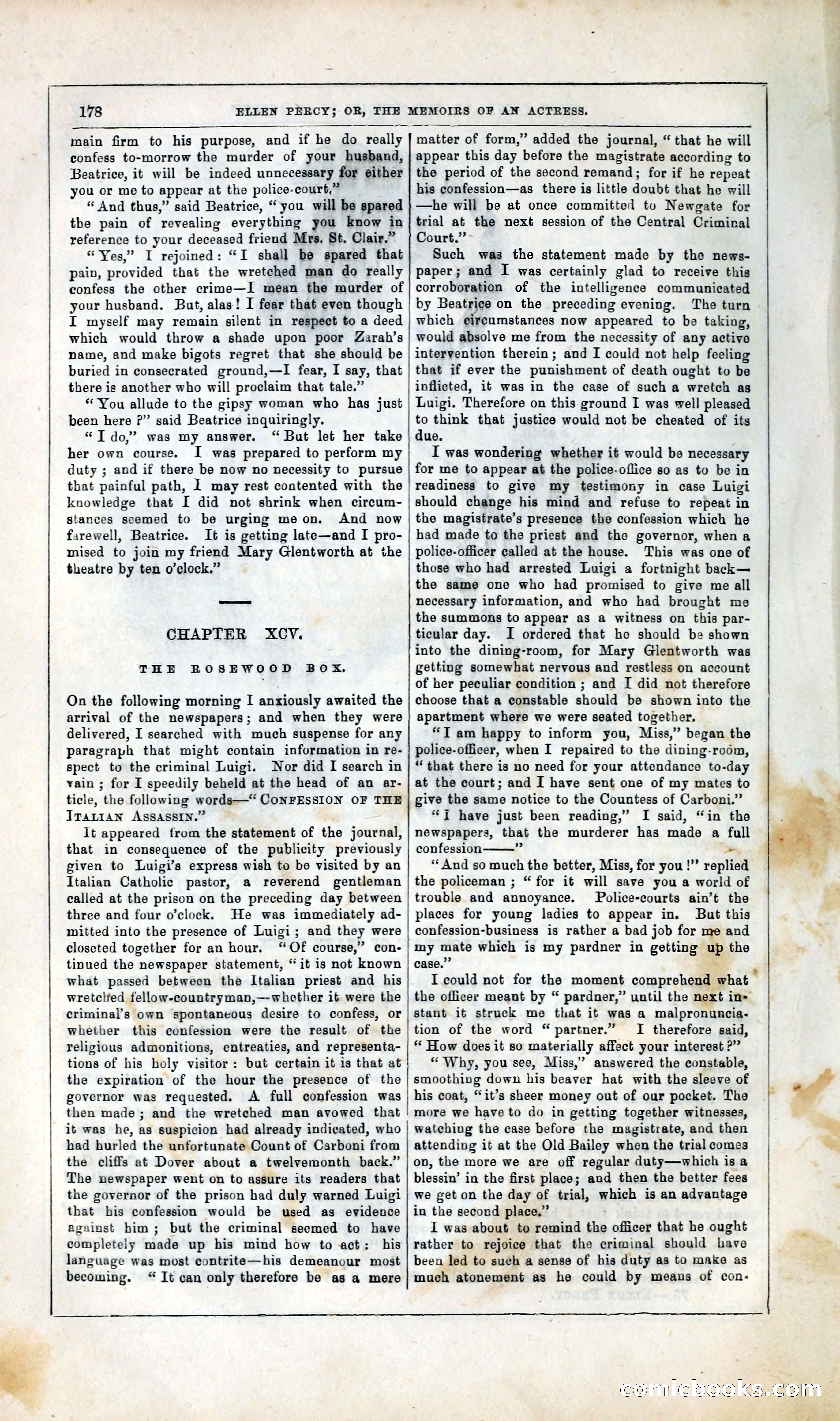
A restored page from Penny Dreadfuls, 1856. Page through the whole issue in the reader above.
📄 Transcribed text from this page (OCR, searchable)
Machine-transcribed from the original scan — historical spelling and the odd misread are preserved.
178 main firm to his purpose, and if he do really confess to-morrow the murder of your husband, Beatrice, it will be indeed unnecessary for either you or me to appear at the police-couré,” “ And thus,” said Beatrice, “you will be spared the pain of revealing everything you know in reference to your deceased friend Mrs. St. Clair.” “Yes,” I rejoined: “I shall be spared that pain, provided that the wretched man do really confess the other crime—I mean the murder of your husband. But, alas! I fear that even though I myself may remain silent in respect to a deed which would throw a shade upon poor Zarah’s name, and make bigots regret that she should be buried in consecrated ground,—I fear, I say, that there is another who will proclaim that tale.” “You allude to the gipsy woman who has just been here P” said Beatrice inquiringly. “T do,’ was my answer. “But let her take her own course. I was prepared to perform my duty ; and if there be now no necessity to pursue that painful path, 1 may rest contented with the | knowledge that I did not shrink when circum- stances seemed to be urging meon. And now farewell, Beatrice. It is getting late—and I pro- mised to join my friend Mary Glentworth at the theatre by ten o’clock.” CHAPTER XCV. THE ROSEWOOD BOX, On the following morning I anxiously awaited the arrival of the newspapers; and when they were delivered, I searched with much suspense for any paragraph that might contain information in re- spect to the criminal Luigi. Nor did I search in vain ; for I speedily beheld at the head of an ar- ticle, the following words—‘ CONFESSION OF THE ITALIAN ASSASSIN.” It appeared from the statement of the journal, that in consequence of the publicity previously given to Luigi’s express wish to be visited by an Italian Catholic pastor, a reverend gentleman called at the prison on the preceding day between three and four o’clock. He was immediately ad- mitted into the presence of Luigi; and they were closeted together for an hour. “Of course,” con- tinued the newspaper statement, “it is not known what passed between the Italian priest and his wretclied fellow-countryman,— whether it were the criminal’s own spontaneous desire to confess, or whether this confession were the result of the religious admonitions, entreaties, and representa- tions of his holy visitor: but certain it is that at the expiration of the hour the presence of the governor was requested. A full confession was then made; and the wretched man avowed that it was he, as suspicion had already indicated, who had hurled the unfortunate Count of Carboni from the cliffs at Dover about a twelvemonth back.” The newspaper went on to assure its readers that the governor of the prison had duly warned Luigi that his confession would be used as evidence against him; but the criminal seemed to have completely made up his mind how to act: his language was most contrite—his demeanour most becoming. “ It can only therefore be as a mere ELLEN PERCY; OR, THE MEMOIRS OF AN ACTRESS. matter of form,” added the journal, “ that he will appear this day before the magistrate according to the period of the second remand; for if he repeat his confession—as there is little doubt that he will —he will be at once committed to Newgate for trial at the next session of the Central Crimiral Court.” Such was the statement made by the news- paper; and I was certainly glad to receive this corroboration of the intelligence communicated by Beatrice on the preceding evening, The turn which eircumstances now appeared to be taking, would absolve me from the necessity of any active intervention therein; and I could not help feeling that if ever the punishment of death ought to be inflicted, it was in the case of such a wretch as Luigi. Therefore on this ground I was well pleased to think that justice would not be cheated of its due. I was wondering whether it would be necessary for me to appear at the police-office so as to be in readiness to give my testimony in case Luigi should change his mind and refuse to repeat in the magistrate’s presence the confession which he had made to the priest and the governor, when a police-officer called at the house. This was one of those who had arrested Luigi a fortnight back— the same one who had promised to give me all necessary information, and who had brought me the summons to appear as a witness on this par- ticular day. I ordered that he should be shown into the dining-room, for Mary Glentworth was getting somewhat nervous and restless on account of her peculiar condition ; and I did not therefore choose that a constable should be shown into the apartment where we were seated together. “Tam happy to inform you, Miss,” began the police-officer, when I repaired to the dining-room, “that there is no need for your attendance to-day at the court; and I have sent one of my mates to give the same notice to the Countess of Carboni.” “{ have just been reading,” I said, “in the newspapers, that the murderer has made a full confession ‘4 ‘And so much the better, Miss, for you!” replied the policeman ; “ for it will save you a world of trouble and annoyance. /Police-courts ain’t the places for young ladies to appear in. But this confession-business is rather a bad job for me and my mate which is my pardner in getting up the case.’ ' - I could not for the moment comprehend what : the officer meant by “ pardner,” until the next in= stant it struck me that it was a malpronuncia- tion of the word “ partner.” I therefore said, ** How does it so materially affect your interest ?” “Why, you see, Miss,” answered the constable, smoothing down his beaver hat with the sleeve of his coat, “it’s sheer money out of our pocket. The more we have to do in getting together witnesses, watching the case before the magistrate, and then attending it at the Old Bailey when the trial comes on, the more we are off regular duty—which is a blessin’ in the first place; and then the better fees we get on the day of trial, which is an advantage in the second place,” I was about to remind the officer that he ought rather to rejoice that the criminal should have been led to such a sense of his duty as to make as much atonement as he could by means of con- EORNICLOOOLKS (EO)