
Penny Dreadfuls, 1856 · page 165 of 399
Ellen Percy; or, The Memoirs of an Actress — page 165: what you’re looking at
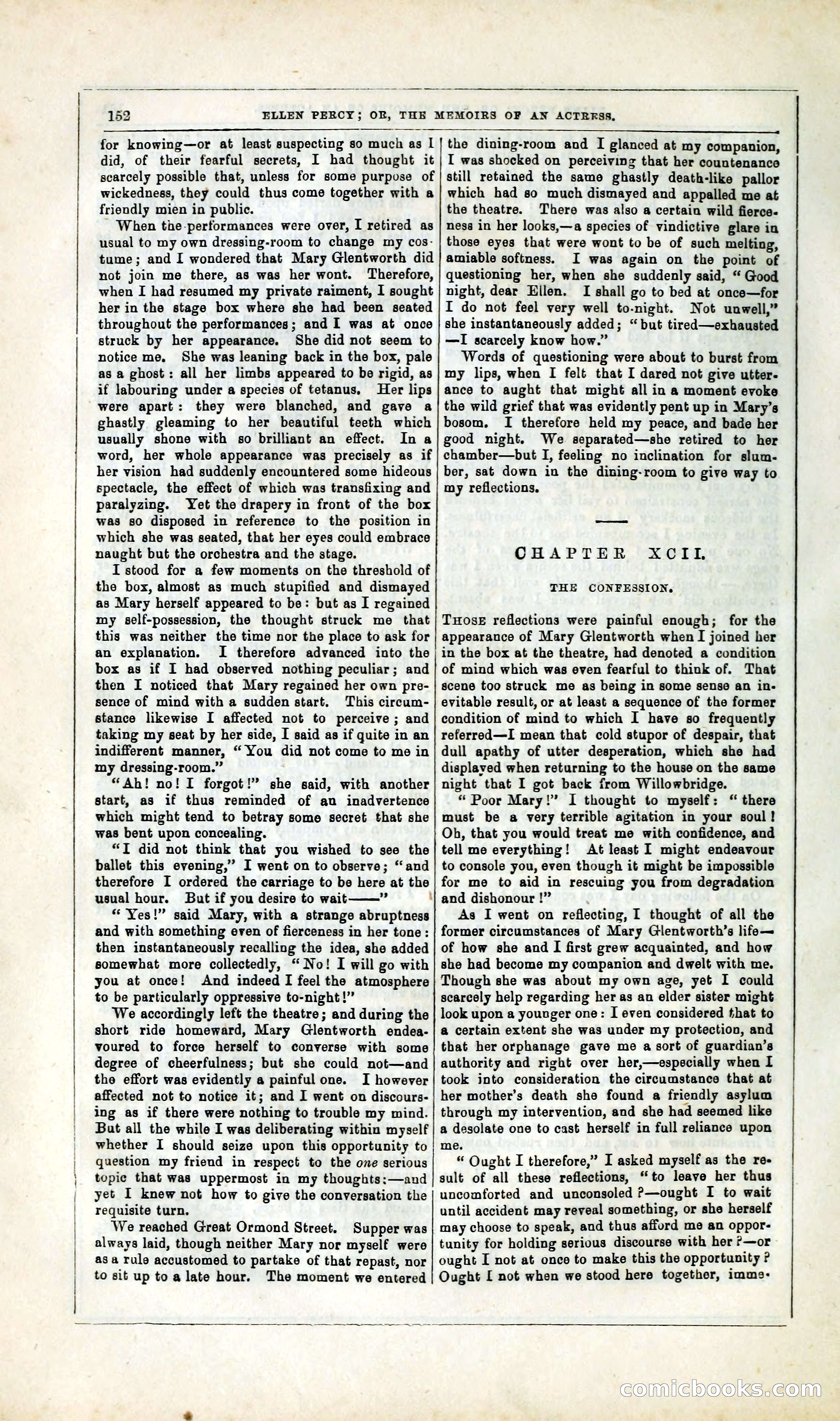
A restored page from Penny Dreadfuls, 1856. Page through the whole issue in the reader above.
📄 Transcribed text from this page (OCR, searchable)
Machine-transcribed from the original scan — historical spelling and the odd misread are preserved.
———_ — for knowing—or at least suspecting so much as I did, of their fearful secrets, I had thought it scarcely possible that, unless for some purpose of wickedness, they could thus come together with a friendly mien in public. When the-performances were over, [ retired as usual to my own dressing-room to change my cos- tume; and [ wondered that Mary Glentworth did not join me there, as was her wont. Therefore, when I had resumed my private raiment, I sought her in the stage box where she had been seated throughout the performances; and I was at once struck by her appearance. She did not seem to notice me, She was leaning back in the box, pale as a ghost: all her limbs appeared to be rigid, as if labouring under a species of tetanus, Her lips were apart: they were blanched, and gave a ghastly gleaming to her beautiful teeth which usually shone with so brilliant an effect. In a word, her whole appearance was precisely as if her vision had suddenly encountered some hideous spectacle, the effect of which was transfixing and paralyzing. Yet the drapery in front of the box was so disposed in reference to the position in which she was seated, that her eyes could embrace naught but the orchestra and the stage. I stood for a few moments on the threshold of the box, almost as much stupified and dismayed as Mary herself appeared to be: but as I regained my self-possession, the thought struck me that this was neither the time nor the place to ask for an explanation. I therefore advanced into the box as if I had observed nothing peculiar; and then I noticed that Mary regained her own pre- sence of mind with a sudden start. This circum- stance likewise I affected not to perceive; and taking my seat by her side, I said as if quite in an indifferent manner, “ You did not come to me in my dressing-room.” : “Ah! no! I forgot!” she said, with another start, as if thus reminded of au inadvertence which might tend to betray some secret that she was bent upon concealing. “I did not think that you wished to see the ballet this evening,” I went on to observe; “and therefore I ordered the carriage to be here at the usual hour. But if you desire to wait re “Yes!” said Mary, with a strange abruptness and with something even of fierceness in her tone: then instantaneously recalling the idea, she added somewhat more collectedly, “No! I will go with you at once! And indeed I feel the atmosphere to be particularly oppressive to-night!’ We accordingly left the theatre; and during the short ride homeward, Mary Glentworth endea- voured to force herself to converse with some degree of cheerfulness; but she could not—and the effort was evidently a painful one. I however affected not to notice it; and I went on discours- ing as if there were nothing to trouble my mind. But all the while I was deliberating within myself whether I should seize upon this opportunity to question my friend in respect to the one serious topic that was uppermost in my thoughts:—and yet I knew not how to give the conversation the requisite turn. We reached Great Ormond Street. Supper was always laid, though neither Mary nor myself were asa rule accustomed to partake of that repast, nor to sit up to a late hour. The moment we entered — A ELLEN PERCY; OR, THE MEMOIRS OF AN ACTRESS, the dining-room and I glanced at my companion, I was shocked on perceiving that her countenance still retained the same ghastly death-like pallor which had so much dismayed and appalled me at the theatre. There was also a certain wild fierce- ness in her looks,—a species of vindictive glare in those eyes that were wont to be of such melting, amiable softness. I was again on the point of questioning her, when she suddenly said, “ Good night, dear Ellen. I shall go to bed at once—for I do not feel very well to-night. Not unwell,” she instantaneously added; “but tired—exhausted —I scarcely know how.” Words of questioning were about to burst from my lips, when I felt that I dared not give utter- ance to aught that might all in a moment evoke the wild grief that was evidently pent up in Mary’s bosom. I therefore held my peace, and bade her good night. We separated—she retired to her chamber—but I, feeling no inclination for slum- ber, sat down in the dining-room to give way to my reflections. CHAPTER XCII. THE CONFESSION, THOSE reflections were painful enough; for the appearance of Mary Glentworth when I joined her in the box at the theatre, had denoted a condition of mind which was even fearful to think of. That scene too struck me as being in some sense an in- evitable result, or at least a sequence of the former condition of mind to which I have so frequently referred—I mean that cold stupor of despair, that dull apathy of utter desperation, which she had displaved when returning to the house on the same night that I got back from Willowbridge. “ Poor Mary!” I thought to myself: “ there must be a very terrible agitation in your soul! Oh, that you would treat me with confidence, and tell me everything! At least 1 might endeavour to console you, even though it might be impossible for me to aid in rescuing you from degradation and dishonour !” | As I went on reflecting, I thought of all the former circumstances of Mary Glentworth’s life— of how she and I first grew acquainted, and how she had become my companion and dwelt with me. Though she was about my own age, yet I could scarcely help regarding her as an elder sister might look upon a younger one: I even considered that to a certain extent she was under my protection, and that her orphanage gave me a sort of guardian’s authority and right over her,—especially when L took into consideration the circumstance that at her mother’s death she found a friendly asylum through my intervention, and she had seemed like a desolate one to cast herself in full reliance upon me. “ Ought I therefore,” I asked myself as the ree sult of all these reflections, “to leave her thus uncomforted and unconsoled P—ought I to wait until accident may reveal something, or she herself may choose to speak, and thus afford me an oppor- tunity for holding serious discourse with her ?—or ought I not at once to make this the opportunity ? Ought [ not when we stood here together, imme- ee ee eee ees ee CORMMICLOOOKS (E(0)