
Penny Dreadfuls, 1856 · page 164 of 399
Ellen Percy; or, The Memoirs of an Actress — page 164: what you’re looking at
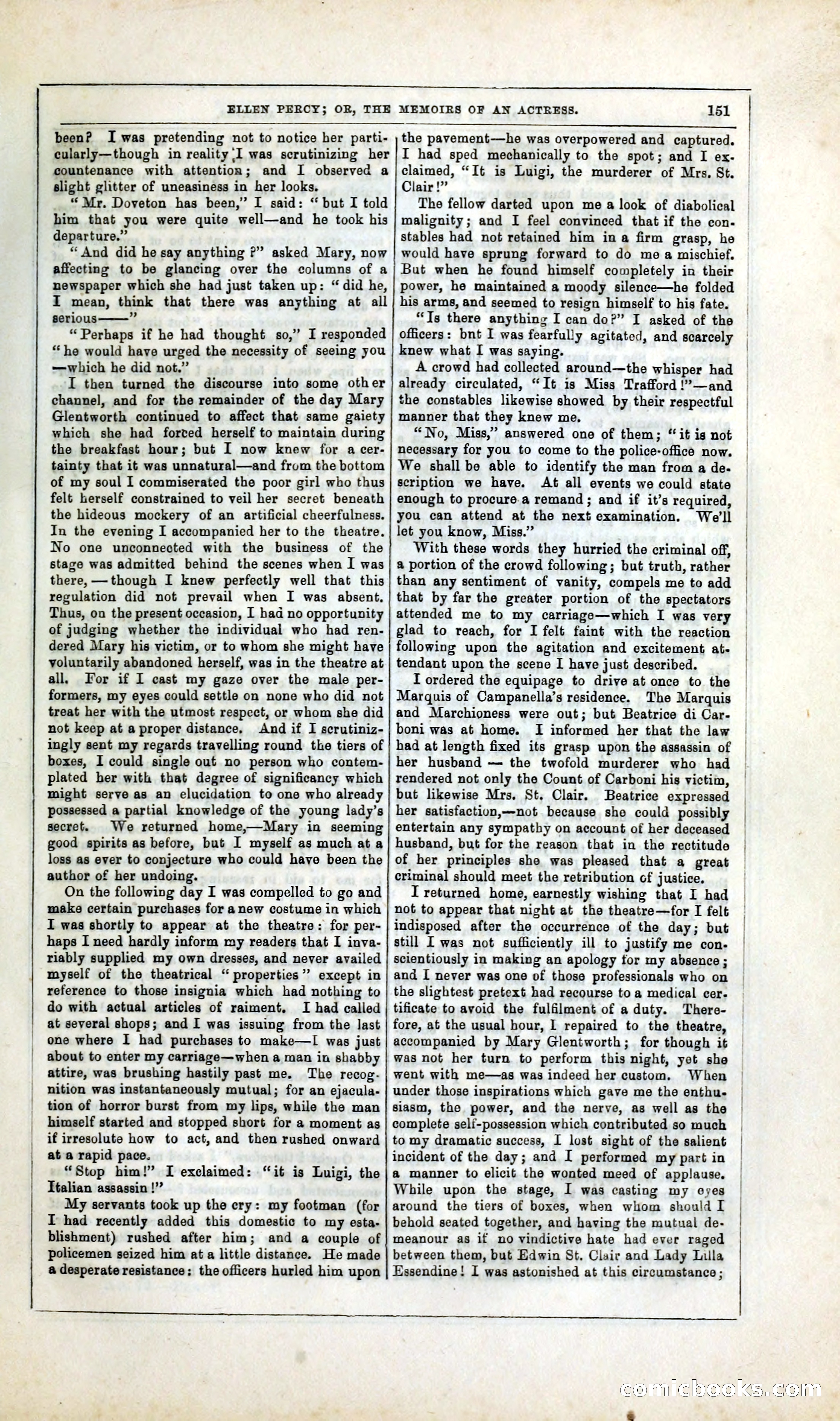
A restored page from Penny Dreadfuls, 1856. Page through the whole issue in the reader above.
📄 Transcribed text from this page (OCR, searchable)
Machine-transcribed from the original scan — historical spelling and the odd misread are preserved.
ELLEN PERCY; OR, THE MEMOIRS OF AN ACTRESS. been? Iwas pretending not to notice her parti- cularly—though in reality I was scrutinizing her countenance with attention; and I observed a slight glitter of uneasiness in her looks. *“ Mr. Doveton has been,’ I said: “ but I told him that you were quite well—and he took his departure.” “And did he say anything ?” asked Mary, now affecting to be glancing over the columns of a newspaper which she had just taken up: “ did he, I mean, think that there was anything at all serious ‘4 “Perhaps if he had thought so,” I responded “he would have urged the necessity of seeing you —which he did not.” I then turned the discourse into some other channel, and for the remainder of the day Mary Glentworth continued to affect that same gaiety which she had forved herself to maintain during the breakfast hour; but I now knew for a cer- tainty that it was unnatural—and from the bottom of my soul I commiserated the poor girl who thus felt herself constrained to veil her secret beneath the hideous mockery of an artificial cheerfulness. In the evening I accompanied her to the theatre. No one unconnected with the business of the stage was admitted behind the scenes when I was there, — though I knew perfectly well that this reculation did not prevail when I was absent, Thus, on the present occasion, I had no opportunity of judging whether the individual who had ren- dered Mary his victim, or to whom she might have voluntarily abandoned herself, was in the theatre at all, For if I cast my gaze over the male per- formers, my eyes could settle on none who did not treat her with the utmost respect, or whom she did not keep at a proper distance, And if I scrutiniz- ingly sent my regards travelling round the tiers of boxes, I could single out no person who contem- plated her with that degree of significancy which might serve as an elucidation to one who already possessed a partial knowledge of the young lady’s secret. We returned home,—Mary in seeming good spirits as before, but I myself as much at a loss as ever to conjecture who could have been the author of her undoing. On the following day I was compelled to go and make certain purchases for anew costume in which I was shortly to appear at the theatre: for per- haps I need hardly inform my readers that I inva- riably supplied my own dresses, and never availed myself of the theatrical “ properties” except in reference to those insignia which had nothing to do with actual articles of raiment, I had called at several shops; and I was issuing from the last one where I had purchases to make—I was just about to enter my carriage—when a man in shabby attire, was brushing hastily past me. The recog. nition was instantaneously mutual; for an ejacula- tion of horror burst from my lips, while the man himself started and stopped short for a moment as if irresolute how to act, and then rushed onward at a rapid pace. “Stop him!” I exclaimed: “it is Luigi, the Italian assassin !” My servants took up the ery: my footman (for I had recently added this domestic to my esta- blishment) rushed after him; and a couple of policemen seized him at a little distance. He made a desperate resistance; the officers hurled him upon 151 ai ME SE ee ee the pavement—he was overpowered and captured. I had sped mechanically to the spot; and I ex- claimed, “It is Luigi, the murderer of Mrs. St. Clair!” The fellow darted upon me a look of diabolical malignity; and I feel convinced that if the con- stables had not retained him ina firm grasp, he would have sprung forward to do me a mischief. But when he found himself completely in their power, he maintained a moody silence—he folded his arms, and seemed to resign himself to his fate. “Ts there anything I can do?” I asked of the officers: bnt I was fearfully agitated, and scarcely knew what I was saying. A crowd had collected around—the whisper had already circulated, “It is Miss Trafford !”—and the constables likewise showed by their respectful manner that they knew me, “No, Miss,” answered one of them; “it is not necessary for you to come to the police-office now. We shall be able to identify the man from a de- scription we have. At all events we could state enough to procure.a remand ; and if it’s required, you can attend at the next examination. We'll let you know, Miss.” With these words they hurried the criminal off, a portion of the crowd following; but truth, rather than any sentiment of vanity, compels me to add that by far the greater portion of the spectators attended me to my carriage—which I was very glad to reach, for I felt faint with the reaction following upon the agitation and excitement at- tendant upon the scene I have just described. I ordered the equipage to drive at once to the Marquis of Campanella’s residence. The Marquis and Marchioness were out; but Beatrice di Car- boni was at home. I informed her that the law had at length fixed its grasp upon the assassin of her husband — the twofold murderer who had rendered not only the Count of Carboni his victim, but likewise Mrs. St. Clair. Beatrice expressed her satisfaction,—not because she could possibly entertain any sympathy on account of her deceased husband, but for the reason that in the rectitude of her principles she was pleased that a great criminal should meet the retribution of justice. I returned home, earnestly wishing that I had not to appear that night at the theatre—for I felt indisposed after the occurrence of the day; but still I was not sufficiently ill to justify me con- scientiously in making an apology tor my absence; and I never was one of those professionals who on the slightest pretext had recourse to a medical cer. tificate to avoid the fulfilment of a duty. There- fore, at the usual hour, I repaired to the theatre, accompanied by Mary Glentworth; for though it was not her turn to perform this night, yet she went with me—as was indeed her custom. When under those inspirations which gave me the enthu- siasm, the power, and the nerve, as well as the complete seli-possession which contributed so much to my dramatic success, I lost sight of the salient incident of the day; and I performed my part in a manner to elicit the wonted meed of applause. While upon the stage, I was casting my eyes around the tiers of boxes, when whom should I behold seated together, and having the mutual de- meanour as if no vindictive hate had ever raged between them, but Edwin St. Clair and Lady Lula Essendine! I was astonished at this circumstance; Se ea COMMU EO — OOK (SO)