
Penny Dreadfuls, 1856 · page 309 of 399
Ellen Percy; or, The Memoirs of an Actress — page 309: what you’re looking at
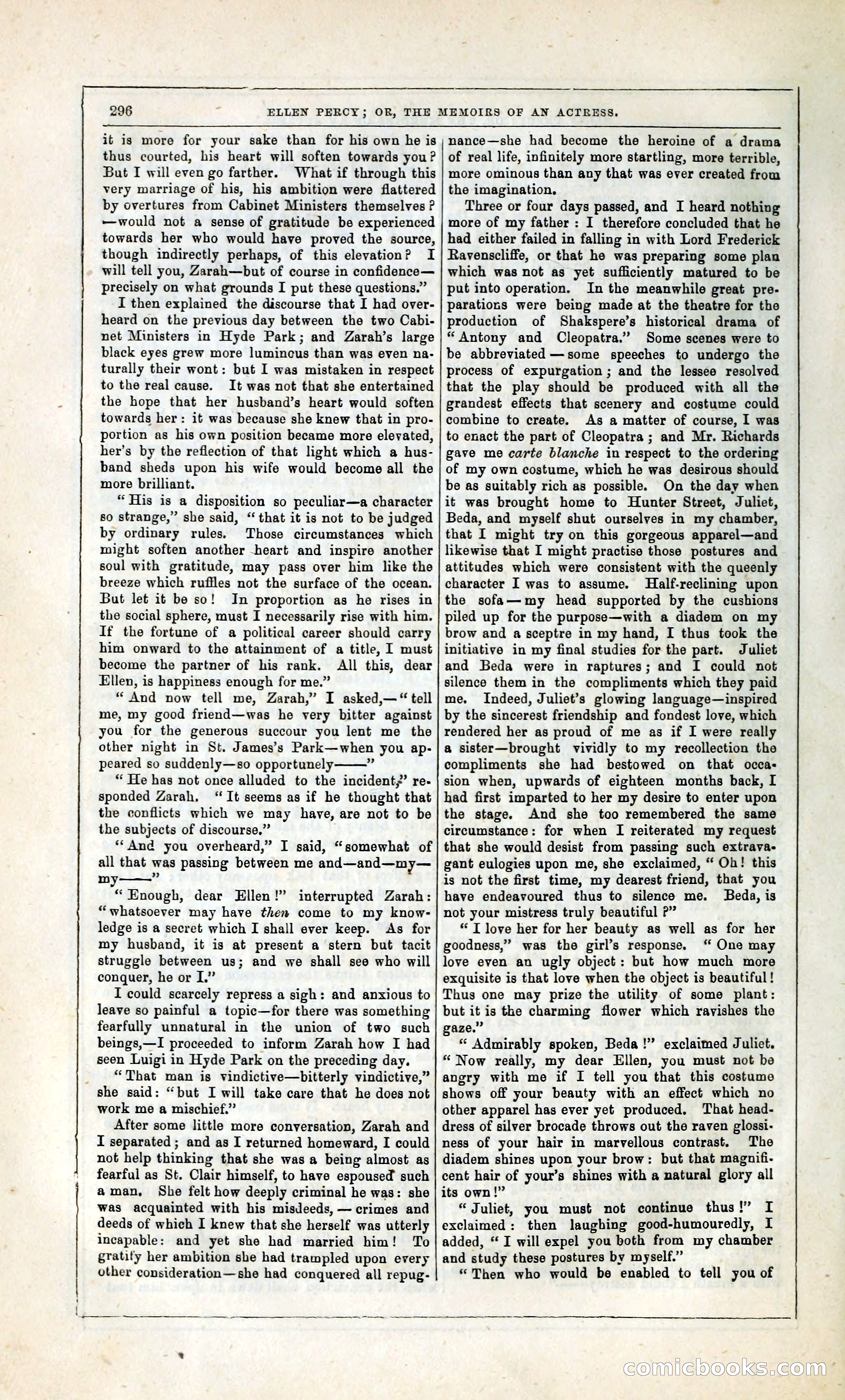
A restored page from Penny Dreadfuls, 1856. Page through the whole issue in the reader above.
📄 Transcribed text from this page (OCR, searchable)
Machine-transcribed from the original scan — historical spelling and the odd misread are preserved.
-e——— >_> - 296 ELLEN PERCY; OR, THE MEMOIRS OF AN ACTRESS. it is more for your sake than for his own he is thus courted, his heart will soften towards you? But I will even go farther. What if through this very marriage of his, his ambition were flattered by overtures from Cabinet Ministers themselves ? —would not a sense of gratitude be experienced towards her who would have proved the source, though indirectly perhaps, of this elevation? I will tell you, Zarah—but of course in confidence— precisely on what grounds I put these questions.” I then explained the discourse that I had over- heard on the previous day between the two Cabi- net Ministers in Hyde Park; and Zarah’s large black eyes grew more lumincus than was even na- turally their wont: but I was mistaken in respect to the real cause. It was not that she entertained the hope that her husband’s heart would soften towards her: it was because she knew that in pro- portion as his own position became more elevated, her's by the reflection of that light which a hus- band sheds upon his wife would become all the more brilliant. “His is a disposition so peculiar—a character so strange,” she said, “that it is not to be judged by ordinary rules. Those circumstances which might soften another heart and inspire another soul with gratitude, may pass over him like the breeze which ruffles not the surface of the ocean. But let it be so! In proportion as he rises in the social sphere, must I necessarily rise with him. If the fortune of a political career should carry him onward to the attainment of a title, I must become the partner of his rank. All this, dear Ellen, is happiness enough for me.” “And now tell me, Zarah,” I asked,—“ tell me, my good friend—was he very bitter against you for the generous succour you lent me the other night in St. James’s Park—when you ap- peared so suddenly—so opportunely 2 ** He has not once alluded to the incident,’ re- sponded Zarah. “ It seems as if he thought that the conflicts which we may have, are not to be the subjects of discourse.” **And you overheard,” I said, “somewhat of all that was passing between me and—and—my— my +P) “Enough, dear Ellen!” interrupted Zarah: “whatsoever may have then come to my know- ledge is a secret which I shall ever keep. As for my husband, it is at present a stern but tacit struggle between us; and we shall see who will conquer, he or I.” I could scarcely repress a sigh: and anxious to leave so painful a topic—for there was something fearfully unnatural in the union of two such beings,—I proceeded to inform Zarah how I had seen Luigi in Hyde Park on the preceding day. _ “That man is vindictive—bitterly vindictive,” she said: “but I will take care that he does not work me a mischief.” After some little more conversation, Zarah and I separated ; and as I returned homeward, I could not help thinking that she was a being almost as fearful as St. Clair himself, to have espoused such aman. She felt how deeply criminal he was: she was acquainted with his misdeeds, — crimes and deeds of which I knew that she herself was utterly incapable: and yet she had married him! To gratify her ambition she had trampled upon every other consideration—she had conquered all repug- nance—she had become the heroine of a drama of real life, infinitely more startling, more terrible, more ominous than any that was ever created from the imagination, Three or four days passed, and I heard nothing more of my father : I therefore concluded that he had either failed in falling in with Lord Frederick Ravenscliffe, or that he was preparing some plan which was not as yet sufficiently matured to be put into operation. In the meanwhile great pre- parations were being made at the theatre for the production of Shakspere’s historical drama of “Antony and Cleopatra.” Some scenes were to be abbreviated —some speeches to undergo the process of expurgation ; and the lessee resolved that the play should be produced with all the grandest effects that scenery and costume could combine to create. As a matter of course, I was to enact the part of Cleopatra ; and Mr. Richards gave me carte blanche in respect to the ordering of my own costume, which he was desirous should be as suitably rich as possible. On the day when it was brought home to Hunter Street, Juliet, Beda, and myself shut ourselves in my chamber, that I might try on this gorgeous apparel—and likewise that I might practise those postures and attitudes which were consistent with the queenly character I was to assume. Half-reclining upon the sofa—my head supported by the cushions piled up for the purpose—with a diadem on my brow and a sceptre in my hand, I thus took the initiative in my final studies for the part. Juliet and Beda were in raptures; and I could not silence them in the compliments which they paid me. Indeed, Juliet’s glowing language—inspired by the sincerest friendship and fondest love, which rendered her as proud of me as if I were really a sister—brought vividly to my recollection the compliments she had bestowed on that occas sion when, upwards of eighteen months back, I had first imparted to her my desire to enter upon the stage. And she too remembered the same circumstance: for when I reiterated my request that she would desist from passing such extrava- gant eulogies upon me, she exclaimed, “ Ob! this is not the first time, my dearest friend, that you have endeavoured thus to silence me. Beda, is not your mistress truly beautiful P” * T love her for her beauty as well as for her goodness,” was the girl’s response. “ One may love even an ugly object: but how much more exquisite is that love when the object is beautiful! Thus one may prize the utility of some plant: but it is the charming flower which rayvishes the aze.” “ Admirably spoken, Beda!” exclaimed Juliet. “Now really, my dear Ellen, you must not be angry with me if I tell you that this costume shows off your beauty with an effect which no other apparel has ever yet produced. That head- dress of silver brocade throws out the raven glossi- ness of your hair in marvellous contrast. The diadem shines upon your brow: but that magnifi- cent hair of your’s shines with a natural glory all its own!” “Juliet, you must not continue thus!” I exclaimed: then laughing good-humouredly, I added, “I will expel you both from my chamber and study these postures by myself.” “Then who would be enabled to tell you of ~ SS ee SS eee ees CONNEOOKS (EL